
Althought civilian air activity was common in Alice Springs since 1920, the military buildup in the north of Australia in the late 1930s saw the need for the establishment of an airport that could receive larger and heavier aircraft. Thus, the Australian Department of Defence decided to built in 1940 the Seven Mile Aerodrome shifting the operations from the already established Town Site Drome. Altought civilian aircraft were allowed to use the airport, due to his strategic location, during World War II its primary purpose was military, being used primarily by the Royal Australian Air Force (RAAF) and the United States Air Force, as the main transit base for transport planes bringing troops and supplies into the Pacific Theater of Operations and as a refuelling and staging facility. At the end of the war, the military left the aerodrome and it returned to civilian use.
By 1946 several improvements were made including the installation of the first underground fuel tanks, a VHF radio range and meteorological facilities. In 1958 the aerodrome became officially known as Alice Springs Airport and in 1961 a major improvement was made with the reconstruction of part of the existing Runway 12/30 and its extension to 2,4 km of longitude. In 1965, the construction of a new passenger terminal and a fire station near the old installation marked the complete transfer of all activity to the current building area. The only facilities that remained active then at the original airfield site (referred even today as the "Seven Mile Area") were those devoted to maintenance tasks.
First uses of the airport to launch balloons
In 1960 was established on behalf the Departament of Supply (DOS) the first Australian Balloon Launch Station (ABLS) which was located at the Mildura airport in Victoria. The main activity there was to support an atmospheric sampling program carried out by the United States Atomic Comission under a first intergovernment agreement which lasted almost seven years and that allowed the launch of near 600 balloons from the station. Once finished a new document was signed reducing sharply the amount of missions devoted to the sampling effort but at the same time diversifying the research aims of the flights to other branches of Science as well to other users.
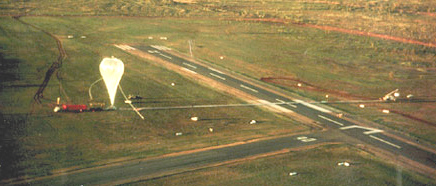
Scientific groups from around the world, realizing the potential of Australia as an excellent site for ballooning, became increasingly interested in performing flights from various locations within the continent. The southerly latitude, combined with the large land mass in the east-west direction could yield extended observation times for astrophysical sources not easily visible from the northern hemisphere. One of those locations was precisally the airport of Alice Springs from which were carried out many experiments in the field of Gamma Ray and X-Ray astronomy on those years.
Obviously in that times, the airport lacked of dedicated facilities so the balloon launches were performed under Mildura ABLS managment: generally all the necessary equipment and staff was transported by road and rail to Alice Springs during each campaign. There were three main reasons to make such an effort each year: Population, Winds and Location.
The very low population density over Central Australia allowed to use heavy payloads and big balloons with less security restrictions and with very safe termination process margins, though the prevalence of semi-desertic landscapes over most of this region difficulted somewhat the recovery operations.
On regard the wind pattern, Alice Springs has two features worth noting: a low wind velocity regime that dominates the altitude range of 90,000 ft. to 110,000 ft. between March and November, giving a long period when flights with payloads that not need extreme altitudes (i.e. infrared) can be carried out and two turnaround periods, one in the October-November window with a duration of three to five weeks of slow moving winds above 120,000 ft and the other in March-April with somewhat short duration. With careful preparation and timing, turnaround flights of over 60 hr duration can be achieved.
Finally, the site offered too better observing conditions than Mildura specially due to its latitude located nearer the declination of the Galactic Centre region along with a higher vertical cut-off rigidity.
All these factors led to the first era of scientific ballooning in Alice Spring, which would extend during the entire 70's decade.
Basic infrastructure
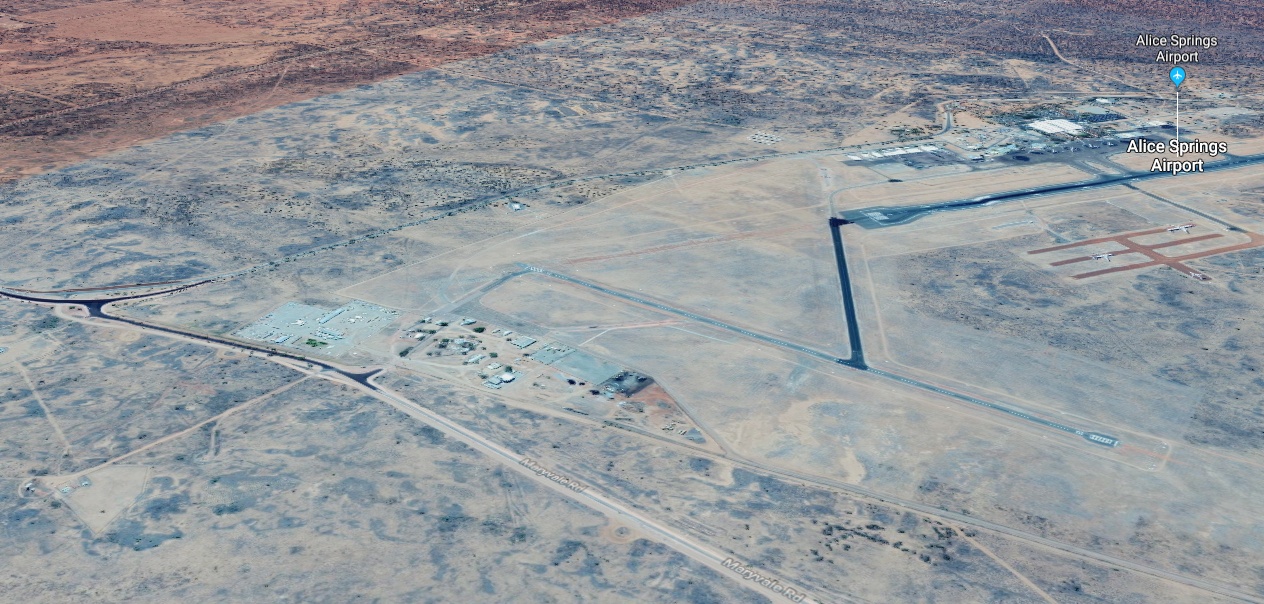
The launch of the balloons is carried out from two runways located in the so-called "Seven Mile Area" of the airport clearly visible in the center-left of the image below. During launch operations, the entire airport is closed to air traffic.
For inflation, Helium gas is used instead of Hydrogen as the extremely dry air of the zone can generate dangerous estatic discharges during balloon inflation. As mentioned, the launch equipment available at the station is the same used for balloon operations at Mildura ABLS and allowed to launch balloons with a volume of up to 46.000.000 cubic feet, and payloads weighting up to 2 tons.
On regard telemetry, the LOS (Line of Sight) hardware is composed of receivers for downlink telemetry channels operating on 234.4, 253.8 and 255.1 MHz, with standard IRIG channels up to F, and transmitters with a power of 2 Watts feeding a quarter-wave ground plane antenna together with a quad-helical receiving antenna system with a gain of 21 dB. The uplink system is composed of a transmiter of 50 w operating on 148.46 MHz coupled to two vertical and horizontal plane multi-element yagis antennas, allowing a reliable control of the payload in flight.
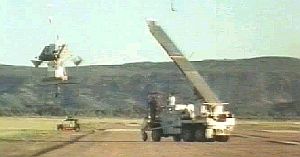
Two downrange stations were used, one located in Newman (West) and the other in Longreach (East) each one with a coverage of 700 kms in all directions. Good telephone links were available between the two stations and Alice Spring with the possibility of data transfer at up to 9.6 kbs.
Althought the tracking of the balloons was performed visually using locally hired aircrafts, almost real time positional information was also available by the use of on-board Omega receivers or Argos transmitters. Termination was also performed from aircrafts with the balloon in sight.
Due to the desertic and rough terrain, in addition to the 4-wheel drive vehicles owned by the station, recovery operations often required the use of helicopters which are also hired.
A new era of cooperation
Scientific ballooning in Australia would suffer two major changes during the 80's decade. The first one was a direct consequence of severe funding troubles started at the end of the 70's decade: the closure of the Mildura ABLS in December 1980. The station equipment was then moved to Alice Springs and the responsability for running the facility was transferred to the Physics Department at the University of Melbourne under direction of Prof. Ravi K. Sood.
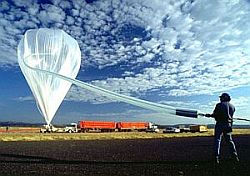
The second change would occur in late 1981, with the entrance in the scene of NASA. Between November and December that year the National Scientific Balloon Facility (now Columbia Scientific Balloon Facility) in charge of the managment of the NASA balloon program, succesfully launched the first six balloons from Alice Spring under a campaign fully managed and supported by NSBF.
This marked the start of some sort of dual mode balloon campaigns, some of them managed by the Australians launching their own payloads as well third part experiments offered by international collaborations and the others carried out by the Americans, launching mainly US scientific payloads and in some occasions Australian payloads as well.
Since the change of management in 1980 all flight operations at the station under Australian managment have been carried out by amateurs, mainly academics, researchers, technicians and students of the University.
Past, present and future
Great part of the activity at the site took place in the 80's decade being launched dozens of missions in the field of Infrared, X-Ray and Gamma Ray astronomy as well were performed several others to measure high energy particles of galactic and cosmic origin. This activity was focused mainly in campaigns performed in the summer that lasted several months. Notably, a few missions on that decade were performed using a concept known as radiation controlled balloon or RACOON. This development allowed to flight large, low-cost polyethylene balloons for several weeks without the need of use great amounts of ballast. Those balloons made at the time crossings of the Pacific Ocean to Southamerica where the payload was recovered and even a few succeded in performing circumglobal flights with diverse results.
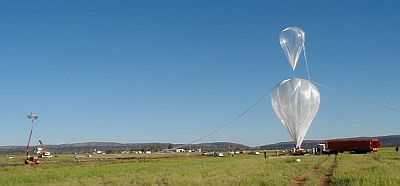
By the end of the decade a flood of scientists were looking to perform balloon missions in Australia to perform observations in all the high energy domain. The reason was that after the discovery in 1987 of the SN1987A supernova in the Large Magellanic Cloud, soon was realized that Alice Spring offered a first class seat to analyze the event, only visible in the southern hemisphere. Thus several missions were performed with this objective in the remainder of the 80's decade and the first years of the next, when the amount of launches started again to decrease.
In the first years of the XXI century, Alice Spring was choosen as the site to perform the first global flights of the NASA Ultra Long Duration Balloon (ULDB), a superpressure craft devoted to perform circumglobal flights of up to 100 days carrying a payload weighting a ton. Nevertheless, none global flight was achieved due to several design flaws of the model used at that time.
Since those launches in 2003 an "impasse" took place in the activity of the station. On one hand the intergovernmental agreement between Australia and the US for the accomplishment of these activities ended. In the other, the NASA's balloon program decided to cancel the missions from Australia initially until 2007, to balance its accounts after extraordinary expenses that demanded the works of improvement of the Antarctic balloon facilities at the McMurdo base.
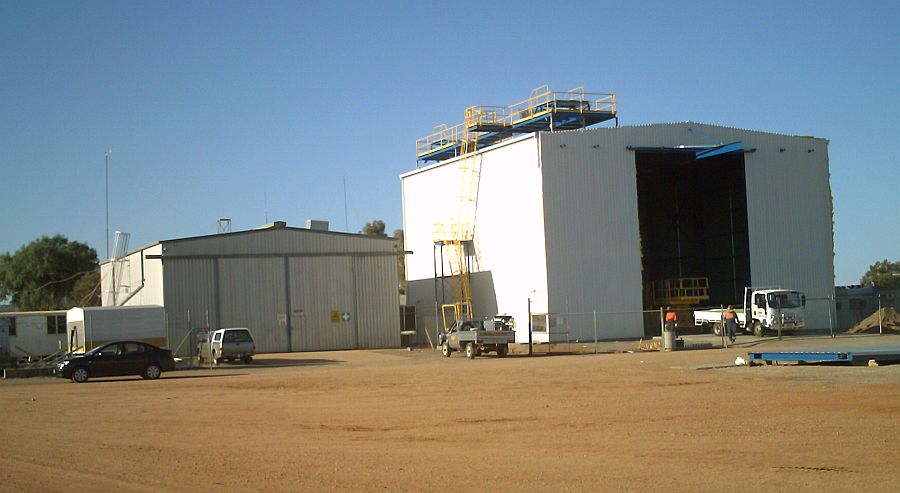
After the renewal of the agreement, NASA's balloon program started in 2008 an important upgrading to the launching facilities in the Seven Miles Area of the airport by constructing an additional Integration and Staging Building adjacent to the existing one as can be seen in the image at right (click to enlarge).
The new construction is a 60-foot by 60-foot building with enough space to allocate four integration bays for big payloads. The older building will be used for the Electronics Shop and Ground Telemetry Station as well as integration building for up to two small payloads. Much of the existing structures were also improved.
The main construction ended in October 2009, and during the rest of the year and the first two months of 2010 was carried out the internal outfitting of the buildings.
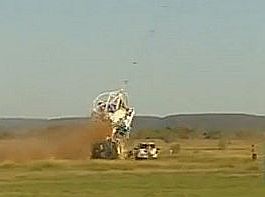
In early Febraury started to arrive the three scientific teams to launch their payloads. The first flight was performed on middle April with a float duration of 50 hours and a succesful performance, but during the launch of the second mission, the payload fell from the launch crane and was dragged for a few meters before impacting violently a car parked near the launch spot. A TV crew was present and recorded the incident which was reproduced worldwide that same day.
As sensitive to bad publicity as NASA is, an investigation comitee was formed and sent to Australia to investigate the incident. The immediate result of the mishap was that the campaign was concluded and all the scientific teams still in the field returned to United States. More important, after analyzing the preliminary data from the event, the comitee issued an order forbidding further flights of the NASA balloon program, even in United States, until a full report come out and corrections would be made to assure not to got again such a situation.
The final report was made public on October that year, and changed from head to toe the NASA safety measures applied on each flight performed by the agency in the United States and also overseas.
A year after the mishap, the last NASA balloon launch was performed at Alice Springs, on April 2011, for the launch and succesful recovery of the HERO telescope. From that moment on, the site remained unused for balloon launches until 2015 when a team from Japanese Space Agency (JAXA) in cooperation with the New South Wales University and the Commonwealth Scientific and Industrial Research Organisation (CSIRO) had sent aloft a gamma ray experiment.
Table of balloons launched from Alice Springs (Incomplete list under permanent updating)
| Date | Hour | Flight Duration | Experiment | Payload landing place or cause of the failure |
|---|---|---|---|---|
| 4/5/1972 | 26 h 55 m | CONTROLLABLE X-RAY TELESCOPE | --- No Data --- | |
| 4/15/1972 | --- | PAYLOAD UNKNOWN | Balloon Failure | |
| 4/19/1972 | --- | CONTROLLABLE X-RAY TELESCOPE | Balloon Failure | |
| 11/7/1975 | 6:14 cst | 11 h 58 m | GAMMA RAY DETECTOR | --- No Data --- |
| 11/11/1975 | 6:35 cst | 23 h 46 m | GAMMA RAY TELESCOPE | --- No Data --- |
| 11/21/1975 | 6:13 cst | 60 h 7 m | GAMMA RAY DETECTOR | --- No Data --- |
| 11/24/1975 | 4:12 cst | 9 h 6 m | GAMMA RAY SPECTROMETER | --- No Data --- |
| 10/26/1977 | F 8 h 15 m | X-RAY OBSERVATIONS | --- No Data --- | |
| 11/11/1977 | F 55 h 45 m | BELL/SANDIA GAMMA RAY TELESCOPE | In the Simpson Desert, 175 miles E of Alice Springs, Australia | |
| 11/16/1977 | 30 h | GAMMA RAY BURST DETECTOR | --- No Data --- | |
| 11/21/1977 | 20:08 utc | F 47 h 45 m | LGT (Large Gamma-ray Telescope) | --- No Data --- |
| 11/24/1977 | F 9 h 30 m | NRL HARD X-RAY OBSERVATORY | --- No Data --- | |
| 11/30/1977 | --- | X-RAY TELESCOPE | Balloon failure at launch. Aborted fligth | |
| 11/1/1978 | --- | X-RAY EXPERIMENT | --- No Data --- | |
| 11/13/1978 | 58 h | GAMMA RAY BURST DETECTOR | --- No Data --- | |
| 11/20/1978 | ~ 23:00 utc | 24 h | X-RAY TELESCOPE | --- No Data --- |
| 11/22/1978 | ~ 55 hr | X-RAY EXPERIMENT | --- No Data --- | |
| 3/23/1979 | 20:57 utc | 1 h 46 m | RADIOMETER | --- No Data --- |
| 3/28/1979 | 21:30 utc | 5h 35m | MEASUREMENTS OF NO AND HNO3 | --- No Data --- |
| 4/3/1979 | 21:45 utc | 3h 10 m | RADIOMETER | --- No Data --- |
| 4/4/1979 | 2 h | GAMMA RAY EXPERIMENT | --- No Data --- | |
| 4/7/1979 | --- | PAYLOAD UNKNOWN | Launch Abort | |
| 4/9/1979 | 17:45 utc | ~ 7 h | MEASUREMENTS OF NO, HNO3 AND OZONE | --- No Data --- |
| 4/15/1979 | F 16 h 10 m | BELL/SANDIA GAMMA RAY TELESCOPE | --- No Data --- | |
| 4/18/1979 | F 13 h 10 m | DOUBLE SCATTER GAMMA RAY TELESCOPE | --- No Data --- | |
| 4/24/1979 | 2 h 10 m | PAYLOAD UNKNOWN | --- No Data --- | |
| 11/12/1980 | 30 h | AGLAE | In an aborigin reserve 600 km from Alice Spring | |
| 11/25/1980 | 1 h | UTIC 80 (University of Tasmania / Imperial College 1980) | Balloon brst at 60.000 ft | |
| 11/10/1981 | 24 h 30 m | UCR GAMMA RAY TELESCOPE | --- No Data --- | |
| 11/20/1981 | 4:20 local | 19 h | LEGS (Low Energy Gamma-ray Spectrometer) | 300 miles W of Alice Springs, Australia |
| 11/21/1981 | 5:10 local | 30 h 5 m | BELL/SANDIA GAMMA RAY TELESCOPE | 311 miles WNW of Alice Springs, Australia |
| 12/1/1981 | --- | COSMIC RAY EXPERIMENT | Balloon failure | |
| 12/1/1981 | 18:24 local | F 12 h | COSMIC RAY EXPERIMENT | --- No Data --- |
| 12/1/1981 | 21:03 local | F 10 h 10 m | UTIC 81 (University of Tasmania / Imperial College 1981) | --- No Data --- |
| 12/14/1982 | --- | PAYLOAD UNKNOWN | Aborted flight | |
| 1/19/1983 | 20:41 utc | 22 d | EOSCOR III (Extended Observation of Solar COsmic Radiation) | Lost over the Indian Ocean |
| 5/4/1983 | 34 h | COSMIC RAY HEAVIES | --- No Data --- | |
| 5/8/1983 | 11 h | INFRARED ASTRONOMY | --- No Data --- | |
| 5/10/1983 | 29 h | COSMIC RAY HEAVIES | --- No Data --- | |
| 5/13/1983 | 25 h | ATMOSPHERIC ELECTRICITY | --- No Data --- | |
| 5/18/1983 | 13 h | INFRARED ASTRONOMY | --- No Data --- | |
| 11/7/1983 | 34 h | COSMIC RAY IRON NUCLEI | --- No Data --- | |
| 11/20/1984 | 19:44 utc | F 9 h 29 m | BELL/SANDIA GAMMA RAY TELESCOPE | 320 miles W of Alice Springs, Australia |
| 12/5/1984 | 12:36 utc | F 4 h 2 m | X-RAY & GAMMA RAY EXPERIMENT | 290 miles W of Alice Springs, Australia |
| 12/7/1984 | 19:40 utc | F 5 h 10 m | BELL/SANDIA GAMMA RAY TELESCOPE | 315 miles W of Alice Springs, Australia |
| 2/21/1985 | 12 h | BIRT (Balloon-borne InfraRed Telescope) | --- No Data --- | |
| 2/27/1985 | 2 h | BIRT (Balloon-borne InfraRed Telescope) | --- No Data --- | |
| 3/8/1985 | 8 h | BIRT (Balloon-borne InfraRed Telescope) | --- No Data --- | |
| 8/27/1986 | 11 h | BIRT (Balloon-borne InfraRed Telescope) | --- No Data --- | |
| 9/4/1986 | 2 h | BIRT (Balloon-borne InfraRed Telescope) | --- No Data --- | |
| 9/13/1986 | 6 h | BIRT (Balloon-borne InfraRed Telescope) | --- No Data --- | |
| 11/20/1986 | 12 h | HIBAL 86 | --- No Data --- | |
| 1/25/1987 | 6 d 6 h | JACEE 7 (Japanese-American Collaborative Emulsion Experiment) | In Concepcion, Paraguay | |
| 2/9/1987 | ~ 21:00 | 12 d | OBSERVATION OF THE SUN CORONA | In Palotina, Parana, Brazil |
| 2/19/1987 | --- | GAMMA RAY TELESCOPE | --- No Data --- | |
| 4/13/1987 | 2 h | X-RAY / GAMMA RAY ASTRONOMY | --- No Data --- | |
| 4/19/1987 | 9 h | SN87A - I | --- No Data --- | |
| 5/20/1987 | 20:21 utc | F 8 h 24 m | GRIP (Gamma-Ray Imaging Payload) | 15 miles S of Middleton, Australia |
| 5/30/1987 | 19:19 utc | F 9 h 40 m | GAMMA RAY SPECTROMETER | 15 miles NNE of Clermount, Australia |
| 6/2/1987 | 20:38 utc | 20 m | BELL/SANDIA GAMMA RAY TELESCOPE | Balloon failure at 10.000 ft. Landed 3 miles S of Alice Springs, Australia |
| 6/8/1987 | 21:11 utc | F 9 h 57 m | SUPERNOVA OBSERVATION | 40 miles N of Longreach, Australia |
| 10/29/1987 | 9:20 utc | 40 h | GAMMA RAY SPECTROMETER | 10 miles S of Tennant Creek, Northern Territory, Australia |
| 11/8/1987 | 18:55 utc | --- | GRIP (Gamma-Ray Imaging Payload) | Aborted launch |
| 11/18/1987 | 10:45 utc | 11 h 30 m | GRIP (Gamma-Ray Imaging Payload) | 400 miles W of Alice Springs, Australia |
| 12/6/1987 | 9:47 utc | 10 h 50 m | GAMMA RAY SPECTROMETER | 550 miles W of Alice Springs, Australia |
| 1/5/1988 | --- | GAMMA RAY TELESCOPE | --- No Data --- | |
| 2/8/1988 | 21:06 utc | 6 d | JACEE 8 (Japanese-American Collaborative Emulsion Experiment) | 3 miles NW of Pratinha, Minas Gerais, Brazil |
| 2/16/1988 | 20:52 utc | 9 d | GAMMA RAY EXPERIMENT | Mogi Mirim, Sao Paulo, Brazil |
| 4/5/1988 | 20:43 utc | --- | SN87A - II | 100 miles SSW of Mongrel Downs, Northern Territory, Australia |
| 4/8/1988 | 22:00 utc | F 31 h | HARD X-RAY TELESCOPE | 11 miles WNW of Murray Downs, Australia |
| 4/11/1988 | 21:50 utc | 32 h 40 m | GRIP (Gamma-Ray Imaging Payload) | 16 miles W of Ti Tree, Northern Territory, Australia |
| 4/15/1988 | 21:00 utc | 10 h | COMPTON GAMMA RAY TELESCOPE | 30 miles N of Erldunda, Northern Territory, Australia |
| 4/18/1988 | 8:20 utc | --- | INFRARED EXPERIMENT | 61 miles SW of Haasts Bluff, Northern Territory, Australia |
| 4/30/1988 | 19:59 utc | 24 h | GRIS (Gamma-Ray Imaging Spectrometer) | 174 miles NW of Longbeach, New South Wales, Australia |
| 5/6/1988 | --- | GAMMA RAY EXPERIMENT | Aborted flight | |
| 5/16/1988 | 20:51 utc | --- | GAMMA RAY EXPERIMENT | 98 miles SE of Longbeach, New South Wales, Australia |
| 5/17/1988 | 21:05 utc | --- | EXITE-1 (Energetic X-Ray Imaging Telescope Experiment) | 121 miles WNW of Longbeach, New South Wales, Australia |
| 10/28/1988 | 9:24 utc | 44 h | GRIS (Gamma-Ray Imaging Spectrometer) | 61 miles NW of Warrabri, Northern Territory, Australia |
| 11/2/1988 | 9:04 utc | --- | GAMMA RAY EXPERIMENT | 34 miles WNW of Mount Isa, Queensland, Australia |
| 11/17/1988 | 8:43 utc | --- | COSMIC RAY EXPERIMENT | 3 miles N of Stirling, Australia |
| 4/3/1989 | 9:02 utc | 18 h 30 m | GRIP (Gamma-Ray Imaging Payload) | 20 miles NE of Fregon, South Australia |
| 4/15/1989 | --- | EXITE-1 (Energetic X-Ray Imaging Telescope Experiment) | Aborted flight | |
| 5/9/1989 | 21:52 utc | 6 h | EXITE-1 (Energetic X-Ray Imaging Telescope Experiment) | 160 miles NE of Longreach, Queensland, Australia |
| 5/17/1989 | 8:27 utc | 10 h | POKER 89 | 31 miles SSE of Tambo, Queensland, Australia |
| 5/22/1989 | 20:45 utc | 5 h | HEXAGONE (High Energy X-ray And Gamma ray Observatory for Nuclear Emissions) | 130 miles WSW of Mackay, Queensland, Australia |
| 5/29/1989 | 22:01 utc | 20 h | LAPEX (Large-Area Phoswich balloon Experiment for hard-X-ray astronomy) | 5 miles E of Muttatura, Australia |
| 4/10/1992 | --- | GRIS (Gamma-Ray Imaging Spectrometer) | Aborted launch | |
| 4/26/1992 | 8:17 utc | 14 h | GRIS (Gamma-Ray Imaging Spectrometer) | 20 miles NNE of Clermont, Queensland, Australia |
| 4/27/1992 | 7:32 utc | 1 h | BICE (Balloon-borne Infrared Carbon Explorer) | Ruby Gorge, Northwestern Territories, Australia |
| 5/7/1992 | 7:37 utc | 24 h | GRIS (Gamma-Ray Imaging Spectrometer) | 35 miles N of Evremunga, Australia |
| 5/8/1992 | 7:09 utc | 11 h | BICE (Balloon-borne Infrared Carbon Explorer) | Mt.H.Witt Station, Australia |
| 5/24/1992 | 7:44 utc | 10 h | BICE (Balloon-borne Infrared Carbon Explorer) | 13 miles NW of Tambo, Queensland, Australia |
| 6/1/1992 | 7:47 utc | 10 h | HEXAGONE (High Energy X-ray And Gamma ray Observatory for Nuclear Emissions) | In Mantuan Downs, Queensland, Australia |
| 9/26/1995 | 22:12 utc | 24 h | AXEL (Astrophysical X-Ray Experimental Laboratory) | 47 km NE of Giles Weather Station, Western Australia |
| 10/4/1995 | 7:30 utc | 24 h | GRIS (Gamma-Ray Imaging Spectrometer) | 13.5 miles N of Alice Springs, Australia |
| 10/6/1995 | 22:24 utc | 34 h | GRIP-2 (Gamma-Ray Imaging Payload) | 140 miles NW of Boulia, Queensland, Australia |
| 10/17/1995 | 22:09 utc | 32 h | GRATIS (Gamma Ray Arcminute Telescope Imaging System) | 30 miles W of Ti Tree, Northern Territory, Australia |
| 10/25/1995 | 21:43 utc | 35 h | GRIS (Gamma-Ray Imaging Spectrometer) + PORTIA | 30 miles E of Alice Springs, Australia |
| 11/14/1995 | 22:00 utc | 9 h 30 m | GRIS (Gamma-Ray Imaging Spectrometer) + PORTIA | 10 miles N of Alice Springs, Australia |
| 2/24/2001 | 23:15 utc | 4 h 17 m | NIGHTGLOW + ULDB (Ultra Long Duration Balloon) | 115 miles SSW of Alice Springs, Australia |
| 3/9/2001 | 23:26 utc | 24 h 42 m | ULDB (Ultra Long Duration Balloon) | 90 nautic miles N of Carnarvon, Western Australia |
| 3/17/2003 | 8:38 local | 12 h 13 m | NIGHTGLOW + ULDB (Ultra Long Duration Balloon) | 130 miles WSW of Ayers Rock, Australia |
| 4/16/2010 | 57 h | TIGRE (Tracking and Imaging Gamma Ray Experiment) | 70 km SW of Longreach, Australia | |
| 4/28/2010 | 8:00 local time | --- | NCT (Nuclear Compton Telescope) | Ground abort. Payload destroyed at launch |
| 4/18/2011 | 22:13 utc | 34 h 37 m | HERO (High Energy Replicated Optics) | N of Balcardine, Queensland, Australia |
| 5/12/2015 | 6:03 JST | 15 h | GRAINE (Gamma-Ray Astro-Imager with Nuclear Emulsion) | 130 km N of Longreach, Queensland, Australia |
| 4/4/2017 | 4 h 55 m | CLIMAT (Combinaison de Lasers et d'Instrument in-situ de Mesure dans l'Atmosphère Terrestre) | 10 km from Glen Helen creek, Northern Territory, Australia | |
| 4/9/2017 | 12 h 33 m | CARMEN | North of Tanami road between Hamilton Downs and Milton Park, Northern Territory, Australia | |
| 4/16/2017 | 15:50 utc | 33 h 40 m | PILOT (Polarized Instrument for Long wavelength Observation of the Tenuous interstellar medium) | Diamantina Lakes National Park, Queensland, Australia |
| 4/7/2018 | 6:24 acst | 28 h 43 m | SMILE-2+ (Sub-MeV/MeV gamma-ray Imaging Loaded-on-balloon Experiment) | 190 km SSE of Alice Springs, Australia |
| 4/26/2018 | 6:03 jst | 16 h 44 m | GRAINE (Gamma-Ray Astro-Imager with Nuclear Emulsion) | W of Windorah, Queensland, Australia |
| 4/29/2023 | 21:02 utc | 26 h 45 m | GRAINE (Gamma-Ray Astro-Imager with Nuclear Emulsion) | 220 km S of Longreach, Queensland, Australia |
| 5/11/2023 | 22:09 UTC | 7 h | SRC (Sample Return Capsule) | In Queensland, Australia |
StratoCat is an independent, non-commercial project maintained to preserve and share the history of scientific and stratospheric ballooning. If you find the site useful, you can help keep it running with a small donation toward its operating costs. Every contribution, even the equivalent of a cup of coffee, is greatly appreciated.