
Purpose of the flight and payload description
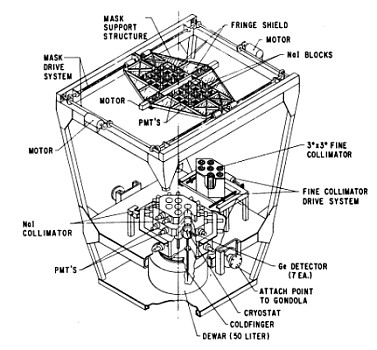
The GRIS instrument consists of an array of seven coaxial n-Type germanium detectors surrounded by a thick active NaI shield/Collimator. Located above this assembly is an active NaI coded-aperture mask for imaging and precise source location. The seven germanium detectors are each enclosed in individual cryostats. This design (rather than a single large multi-detector cryostat) was chosen for two principal reasons: to minimize the internally produced background and for easier replacement of individual detectors, as well as upgrades and modifications.
The instrument is mounted in a gondola offering a conventional azimuth-over-elevation pointing system with a momentum wheel for azimuth control. Coarse pointing control used the earth's magnetic field as a reference. A CID camera was used to image star fields and the sun to obtain an independent and more accurate measure of the absolute pointing direction.
Details of the balloon flight
Balloon launched on: 10/28/1988 at 9:24 utc
Launch site: Australian Balloon Launching Station, Alice Springs, Australia
Balloon launched by: National Scientific Balloon Facility (NSBF)
Balloon manufacturer/size/composition: Zero Pressure Balloon SF3-424.37-080-NSCR-03
Balloon serial number: W29.47-3-04
Flight identification number: 262N
End of flight (L for landing time, W for last contact, otherwise termination time): 10/29/1988 at 7:30 utc
Balloon flight duration (F: time at float only, otherwise total flight time in d:days / h:hours or m:minutes - ): 44 h
Landing site: 61 miles NW of Warrabri, Northern Territory, Australia
Observations of the supernova SN1987A, the Galactic center, the Galactic plane and the Crab Nebula.
External references
- GRIS web site at Goddard Space Flight Center archive
- Balloon-Borne Gamma Ray Experiment Observes Supernova and the Center of Our Galaxy Goddard News Vol. 34 Nº 12, December 1988
- Great Moments in GRIStory at NASA's Goddard Space Flight Center website
- Suborbital Study of Gamma Rays Snatches Lindsay Award Goddard News Vol. 37 Nº 8, August 1991, p. 5
StratoCat is an independent, non-commercial project maintained to preserve and share the history of scientific and stratospheric ballooning. If you find the site useful, you can help keep it running with a small donation toward its operating costs. Every contribution, even the equivalent of a cup of coffee, is greatly appreciated.