
The beginning of the base can be traced back to 1939, when two land areas were bought near Fairbanks to establish a base for the Army Aviation. The extreme climatic conditions did not the construction an easy task, forcing even to mount a railway line exclusively for the transport of the supplys and materials from the neighbor Fairbanks.
The new base was denominated "Ladd Field" and until the entrance of US in the World War II it was merely a range to test new suits and equipment during the crude winters in the region. With U.S. fullyinvolved in the fight Ladd Field became a vital point in the Alaska-Siberia crossing. At that time U.S. sold airplanes to the Russians in support to their fight against the Germans. The fighters were taken in flight by American pilots from Great Falls in Montana passing by Canada to Fairbanks, there landed in Ladd Field where they were given to the Soviet pilots who crossed them in flight to Siberia and then to the fight front. This process would endure until September of 1945.
Two years after the end of the war, Alaska was the first place in having a unified command, which allowed the three arms to operate togheter. At the middle 50's the zone acquires a fundamental strategic importance due to his proximity to the potential scene of a confrontation with the Soviets, turned from allies to enemies in the new context of the "Cold War".
In 1961 the Army assumes the total control of the base renaming it Fort Wainwright in honor to a general who participated in the defense of the Bataan peninsula in the Pacific war. Since then, several units of infantry have their seat there, that have participated in combat operations in several countries of the world.
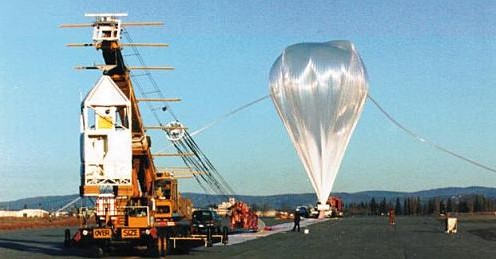
In the context of the scientific activity, starting from 1962 Fort Wainwright has been used as a base to perform stratospheric balloon launches for several research purposes ranging from cosmic ray studies to atmospheric sampling. In recent years the site was included as one alternative launch site for the NASA balloon program through the National Scientific Balloon Facility (NSBF).
As far as no restriction on the volume of the balloons used are aplicable, in addition to the short duration flights, also transoceanic flights around the north pole have been made. These flights left from Fort Wainwright, flying over the north of Siberia and Europe, crossing the Atlantic Ocean passing over Greenland and Iceland to end the trip on the center of Canada or if possible again in Alaska.
The last balloons flight of this kind were done in 1998 because in recent years, Russia showed a persistent refusal at the time of allowing the balloons to fly over its national territory, so in 2005 NASA signed an agreement to use the balloon facilities at Esrange in Sweden for this kind of flights. However no such flights were performed by the agency. Instead, 3 to 5 days long transatlantic flights from Sweden to Canada were performed during the 2000's decade.
Table of balloons launched from Fort Wainwright, Fairbanks, Alaska
| Date | Hour | Flight Duration | Experiment | Payload landing place or cause of the failure |
|---|---|---|---|---|
| 2/25/1962 | 22:26 AST | --- | PAYLOAD UNKNOWN | Near Topeka, Kansas, USA |
| 2/27/1962 | 22:04 AST | 15 h | PAYLOAD UNKNOWN | Payload no recoverable |
| 3/2/1962 | 22:11 AST | 15 h | PAYLOAD UNKNOWN | Payload no recoverable |
| 3/3/1962 | 22:00 AST | 15 h | PAYLOAD UNKNOWN | Payload no recoverable |
| 3/4/1962 | 02:00 AKST | 15 h | PAYLOAD UNKNOWN | Payload no recoverable |
| 3/5/1962 | 00:30 AKST | 15 h | PAYLOAD UNKNOWN | Payload no recoverable |
| 3/6/1962 | 00:10 AKST | 15 h | PAYLOAD UNKNOWN | Payload no recoverable |
| 7/5/1962 | 8:30 ast | 5 h 30 m | INFRARED RADIOMETER | 5 miles E of Nenana, Alaska, US |
| 7/14/1962 | --- | INFRARED RADIOMETER | 28 miles NW of Tanana, Alaska, US | |
| 7/16/1962 | 22:29 ast | --- | INFRARED RADIOMETER | 28 miles NW of Tanana, Alaska, US |
| 7/7/1964 | 21:20 ast | 8 h | SOLAR SPECTRUM MEASUREMENTS | --- No Data --- |
| 7/13/1964 | 19:04 ast | 8 h | SOLAR SPECTRUM MEASUREMENTS | --- No Data --- |
| 7/21/1964 | 13:52 ast | 5 h | SOLAR SPECTRUM MEASUREMENTS | --- No Data --- |
| 9/12/1969 | 1:25 adt | ~ 6 h | INFRARED INSTRUMENTATION | In the White Mountains, Alaska, US |
| 9/15/1969 | 0:58 adt | ~ 2 h | INFRARED INSTRUMENTATION | Balloon burst at 29 km.Payload recovered 10 miles E of Fairbanks, Alaska, US |
| 9/23/1969 | 2:50 adt | ~ 2 h | INFRARED INSTRUMENTATION | Balloon burst at 29 km.Payload recovered 40 miles SE of Fairbanks, Alaska, US |
| 9/12/1972 | 6 h | INFRARED ATMOSPHERIC EMISSION STUDY | --- No Data --- | |
| 9/16/1972 | 6 h | INFRARED ATMOSPHERIC EMISSION STUDY | --- No Data --- | |
| 9/22/1972 | 4 h | INFRARED ATMOSPHERIC EMISSION STUDY | --- No Data --- | |
| 9/25/1972 | 2 h | INFRARED ATMOSPHERIC EMISSION STUDY | --- No Data --- | |
| 4/30/1975 | 5:36 ADT | --- | SPECTRAL RADIOMETER | 70 miles NW of Ft. Wainwright, Alaska, US |
| 5/5/1975 | 4:48 ADT | --- | SPECTRAL RADIOMETER | 55 miles W of Ft. Wainwright, Alaska, US |
| 5/16/1975 | 4:51 ADT | --- | SPECTRAL RADIOMETER | 62 miles NW of Ft. Wainwright, Alaska, US |
| 4/25/1978 | F 8 h | ATMOSPHERIC SCIENCES | --- No Data --- | |
| 4/28/1978 | F 4 h 10 m | ATMOSPHERIC SCIENCES | --- No Data --- | |
| 4/30/1978 | F 7 h 10 m | CRYOGENIC SAMPLER (NCAR) | --- No Data --- | |
| 5/4/1978 | F 4 h 10 m | ATMOSPHERIC SCIENCES | --- No Data --- | |
| 5/1/1993 | 13:41 utc | F 4 h 24 m | AURORAL SCIENCE | 55 miles NW of Fairbanks, Alaska, US |
| 5/6/1993 | 13:27 utc | F 3 h 54 m | AURORAL SCIENCE | 53 miles NW of Fairbanks, Alaska, US |
| 7/4/1996 | 18:57 utc | 7 h | COSMIC AND HELIOSPHERIC PHYSICS | Balloon burst 30 miles SW of Tanana, Alaska, US |
| 4/30/1997 | 15:17 utc | 8 h 50 m | FIRS-2 (far infrared Fourier transform spectrometer) + UV O3 PHOTOMETER | 10 miles SW of Bettles, Alaska, US |
| 5/8/1997 | 5:56 utc | 8 h 30 m | MKIV INTERFEROMETER | 35 miles SW of Tanana, Alaska, US |
| 6/23/1997 | 14:10 utc | 12 d 8 h | TEST FLIGHT + COSMIC RAY EXPERIMENT | 300 miles E of Inuvik, Canada. |
| 6/30/1997 | 14:52 utc | 5 h 50 m | OMS (Observations of the Middle Stratosphere) + ALIAS II + UV O3 PHOTOMETER + ARGUS | 12 miles NNW of Nenana, Alaska, US |
| 7/8/1997 | 7:15 utc | 7 h | MKIV INTERFEROMETER + UV O3 PHOTOMETER | 21 miles NW of Nenana, Alaska, US |
| 6/18/1998 | 14:47 utc | 7 h | COSMIC RAYS STUDIES | Balloon failure. Payload landed 3 miles E of Manley Hot Springs, Alaska, EEUU |
| 6/29/1998 | 13:58 utc | ~ 13 d | COSMIC RAYS STUDIES | 35 miles NE of Cambridge Bay, Canada |
StratoCat is an independent, non-commercial project maintained to preserve and share the history of scientific and stratospheric ballooning. If you find the site useful, you can help keep it running with a small donation toward its operating costs. Every contribution, even the equivalent of a cup of coffee, is greatly appreciated.