
-
September 3 1990
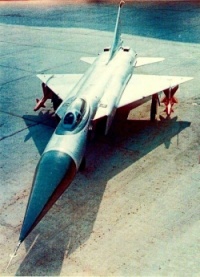
Soviet fighter shotdown a Swedish balloon over Murmansk
On this day in September 1990, a stratospheric balloon launched a few days before from ESRANGE balloon base in Sweden that failed to end its flight was carried by prevailing winds over the Murmansk area and was detected visually and by radar by Soviet Defence Forces. The balloon would be eventually shotdown by a Sukhoi Su-15TM plane of the 431st Fighter Regiment sent from Afrikanda Air Base using two air-to-air missiles. The balloon envelope collapsed by the explosion, but the payload managed to land on its own parachutes.
Initially, it was informed that the payload -the Pointing Infrared Observing Gondola or PIROG- had been destroyed in the event, but scientists from the USSR covertly contacted their Swedish counterparts to inform them of the instrument's landing site. After a long series of diplomatic negotiations, the platform would be returned to its Swedish owners, albeit "stripped" of its main components. -
September 5 1862
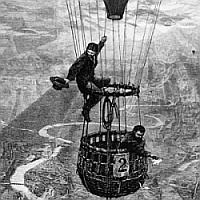
Glashier and Coxwel beat world altitude record
On this day in 1862, British meteorologist James Glaisher and aeronaut Henry Tracey Coxwell set a world altitude record during a balloon ascent from Wolverhampton, England.
Glaisher was investigating the behavior of water vapor at different altitudes, a subject of interest following a severe drought in Britain. Coxwell, an experienced balloonist, built a balloon 55 feet wide and 90 feet high to carry them and their instruments. The flight reached an estimated 37,000 feet, though Glaisher lost consciousness around 29,000 feet due to lack of oxygen. Coxwell, nearly incapacitated by the extreme cold, managed to release gas from the balloon using his teeth to pull the valve cord to brought them back to earth. They finally landed safely near Ludlow, Shropshire.
The expedition provided valuable data for early meteorological research and highlighted both the potential and dangers of high-altitude flight. -
September 7 1956
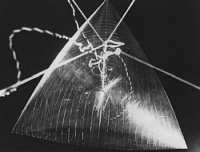
Altitude record by a Mylar tetroon
On this day in 1956, a helium-filled plastic balloon launched from Anoka Airport, Minnesota, reached an altitude of 142,600 feet (about 27 miles), setting a new world record for such flights.
The balloon, built of Mylar and pyramidal in shape, measured 185 feet in length and contained one million cubic feet of helium. It carried a 48-pound payload equipped with instruments to measure infrared radiation, air pressure, and temperature, as well as cameras for photographs and radio transmitters to relay data. The flight was organized by Edward P. Ney and John R. Winckler of the University of Minnesotas physics department, while the balloon was constructed by Winzen Research, Inc.
The ascent surpassed the previous record of 125,000 feet set in 1955. -
September 12 1964
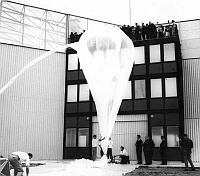
Inauguration of the Aire Sur L'Adour balloon base
On this day in 1964 was formally inaugurated the Centre de Lancement de Ballons dAire-sur-lAdour (CLBA), following the construction of its first operational building. Located in the Landes department of southwestern France, the base was established after earlier balloon operations at the Mont-de-Marsan air base proved incompatible with military air traffic. Aire-sur-lAdour was chosen for its stable meteorological conditions and its proximity to Potez aeronautical facilities.
The inauguration ceremony was attended by senior officials from the French government and the Centre National dÉtudes Spatiales (CNES), who toured the facilities and observed the launch of a balloon. Initially administered by the Service dAéronomie, the base operated with limited resources, including a small control center provided by the military and aircraft rented on a flight-by-flight basis for balloon tracking and payload recovery.
The establishment of the CLBA marked the beginning of a permanent French infrastructure for stratospheric balloon research and experimentation, which has conducted over 2,000 launches during its almost six decades of operation. -
September 16 1954
First large plastic balloon launch in Japan
On this day in 1954 was performed the first successful flight of a large polyethylene balloon in Japan. Objective of the flight was to study cosmic rays by using nuclear emulsions. The balloon was launched from the Kobe University at 6:22 and fell on the Japan Sea off Shimane prefecture, about 80 km north-west from Kobe, after a total flight time of five hours floating above the 15 mb level.
-
September 18 1984
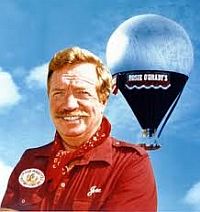
First balloon solo crossing of the Atlantic
On this day in 1984, Col. Joe Kittinger, former USAF pilot and parachutist became the first man to complete a solo transatlantic crossing by balloon.
Kittinger lifted off from Caribou, Maine, in the United States on September 14 in the 101,000 cubic feet helium-filled balloon Rosie O'Grady. He covered a distance of 5701 kilometers across the Ocean and part of Europe before landing on September 18 at Montenotte, near Savona, Italy.
Total flight time was 86 hours. -
September 19 1783

First balloon flight with animals on board
On this day in 1783, the Montgolfières brothers balloon Aerostat Réveillon was flown in front of a crowd at Versailles, France before King Louis XVI and Queen Marie Antoinette.
On board the basket were a sheep called Montauciel ("Climb-to-the-sky"), a duck and a rooster. The sheep was believed to have a reasonable approximation of human physiology. The duck was expected to be unharmed by being lifted aloft. It was included as a control for effects created by the aircraft rather than the altitude. The rooster was included as a further control as it was a bird that did not fly at high altitudes.
The flight lasted approximately eight minutes at 460 meters, covering 3 km at about 1,500 feet. -
September 20 1980
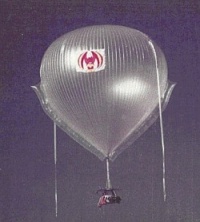
First attempt of Super Chicken Across America
On this day in 1980, Arizona businessmen John Shoecraft and Ron Ripps launched a ten-story helium balloon from a football field at MiraCosta College in Oceanside. Their endeavor, named "Super Chicken Across America," was inspired by the vibrant orange, red, and yellow cartoon-style character Super Chickencreated by artist Sheila Rippswhich adorned the balloons equator.
Aiming to complete the first transcontinental crossing of the United States in a helium-filled balloon, the team reached Columbus, Ohio, before thunderstorms forced them down on their second day aloft. During an emergency landing attempt, the gondola failed to settle, prompting Shoecraft to jump out. His exit made the craft suddenly lighter, causing it to rocket back upward to an altitude of 1,200 feet. Ron Ripps, who had never parachuted before, then ejected safely to the ground.
Another attempt was made later that year, though it wasnt until 1981 that Shoecraft ultimately achieved his goal. -
September 20 2013
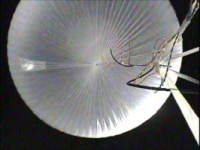
A Japanese balloon reaches 53.7 km and sets a new record
On this day in 2013, the Japanese Space Agency JAXA launched from Taiki in Hokkaido, a zerp-pressure balloon with a volume of 80,000 m3 made from a 2.8 µm-thick ultra-thin film that reached a float altitude of 53.7 km. The record altitude surpassed the previous mark of 53 km set by the same agency in 2003. The balloon carried a package with cameras, sensors and a GPS that served to confirm the flight level achieved.
From the upward video taken by an onboard camera, was confirmed that the escape tube of the balloon opened fully at float, thus showing that the balloon had fully deployed. After floating for 12 minutes, the flight was terminated by radio command due to the balloon was approaching the boundary of the notified splashdown area. -
September 22 1992
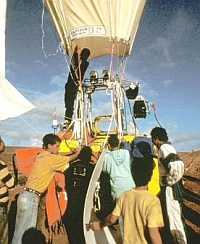
New record flight by Bradley and Abruzzo during Transatlantic Challenge
On this day in 1992, aeronauts Troy Bradley and Richard Abruzzo made a standup landing in Morocco setting an absolute duration record for balloons (144 hours and 16 minutes) after traveling 3,318 miles (5,340 km) and completing the first US to Africa balloon flight. The balloon, of the Roziere type, was launched on September 16 from Bangor, Maine.
The flight was part of the Transatlantic Challenge a balloon race that included teams from Belgium, Germany, United Kingdom, the Netherlands and United States. -
September 29 2007

Closing ceremony of the Sanriku Balloon Center
On this day in 2007, a closing ceremony was held to mark the end of operations at the Sanriku Balloon Center, located in Iwate Prefecture, Japan. Officially inaugurated in 1971, the facility served for 37 years as the countrys principal stratospheric balloon launch base for the Japanese Space Agency JAXA. Over this period, it conducted two launch campaigns each year and oversaw a total of 413 balloon flights.
Following its closure, operations were transferred in 2008 to the Taiki Aerospace Research Field in Hokkaido, which became Japans main balloon launch site. The former Sanriku facilities are now used by a local fishery company.
About StratoCat
Some Statistics
+ 20 articles from different contributors
+ 16040 balloon launch records already published
+ 16136 balloon launch records in the full database
StratoCat is a non-profit, educational and informative website created, developed and programmed by Luis E. Pacheco. It is based on an idea first conceived by the author in 2001 and is online since September 17th, 2005.
This website is an independent initiative, and thus is not endorsed, supported or have any relationship with any governmental or private agency or company in the balloon field.
Page generated on 1-Oct-2026 - 08:41:18am  © StratoCat 2005~2026 - All Rights Reserved.