
Purpose of the flight and payload description
SALOMON is the acronym of Spectroscopie d'Absorption Lunaire pour l'Observation des Minoritaires Ozone et Nox. Its a instrument developed by the Laboratoire de Physique et Chimie de l'Environnement (LPCE) with funds from the Centre National d'Etudes Spatiales (CNES). The instrument is a balloon-borne UV-visible spectrometer designed to acquire vertical profiles of O3, NO2, NO3, OClO and OBrO as well as the extinction coefficient of aerosols, at altitudes between 15 and 40 km. It was developed based on the experience acquired by the scientific teams that developed the AMON and SAOZ spectrometers, that used stars and sun as light source respectively.
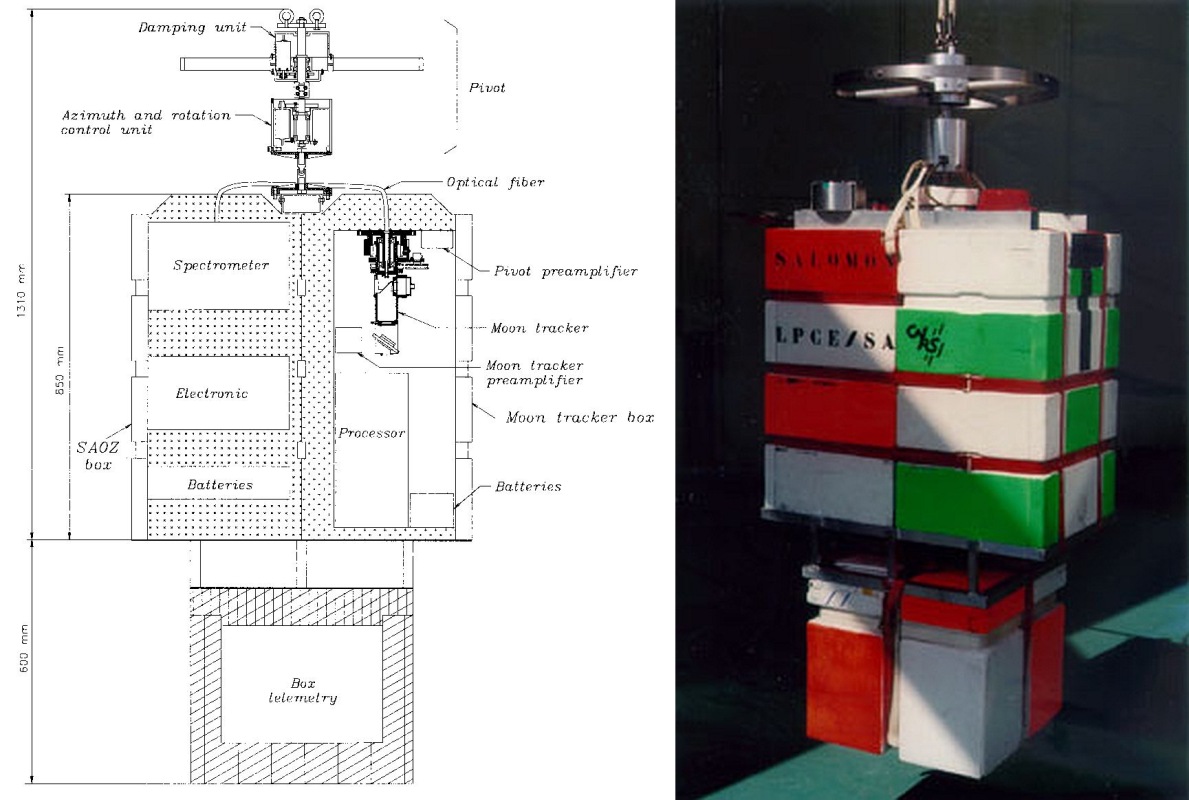
At left we can see an scheme of the instrument (click to enlarge). SALOMON is made from three boxes. The top two boxes, linked by an optical fiber, include a spectrometer and the moon-tracker system. The third, below the two others, contains the CNES telemetry system. The boxes are made from polystyrene, which is well suited for protecting the onboard instruments at landing. The pivot (also known as the primary pointing system) is located above the boxes and links the gondola to the flight chain. The total weight of SALOMON is about 80 kg, which permits the use of balloons in the 10,00065,000-m3 range to reach float altitudes of 27 to 38 km at mid-latitudes.
The measurements are performed by the lunar occultation method. This method consists of recording spectra affected by atmospheric absorption during a moonset or a moonrise. The elevation of the Moon decreases from a few degrees above the gondolas horizon to 24°, which implies a duration at float of about 40 minutes. A reference spectrum is recorded when the Moon is as high as possible and the balloon is at float.
The hearth of the system is the spectrometer, the detector, and the electronics which are the same as those used for the SAOZ instrument. The spectrometer is a Jobin-Yvon Model CP200, with a wavelength domain shifted to 350~700 nm to cover the NO3 absorption band at 662 nm. The detector is a Hamamatsu photodiode array of 1024 pixels, with a theoretical spectral resolution of 0.34 nm, which is 2.5 times the theoretical resolution of AMON. A dark current exposure is performed after every ten exposures, and its value is subtracted automatically from the recorded spectra by the onboard processor.
The moon tracker consists of a 25 mm x 76 mm plane mirror that can move on elevation mounted upon a turret that turns on azimuth. A portion of the light focused by a lens in the turret is sent to a position sensor, which determines the spot position. The error in elevation and the error in azimuth are calculated, and the calculated correction is sent directly to the motors by the onboard processor. The system is designed to achieve a precision below 30 arc/sec when the gondola is affected by only small perturbations. In the case of strong oscillations of the gondola, as can be encountered during ascent of the balloon, the error on azimuth can be as much as 1 arc min, and the error on elevation can reach a few arc minutes because this axis is not controlled by the pivot. The flux collected by the mirror is focused onto an optical fiber to send the light to the spectrometer. This device homogenizes the flux and eliminates sensitivity to the variations of the Moons albedo induced by its nonuniform ground composition.
The pivot or stabilization unit is designed to stabilize the gondola and to perform rough azimuth control. It is composed of a magnetic damping device to stabilize the flight chain and a mechanical unit with a velocity sensor to perform the gondola rotation. The Moons location in the sky is determined automatically by two photodiodes mounted 45° from each other. The pivot induces a rotation of the gondola until the fluxes on the two photodiodes are identical.
SALOMON operates automatically for on-off switching, pointing, data acquisition, and telemetry. The housekeeping and spectroscopic data are telemetered in real time to the ground.
Details of the balloon flight
Balloon launched on: 1/16/2006 at 16:06
Launch site: European Space Range, Kiruna, Sweden
Balloon launched by: Centre National d'Etudes Spatiales (CNES)
Balloon manufacturer/size/composition: Zero Pressure Balloon model 100z 100.000 m3
End of flight (L for landing time, W for last contact, otherwise termination time): 1/16/2006 at 21:25
Balloon flight duration (F: time at float only, otherwise total flight time in d:days / h:hours or m:minutes - ): 6 h
Landing site: In the N part of Finland, near the lake Inari.
Campaign: ENVISAT IV
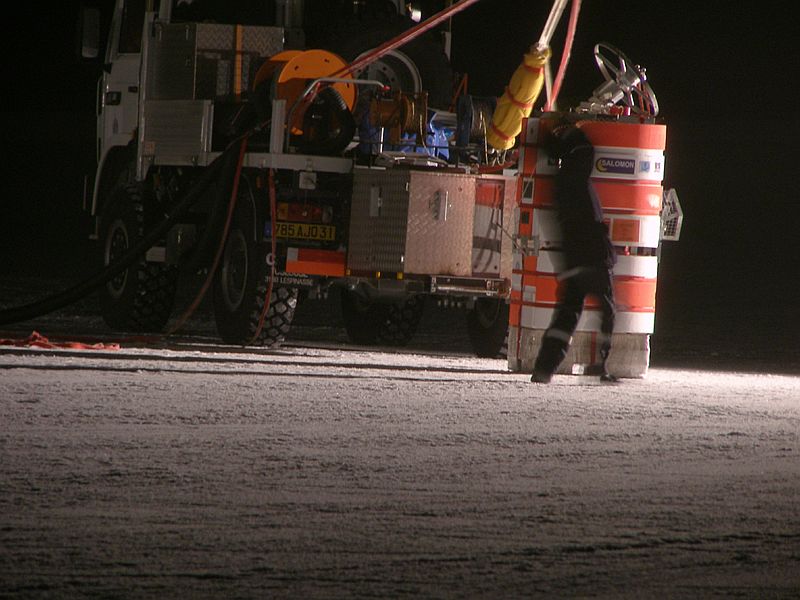
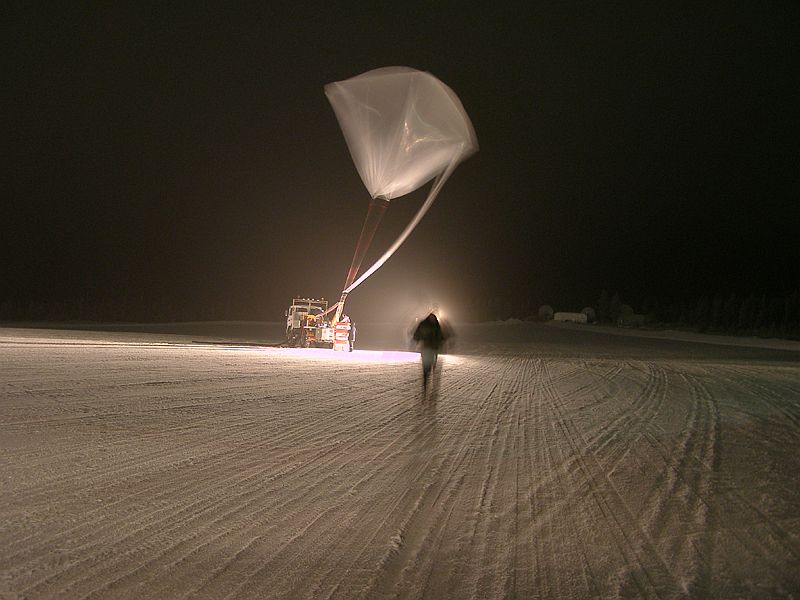
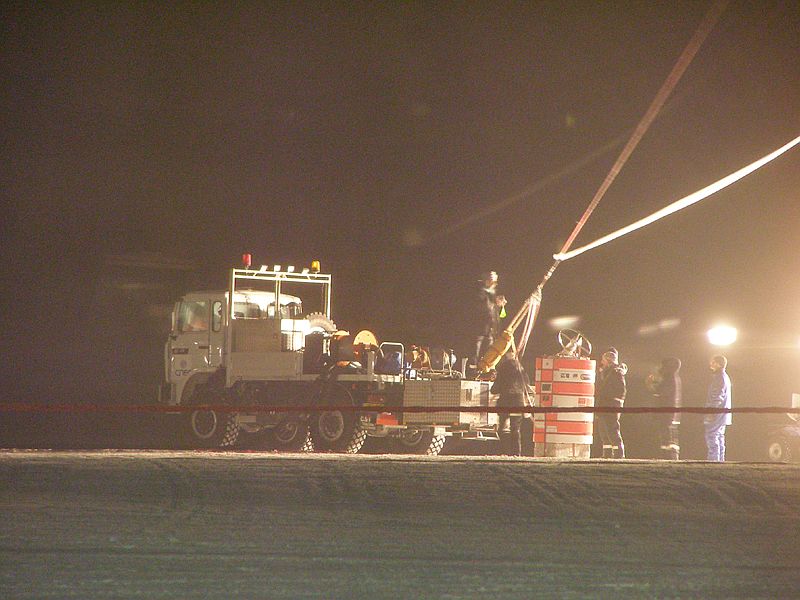
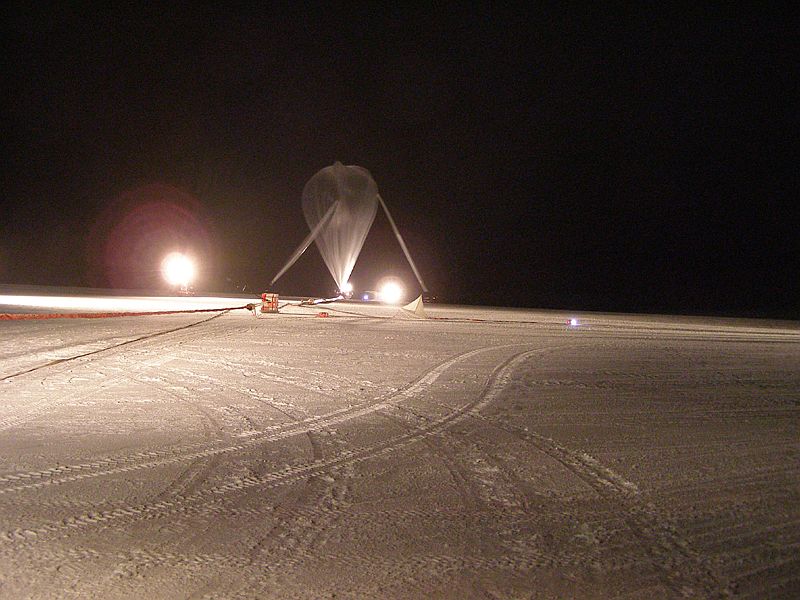
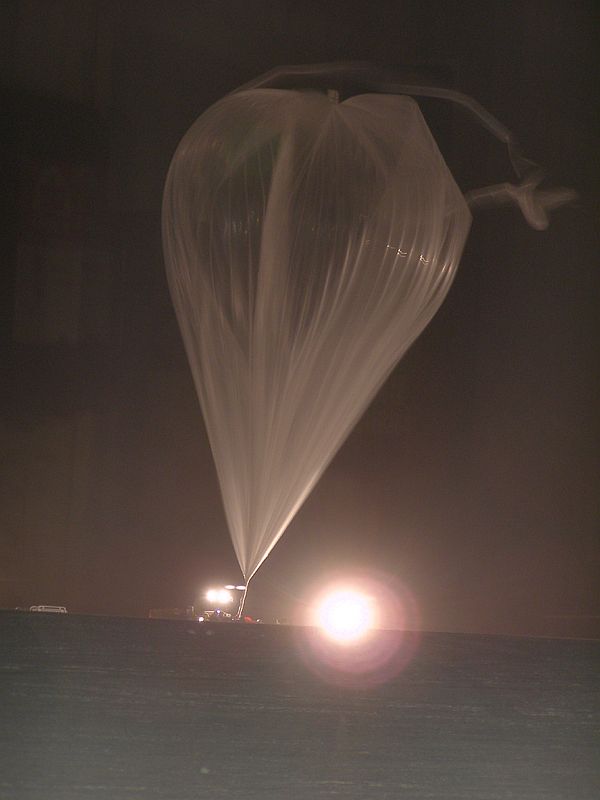
The balloon was successfully launched by dynamic method assisted by an auxiliary balloon under windy conditions at 16:06 UTC on January 16th, reaching a flight level of 34 km.
Then started a slow controled descent by several hours until the cut down command was given at 21:25 UTC and the payload landed in the north part of Finland, near the lake Inari. The gondola structure was damaged during the landing without however affecting the instrument.
The aim of this campaign was to determine the limitations of the remote sensing measurement methods of stratospheric species used in particular by satellite instruments such as those onboard ENVISAT (e.g. GOMOS).
During this flight SALOMON conducted its observations during the balloon ascent (from 14 to 34 km) and for the first time during a slow descent (from 34 to 18.5 km).
External references
- SALOMON website Laboratoire de Physique et Chimie de l'Environnement - Orleans
- ENVISAT VALIDATION 4 Measurements made by balloon SSC Press Release (via Archive.org)
- List of balloons launched from ESRANGE SSC Space website (via Archive.Org)
Images of the mission
If you consider this website interesting or useful, you can help me to keep it up and running with a small donation to cover the operational costs. Just the equivalent of the price of a cup of coffee helps a lot.