
Purpose of the flight and payload description
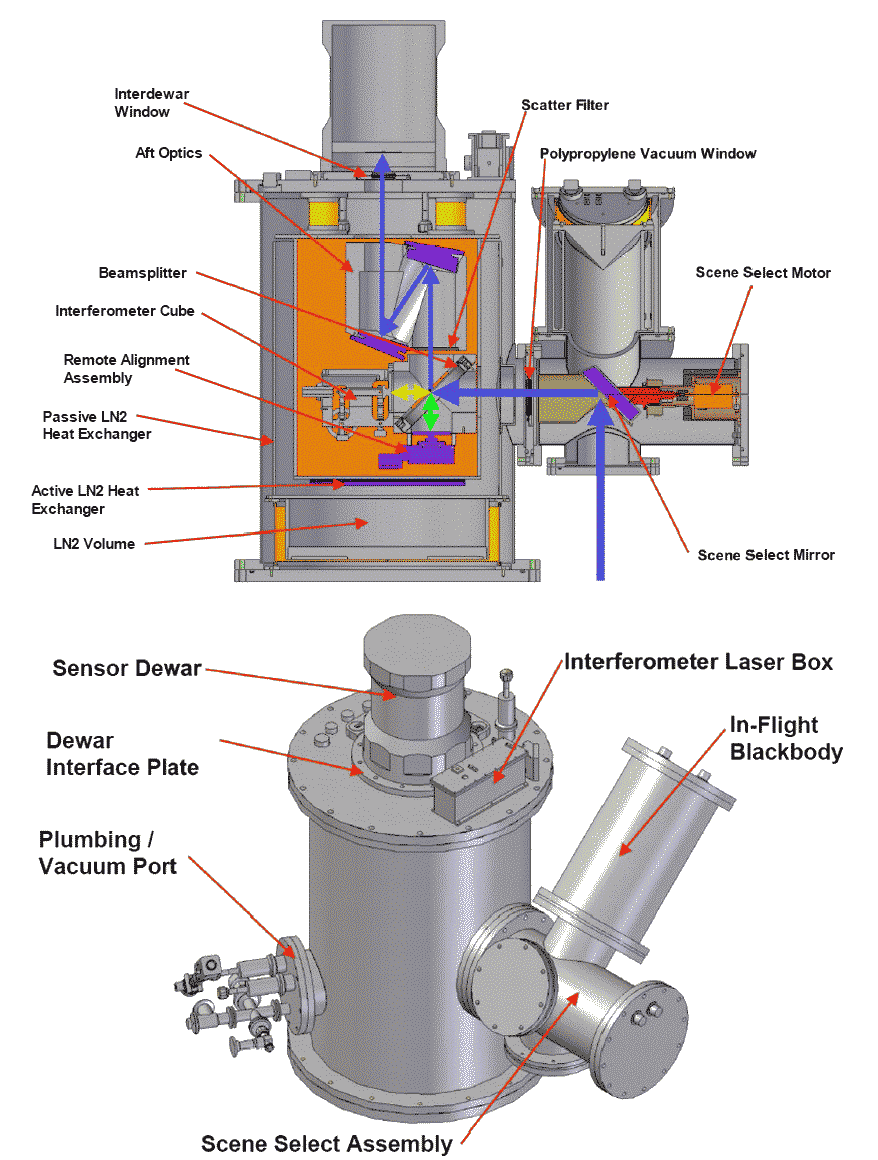
FIRST is a new sensor designed to measure critical but previously unobserved components of the Earths atmosphere. It's mainly composed by a Fourier Transform Spectrometer wich gives greatest possible span of wavelengths in a single instrument along with a beamsplitter made of germanium on polypropylene with excellent response in far-IR and minimal absorption features, detectors with kilohertz sampling frequencies to record more than 1000 samples by second and with a single focal plane to simplify the optical design and calibration. At left can be seen a scheme of it (click to enlarge).
The goal of the FIRST project was to develop the technologies that will allow direct measurements of the infrared radiation leaving the Earth and its atmosphere at wavelengths longer than 15 micrometers out to as far as 100 micrometers. The portion of the infrared spectrum between 15 and 100 micrometers, which scientists refer to as the "far-infrared," has rarely been observed directly from space or from instruments on the ground or in aircraft.
Also in this flight as a Piggyback experiments from 41 schools representing 17 states were flown in a NASA Student Experiment Module. The experiments, in brick-size plastic containers inside two larger containers about the size of large briefcases, are looking at the effect of the flight environment on test articles such as materials, microscopic organisms and seeds.
Details of the balloon flight
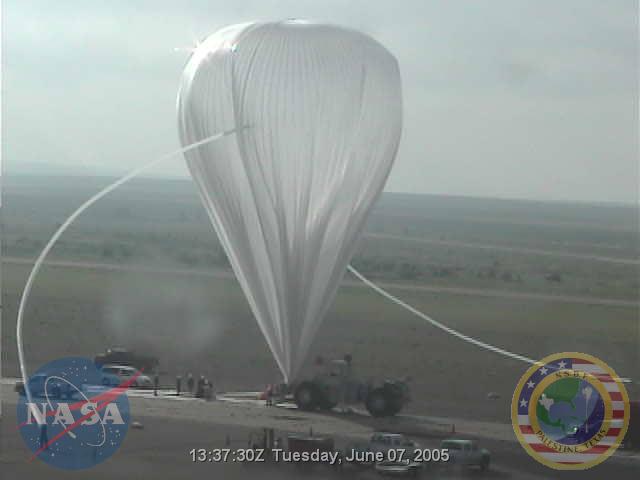
Balloon launched on: 6/7/2005 at 13:56
Launch site: Scientific Flight Balloon Facility, Fort Sumner, (NM), US
Balloon launched by: National Scientific Balloon Facility (NSBF)
Balloon manufacturer/size/composition: Zero Pressure Balloon Raven 11.820.000 cuft - (0.8 Mil.)
Balloon serial number: W 11.82-3E-08
Flight identification number: 544N
End of flight (L for landing time, W for last contact, otherwise termination time): 6/7/2005 at 23:49
Balloon flight duration (F: time at float only, otherwise total flight time in d:days / h:hours or m:minutes - ): 10 h 39 m
Landing site: 44 miles northwest of Fort Sumner (NM) USA
Payload weight: 2485 lbs
Overall weight: 3768 lbs
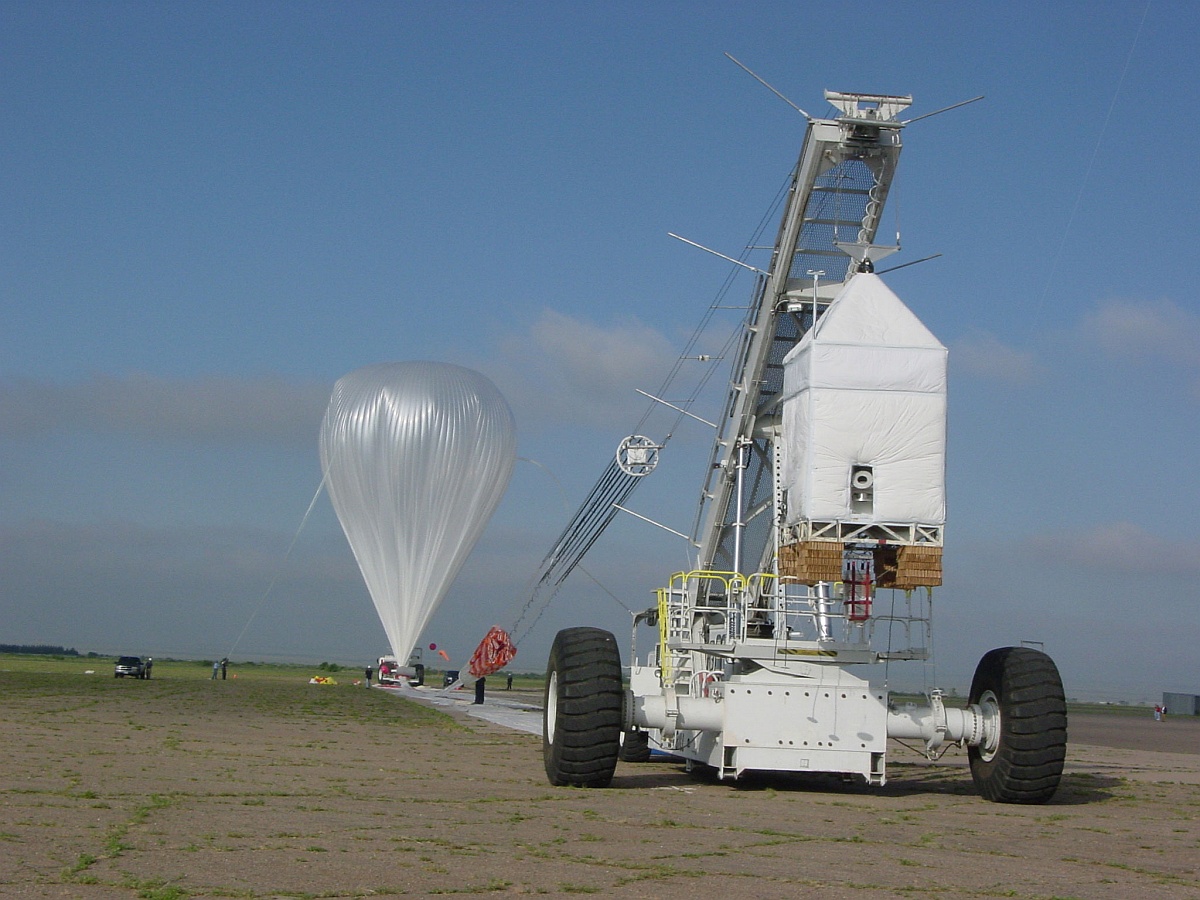
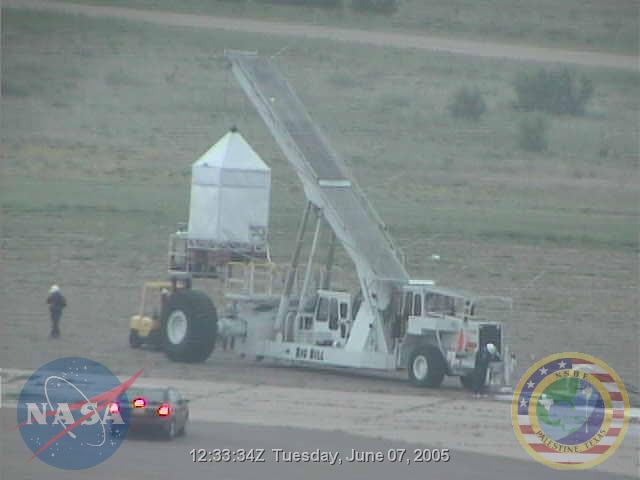
Succesfull launch using dynamic method by launch vehicle (Big Bill) at 13:56 utc.
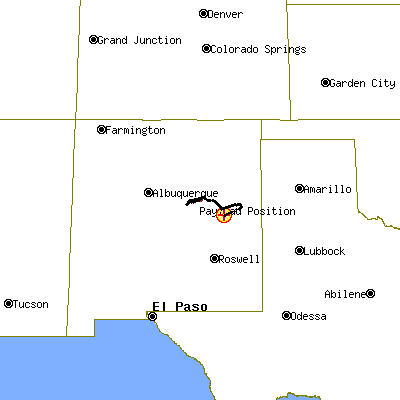
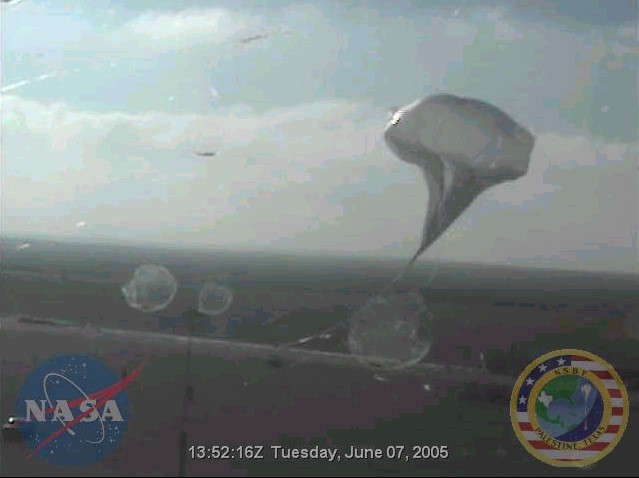
After a nominal ascent phase the balloon reached the float altitude of 107.800 ft and started a drift toward the centre of the State (click the map at left to see the flight path).
Then a mid-float valve down was commanded, permitting the balloon descent to approximately 88.000 ft to facilitate the science instrument functioning.
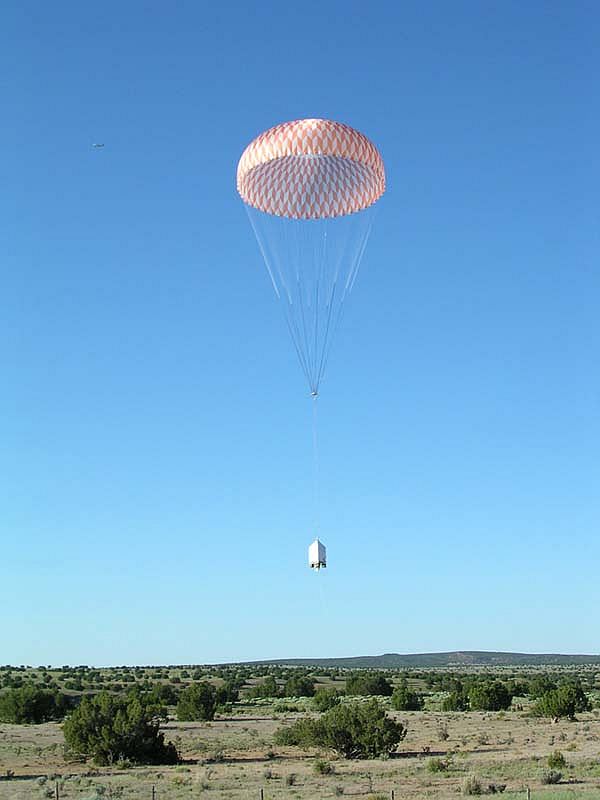
After more than 10 hours of flight the balloon was terminated at 23:49 utc. The termination and visual parachute separation were normal and the payload touched ground at 00:32 utc (on June 8th UTC time) 44 miles northwest of Fort Sumner (34-53.6 N / 104-59.4 W).
Moderate surface winds resulted in the payload being drug for a short distance. However, only minor damage resulted.
During the flight was obtained 5.5 hours of data, near 15,000 interferograms recorded on 10 detectors. Also was achieved an overflight of AQUA satellite at 2:25 pm local time, wich allowed intercomparisons. Found essentially coincident footprints beetween FIRST and AQUA instruments.
FIRST met or exceeded technology development goals and recorded complete thermal emission spectrum of the Earth at high spatial and spectral resolution.
External references
- FIRST website Space Dynamics Laboratory, Utah State University
- A Famous FIRST Launched by NASA to Study Earth's Energy NASA press release
- Far-infrared spectroscopy of the troposphere (FIRST): sensor calibration performance 31st International Symposium on Remote Sensing of Environment - Russian Federation
- New Sensor will Measure Earth's Energy Loss UTAH State University press release
- The Far-Infrared Spectroscopy of the Troposphere (FIRST) Project Earth Science Technology Conference - 11 & 13 June 2002 - Pasadena, CA
Images of the mission
If you consider this website interesting or useful, you can help me to keep it up and running with a small donation to cover the operational costs. Just the equivalent of the price of a cup of coffee helps a lot.