
Purpose of the flight and payload description
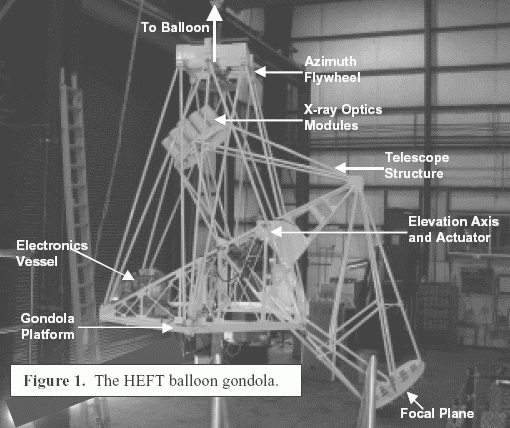
It's an instrument which employs focusing optics in the hard X-ray band (20 keV - 100 keV) for sensitive observations of astrophysical sources.
HEFT takes the basic principles of previous soft x-ray missions and moves into the hard x-ray domain, where the demands for accuracy and precision in engineering the telescopes optics are much higher. Because of its range and relatively large effective collecting area, HEFT is well suited for imaging objects such as supernova remnants and galaxy clusters as well for to made observations of active galactic nuclei. These are some of the brightest extragalactic x-ray sources but ratter hard to observe because often they are obscured by dust clouds.
The HEFT telescope consists of an array of co-aligned conical-approximation Wolter I mirror assemblies. Depth-graded multilayer coatings provide high-energy reflectivity at reasonable graze angles, with response extending to 100 keV.
Each of the thin nested-shell mirrors focuses the incoming radiation onto an individual, shielded, solid-state Cadmium Zinc Telluride (CdZnTe) pixel detector, separated from the focal plane detectors by 6 meters. The HEFT pixel detector consists of a 1.3 cm x 1.3 cm x 2 mm thick CdZnTe crystal, connected to a readout chip containing one circuit for each pixel laid out on a grid exactly matching the detector pixel array. Fourteen modules are packed into a 1.25 meter diameter structure.
As the imaging performance of HEFT places challenging demands on attitude control systems the complete telescope estructure is mounted on a precision balloon pointing platform. In the upper-left figure can be seen the gondola in a hang test in laboratory, with the two rotation axes, two of the four actuators, and the hermetically sealed electronics vessel identified. The four actuators used to drive gondola motions on HEFT were inherited from the GRATIS balloon experiment. The gondola system include a telescope torque motor, an oscillation-damping motor, an Azimuth motor, and a gondola-balloon coupling motor. The torque motor drives the motions of the main telescope structure, to which the optics modules and detectors are mounted, relative to the gondola platform. The oscillation-damping motor drives a reaction wheel whose normal lies along the main axis, and is used to damp pendulum motion around it. Finally a variety of sensors, oftentimes providing redundant attitude information to the system, are mounted to the gondola platform and telescope structure.
Future plans are already under way to take HEFT to the next level. NASAs Small Explorer Program has approved the Nuclear Spectroscopic Telescope Array (NuSTAR), a project wich will put HEFTs x-ray focusing abilities on a satellite. The optics design and the proposed production process for NuSTAR are based on those used to build the HEFT telescopes.
Details of the balloon flight
Balloon launched on: 5/18/2005 at 18:45
Launch site: Scientific Flight Balloon Facility, Fort Sumner, (NM), US
Balloon launched by: National Scientific Balloon Facility (NSBF)
Balloon manufacturer/size/composition: Zero Pressure Balloon Raven - 39.570.000 cu ft - (0.8 Mil.)
Balloon serial number: W 39.57-2-46
Flight identification number: 542N
End of flight (L for landing time, W for last contact, otherwise termination time): 5/19/2005 at 19:39
Balloon flight duration (F: time at float only, otherwise total flight time in d:days / h:hours or m:minutes - ): 25 h 30 m
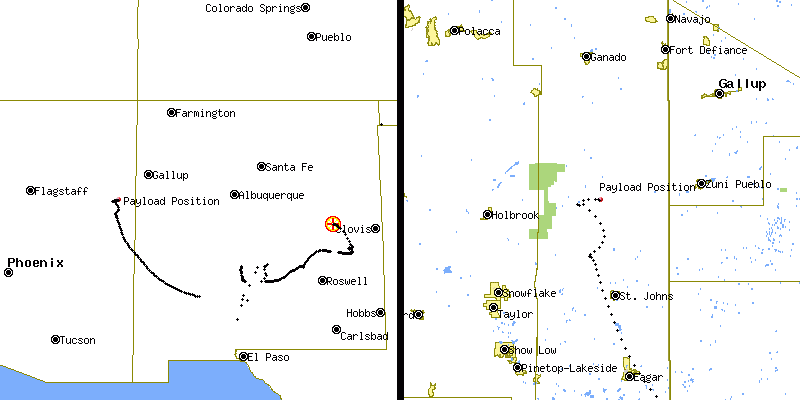
Landing site: 35 miles east-northeast of Holbrook, Arizona, USA
Payload weight: 4175 lbs
Overall weight: 6000 lbs
The balloon was launched using the dynamic method assited by launch vehicle at 18:45 utc on May 18th.
After an initial ascent phase the float altitude of 127.800 feet was achieved and the balloon followed a clockwise pattern flow around an upper level ridge of high pressure building over northwest Mexico wich initially carried it toward the south and then toward the northwest of the New Mexico state.
The flight was terminated from the chase plane at 19:39 utc on May 19th while flying over east Arizona. The instrument touched ground at 20:20 utc 35 nm east northeast of Holbrook (34-59.0 North/105-27.68 West). After the impact the payload remained upright.
During this first mission HEFT spent about 20 hours focusing on planned targets. Its detectors located quickly bright sources such as Cygnus X-1 and the Crab Nebula. Because the later target was extremely bright, the high-energy telescope needed only 5 minutes to record the data. Other fainter sources required several hours to confirm detection.
During the flight were made coordinated observations between HEFT and NASAs Swift x-ray telescope wich simultaneously observed the extragalactic blazar 3C454.3. Because the blazar was under eruption during the HEFT flight, it was one of the brightest active galactic nuclei in the sky.
External references
- HEFT Home Page at Caltech website
- Development and production of hard X-ray multilayer optics for HEFT Proceedings of SPIE - The International Society for Optical Engineering 4851(1):607-618, March 2003
- Development of the High-Energy Focusing Telescope (HEFT) Balloon Experiment Proc. SPIE Vol. 4012, p. 693-699, X-Ray Optics, Instruments, and Missions III, 7/2000.
- Floating into Thin Air Science and Technology Review, Lawrence Livermore National Laboratory, March 2006
- Hard X-ray telescope idea up for final NASA review Space Flight Now
- HEFT related publications a complete listing of all papers published based on the development, flight and data obtained by the instrument at Caltech website
- Optimization of graded multilayer designs for astronomical x-ray telescopes Applied Optics Vol. 38, Issue 22, pp. 4766-4775 (1999)
- Probing the Universe with mirrors that trick light Science & Technology Review, November 2004
- Supernovae-searching tech boosts fight against terrestrial terror DOE PULSE Newsletter - Number 133 - May 26, 2003
Images of the mission
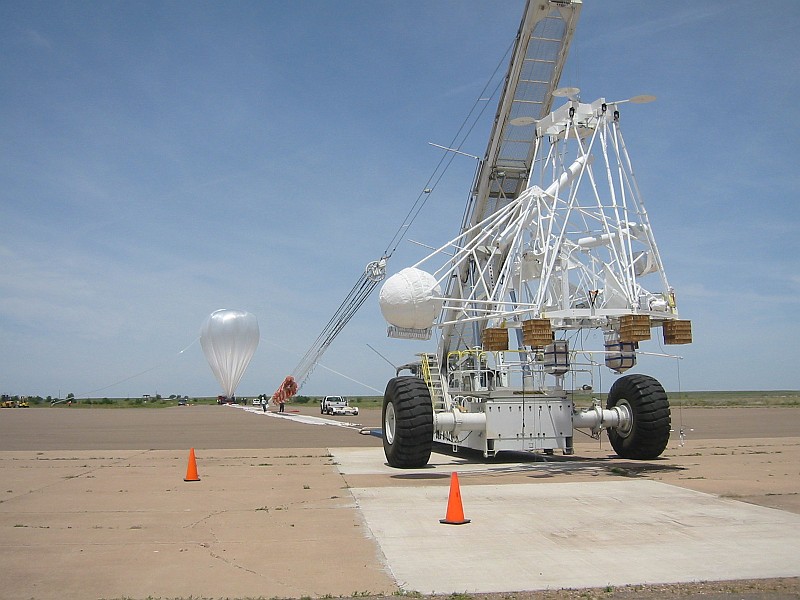
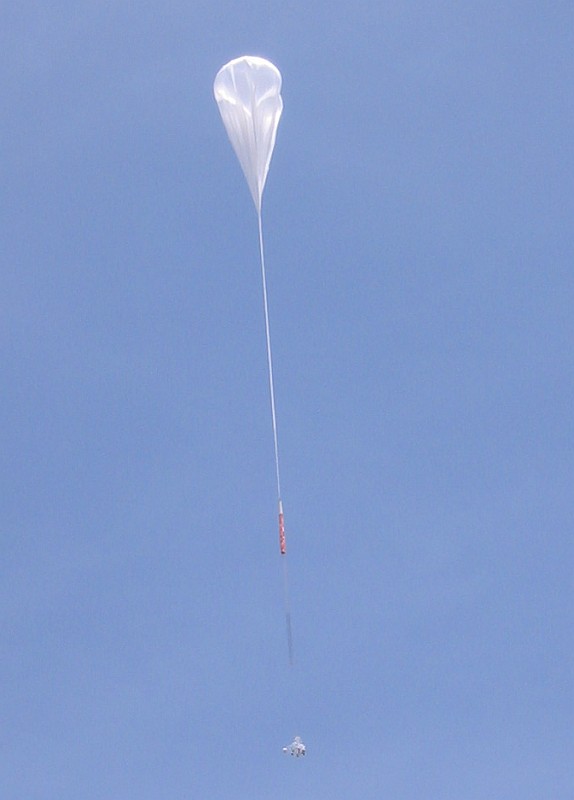
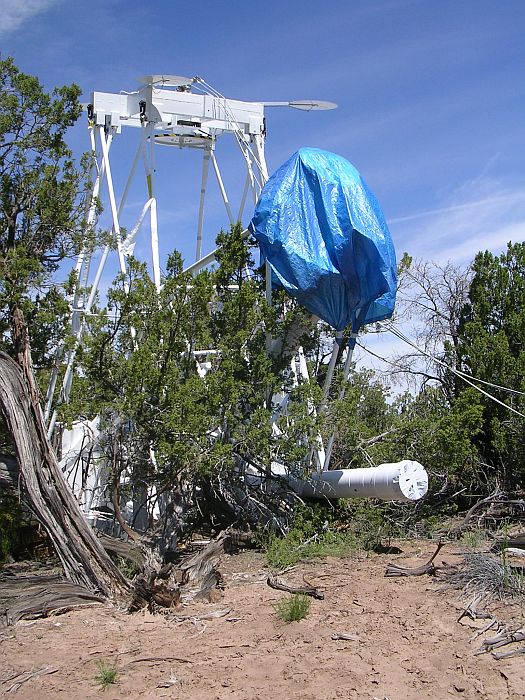
If you consider this website interesting or useful, you can help me to keep it up and running with a small donation to cover the operational costs. Just the equivalent of the price of a cup of coffee helps a lot.