
Purpose of the flight and payload description
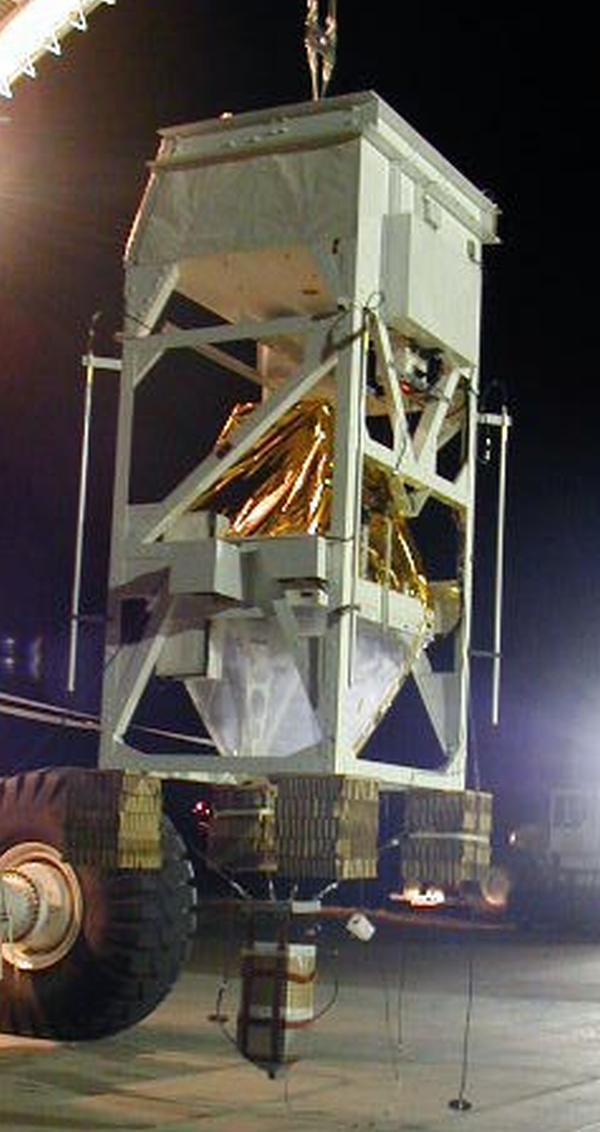
The SBI (Solar Bolometric Imager) is a solar telescope equipped with an innovative bolometric detector that is capable of recording images with a high angular resolution in total photospheric light. SBI provides the first opportunity to bolometrically image brightness variations at the solar photosphere, allowing to determine the contribution of magnetic as well as non-magnetic solar thermal structures to the total solar irradiance (TSI) variation. The knowledge of this irradiance is a key issue for scientists because it heats directly the troposphere being the most direct effect of the Sun on the Earth.
The SBI consists of a 30 cm aperture F/12 Dall-Kirkham telescope feeding a 320 x 240 element thermal detector array. The telescope primary and secondary Pyrex mirrors are uncoated; first, to reduce the sunlight to the level suitable for the detector and second, because of the favorable reflection properties of bare Pyrex.
The detector is an array of ferroelectric thermal IR elements modified by deposition of a thin coat of gold-black wich is a colloidal form of gold that exhibits excellent photon absorption characteristics.
Incident radiation is uniformly absorbed and its energy is redistributed by the gold-black as thermal emission. The thermal emission is detected by the underlying thermal IR barium-trontium-titanate (BST) imaging array to produce an essentially flat response across all wavelengths
from the UV to beyond 10 um in the IR.
Because of the relatively small size of the detector array the actual field of view of the instrument is only 91700 x 68700, and to obtain a full image of the Sun (96000 in diameter) it is necessary to create a mosaic image with the telescope pointing at 10 diferent locations on the solar disk.
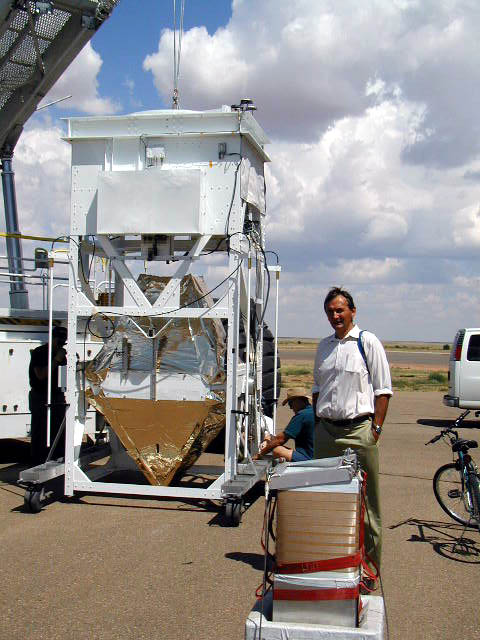
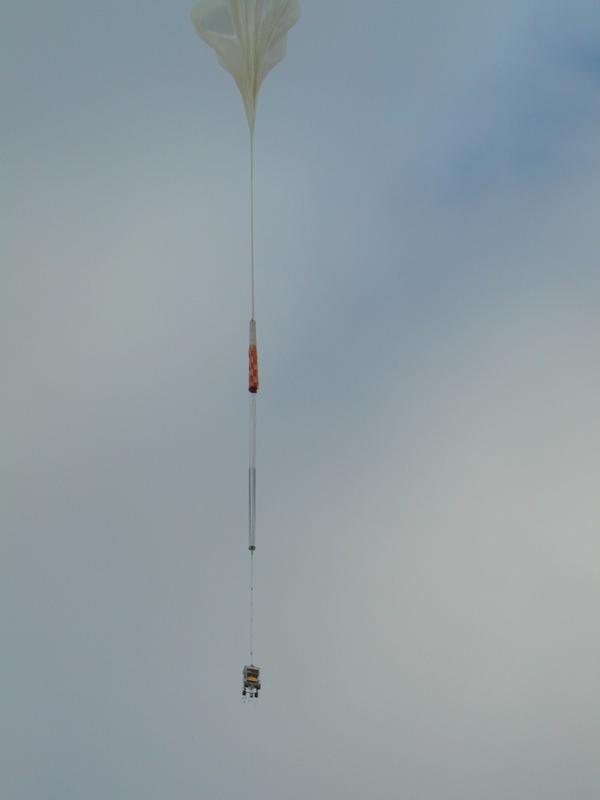
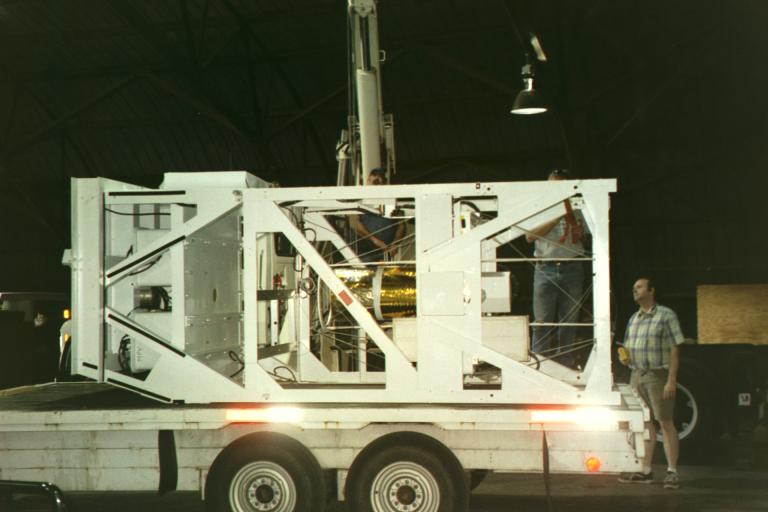
After development of a ground based prototype, the SBI was modified for balloon flight housing it inside the observing platform (gondola) attached with a mount that allows to tilt the instrument in elevation. This gondola was previously used for the Flare Genesis Experiment project, but retrofitted to house and control the SBI telescope and detector.
To point the instrument at the Sun in azimuth the entire gondola is rotated around its vertical axis by means of a reaction wheel. In addition to providing pointing for the telescope the gondola houses all the electronics and mechanisms necessary to operate the instrument, to store the data and to transmit telemetry to the ground, as well as receiving commands.
Power is provided by a series of photovoltaic cells.
Details of the balloon flight
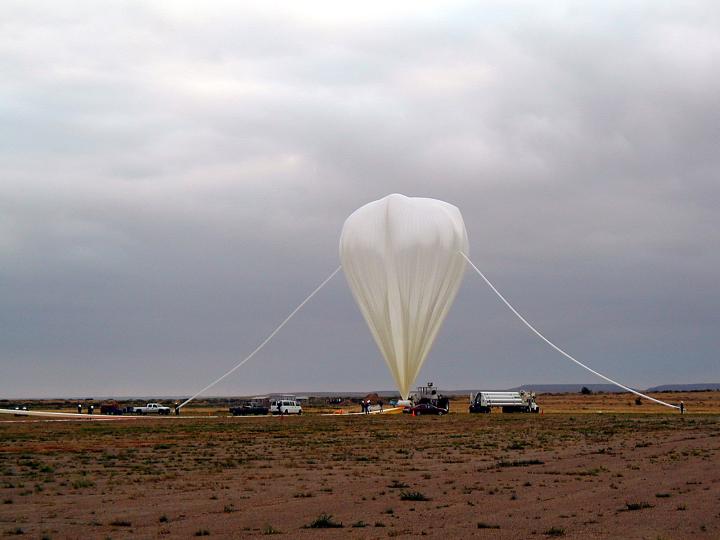
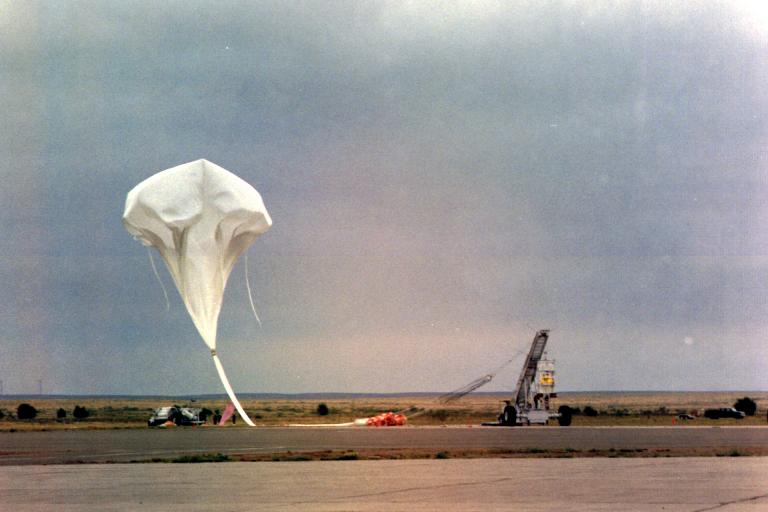
Balloon launched on: 9/1/2003 at 13:24 utc
Launch site: Scientific Flight Balloon Facility, Fort Sumner, (NM), US
Balloon launched by: National Scientific Balloon Facility (NSBF)
Balloon manufacturer/size/composition: Zero Pressure Balloon 11.820.000 cuft - SF3-317.60-080-NSCR-ST
Balloon serial number: W11.82-3-06
Flight identification number: 519N
End of flight (L for landing time, W for last contact, otherwise termination time): 9/1/2003 at 22:26 utc
Balloon flight duration (F: time at float only, otherwise total flight time in d:days / h:hours or m:minutes - ): 9 h 48 m
Landing site: 12 miles SE of Bloomfield, New Mexico, US
After a nominal launch, the flight went trough a float altitude of 33 km by 11 hours. At 17:25 was send the cutdown command. The landing was in a field just south of Farmington NM, about 250 mi NW of launch site.
All systems performed well with one exception: the elevation drive at the beginning of flight showed an anomalous behavior possibly due to the extreme low temperatures experienced during the ascent.
At float, SBI recorded a total of ~ 500,000 bolometric images during approximately 5 hours of observations.
Hard drives survived the landing without problems. All the data stored were recovered and analyzed. Also the gondola, telescope and all subsystems survived the landing impact without damage.
The flight of SBI provided important engineering data to validate the space worthiness of the novel gold-blackened thermal array detectors, and to verify the thermal performance of the SBIs uncoated optics in a vacuum environment.
On the science side the first bolometric maps of the photosphere, covering essentially the full spectral range were obtained, allowing to perform the first broad-band photometric contrast measurement of solar magnetic faculae and the first measurement of photospheric limb darkening in broad-band light. These facular contrast measurements have recently been used to produce the first empirical reconstruction of solar irradiance variation with no free parameters.
External references
- SBI website Johns Hopkins University Applied Physics Laboratory
- A Model of Solar Irradiance Variation Using Broad Band Measurements of Facular Photomotric Contrast ApJ (submitted)
- Broad-band Measurements of Facular Photometric Contrast with the Solar Bolometric Imager ApJ 611, L57, 2004
- Finding the Sources of irradiance variation at sunspot minimum Mem. S.A.It. 76, 907, 2005
- Pictures and video footage of Solar Bolometric Imager launch D.V.Wiebe's fotolog
- Sun's Energy Focus of New Airborne Telescope Johns Hopkins University Applied Physics Laboratory web site
- The Solar Bolometric Imager Adv. Space Res. 33, 1746, 2004
- Total-light imager with flat spectral response for solar photometric measurements Appl. Opt. 40(7), 1138, 2001
Images of the mission
If you consider this website interesting or useful, you can help me to keep it up and running with a small donation to cover the operational costs. Just the equivalent of the price of a cup of coffee helps a lot.