
Purpose of the flight and payload description
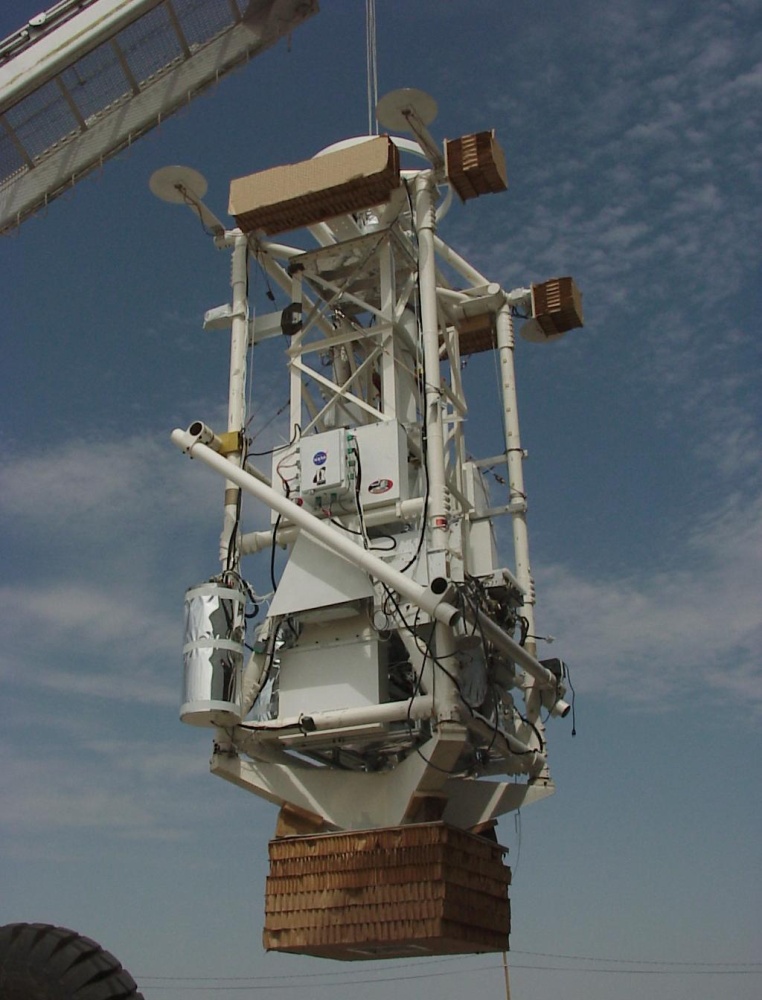
HERO was an X-Ray telescope and the first one aimed to obtain focused images of astronomical X-ray sources at hard X-ray energies (2075 keV).
The key component (the hard X-ray optics) are full-shell electroformed-nickel-replicated (ENR) mirrors coated with iridium to enhance high-energy reflectivity. As the critical grazing angle for reflection varies approximately inversely with energy, these mirrors employ smaller angles than their low-energy counterparts and consequently have smaller diameters and collecting areas per shell. The mirrors have a 6 meter focal length.
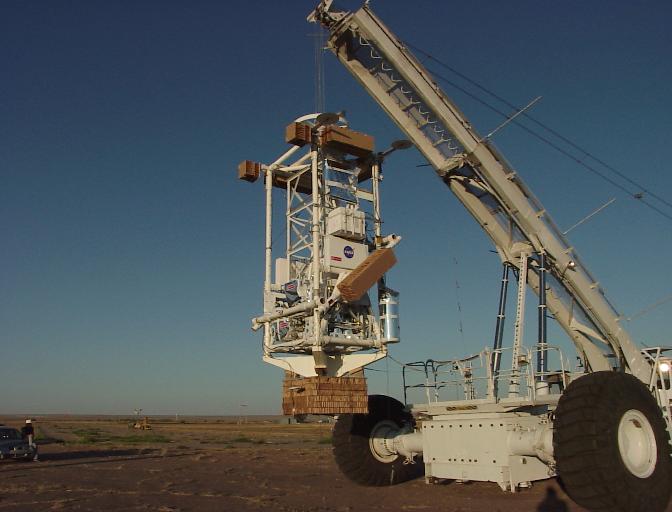
To exploit the full potential of the HERO optics necessitates a balloon gondola that can provide commensurate pointing accuracy, stability, and pointing knowledge. The HERO gondola utilizes a coarse aspect system for slewing based on a differential global positioning system (GPS) and a fine inertial-mode pointing system that uses a novel day/night aspect camera system to update onboard gyroscopes. The total payload dimensions are 25 feet long, 6.5 ft wide and 16 ft high.
Details of the balloon flight
Balloon launched on: 9/19/2000 at 13:55 utc
Launch site: Scientific Flight Balloon Facility, Fort Sumner, (NM), US
Balloon launched by: National Scientific Balloon Facility (NSBF)
Balloon manufacturer/size/composition: Zero Pressure Balloon Raven - 39.570.000 cu ft - 0.8 Mil. - SF3-459.37-080-NSXHR-ST
Balloon serial number: W39.57-2-18
Flight identification number: 489N
End of flight (L for landing time, W for last contact, otherwise termination time): 9/20/2000 at 20:35 utc
Balloon flight duration (F: time at float only, otherwise total flight time in d:days / h:hours or m:minutes - ): 30 h 40 m
Landing site: 10 miles E of Naturita, Colorado, US
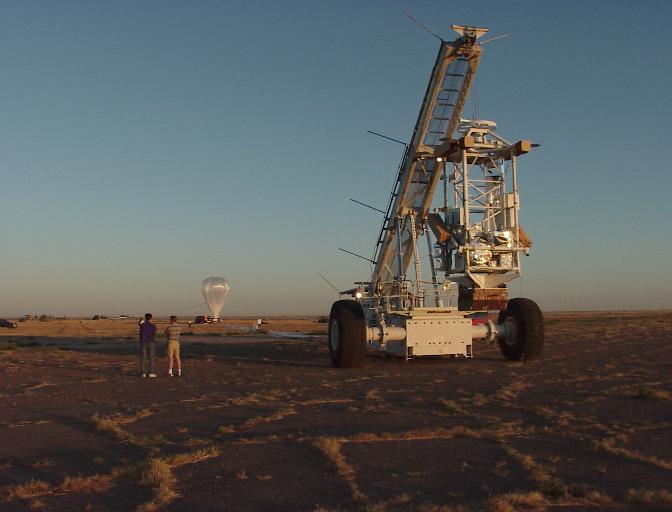
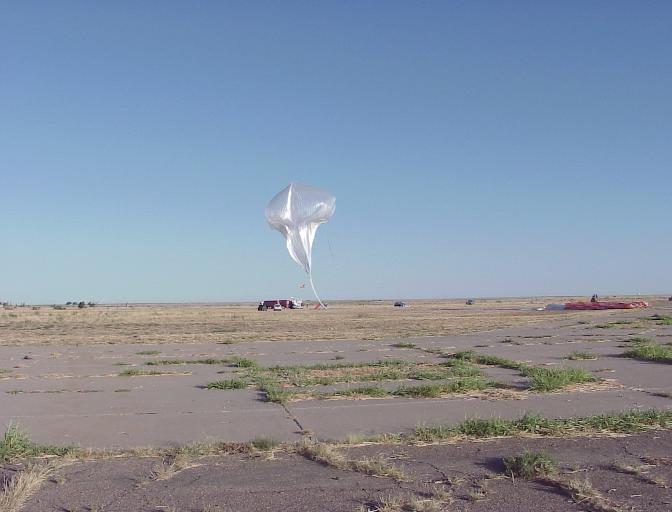
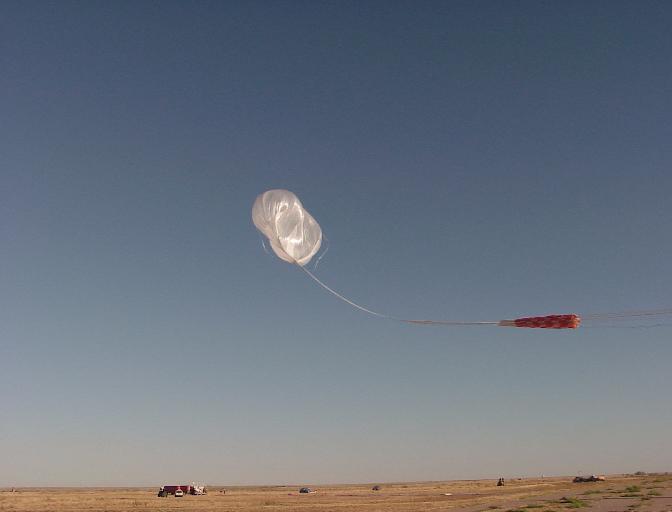
The balloon was launched using the dynamic method with assistance of the Big Bill launch vehicle at 13:55 utc on September 19, 2000. After a nominal climb the balloon reached flaot altitude of 126.000 ft about 17:00 utc.
After more than 30 hours aloft the mission was terminated on September 19, 2000. The payload landed 10 miles E of Naturita, Colorado.
This was the first engineering flight of a basic version of the instrument consisting of a small 3-m-focal-length optical system consisting of a pair of mirror modules, each containing three nested nickel mirrors and as focal plane detectors, a pair of gas scintillation proportional counters.
On this mission were observed the Cygnus X-1 region and the Crab Nebula region.
External references
- HERO website Marshall Space Flight Center, NASA
- Balloon flight 2000 NASA information
- Construction and Testing of a Pixellated CZT Detector and Shield for a Hard X-ray Astronomy Balloon Flight Proc. SPIE Vol. 4140, p. 237-248, X-Ray and Gamma-Ray Instrumentation for Astronomy XI
- HERO : High-Energy Replicated Optics for a Hard-X-Ray Balloon Payload Proc. SPIE Vol. 4138, p. 147-153, X-Ray Optics, Instruments, and Missions IV
- HERO will provide new view of X-ray universe Science NASA
- The Development of Hard-X-Ray Optics at MSFC Proc. SPIE Vol. 4851, p. 631-638, X-Ray and Gamma-Ray Telescopes and Instruments for Astronomy
- The HERO Program, high-energy replicated optics for a hard-x-ray balloon payload Proc. SPIE Vol. 3765, p. 816-821, EUV, X-Ray, and Gamma-Ray Instrumentation for Astronomy X
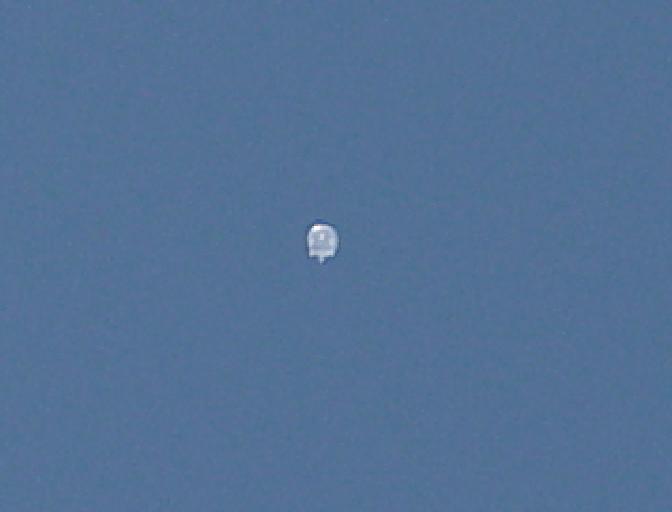
Images of the mission
If you consider this website interesting or useful, you can help me to keep it up and running with a small donation to cover the operational costs. Just the equivalent of the price of a cup of coffee helps a lot.