
Purpose of the flight and payload description
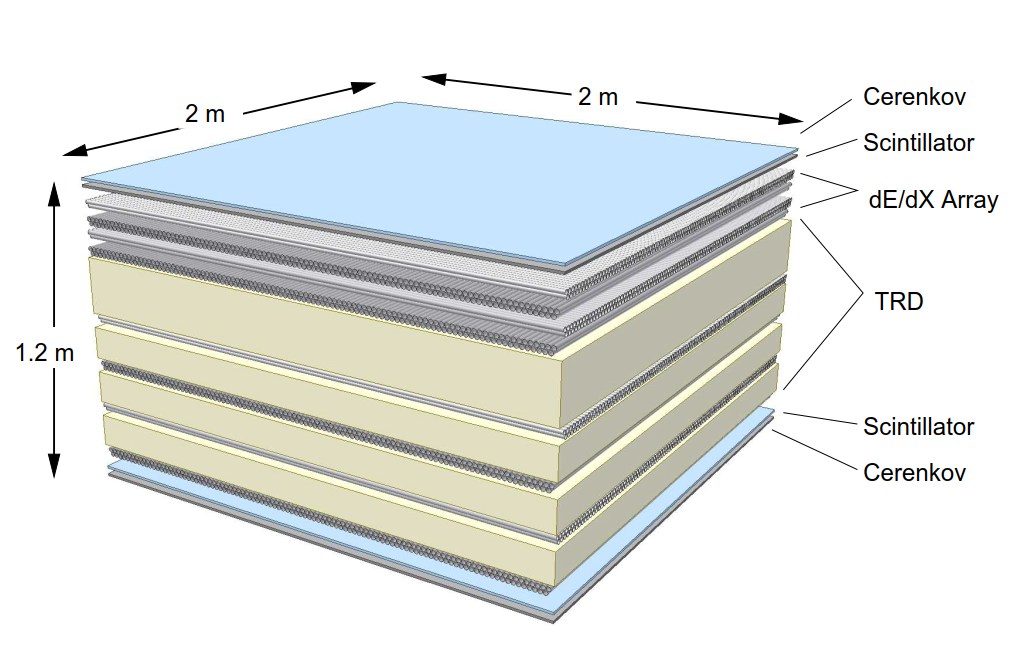
Its a instrument built to measure the intensities of the heavy nuclear species in the cosmic rays up to energies of 10 Tev/nucleon. It measures the nuclear charge, the energy, and the trajectory of the incoming particles through the instrument. The innovative aproach of TRACER is to replace the traditional Multi Wire Proportional Chambers of other detectors by layers of thin-walled single proportional tubes which can easily withstand internal overpressure. This avoid the need of using a heavy pressurized container, saving weight and thus allowing the construction of a larger area detector.
The instrument derives its heritage from the CRN detector developed at the University of Chicago for space flight in the decade of the 80's.
TRACER consists of eight double layers of proportional tubes 2 m long with a diameter of 2 cm made of aluminized mylar, filled with a mixture of xenon and methane. These are mounted in 16 sub assemblies ("manifolds"), each containing a double layer of 99 tubes oriented alternately in two orthogonal directions.
This configuration forms an 2 x 2 square meters array of proportional tubes with 16 layers and 1584 proportional tubes in total allowing to determine the particle trajectory and at the same time to correct the data pathlength variations. Printed circuit boards inside the manifolds provide high voltage for the proportional tubes and allow a capacitive read-out of the signal wires. Eight layers of tubes serve to measure ionization losses of high energy particles. The next eight layers, installed below blankets of plastic fiber material acts as a radiator to generate transition radiation. The wire signals of the proportional tubes are read with a low power AMPLEX integrated circuit. The preamplifiers are installed inside aluminum housings directly at the manifolds in order to reduce electronic noise.
Two scintillators are placed on top and bottom of the detector stack, respectively acting as instrument trigger, and measuring the specific ionization, to determine the particle's charge. Additionally a Cherenkov counter made of acrylic plastic at the bottom of the detector is used to reject non-relativistic particles. The plastic scintillators are 1 cm thick, and are read out via wavelength shifter bars with 12 photomultiplier tubes while the Cerenkov signals are measured by 24 photo multiplier tubes.
Heart of the TRACER electronics is an Intel 486 CPU inside a VME-crate. The crate is installed together with the hard drives for flight data recording, a main electronics crate as well as the high voltage supplies for the proportional tubes and the photomultiplier tubes inside a pressurized sphere. All other electronic components like the valves for the gas system and the main amplifiers and analog to digital converters for the proportional tubes and the photomultiplier tubes are mounted on the instrument frame without a pressurized shell.
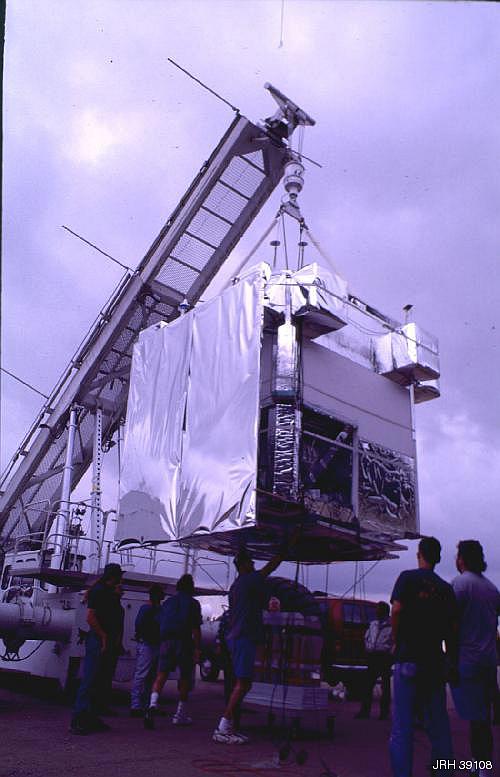
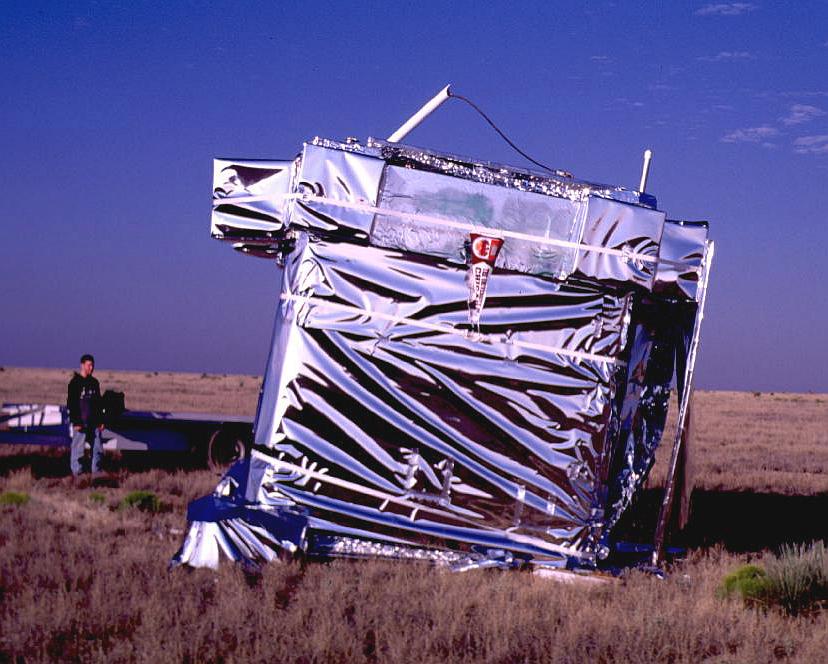
The whole detector is mounted inside a 2.5 x 2.5 x 3 square meters aluminum structure without a surrounding pressurized shell. The outer skin of the instrument is a 10 cm foam layer covered with aluminized mylar acting as thermal insulation.
Details of the balloon flight
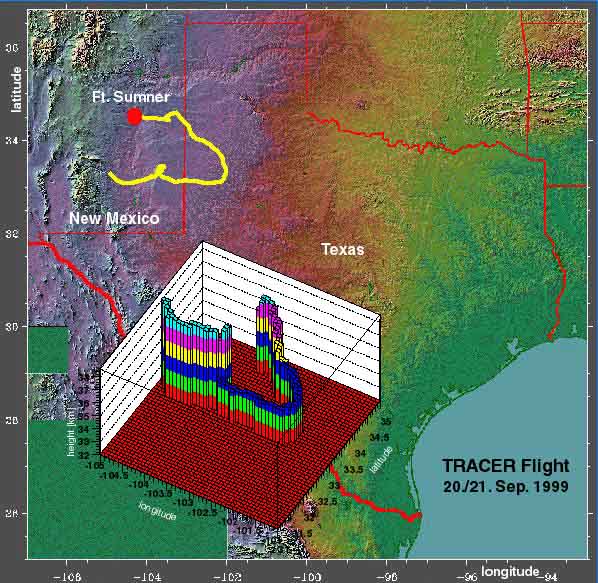
Balloon launched on: 9/20/1999 at 16:36 utc
Launch site: Scientific Flight Balloon Facility, Fort Sumner, (NM), US
Balloon launched by: National Scientific Balloon Facility (NSBF)
Balloon manufacturer/size/composition: Zero Pressure Balloon Raven W 39.570.000 cuft - (0.8 mil) - SF3-39.57-.8/.8/.8/.8-NHR
Balloon serial number: W39.57-319
Flight identification number: 471N
End of flight (L for landing time, W for last contact, otherwise termination time): 9/22/1999 at 22:58 utc
Balloon flight duration (F: time at float only, otherwise total flight time in d:days / h:hours or m:minutes - ): 31 h 50 m
Landing site: 16 miles S of Roswell, New Mexico, US
Payload weight: 4042 lbs
Overall weight: 12328 lbs
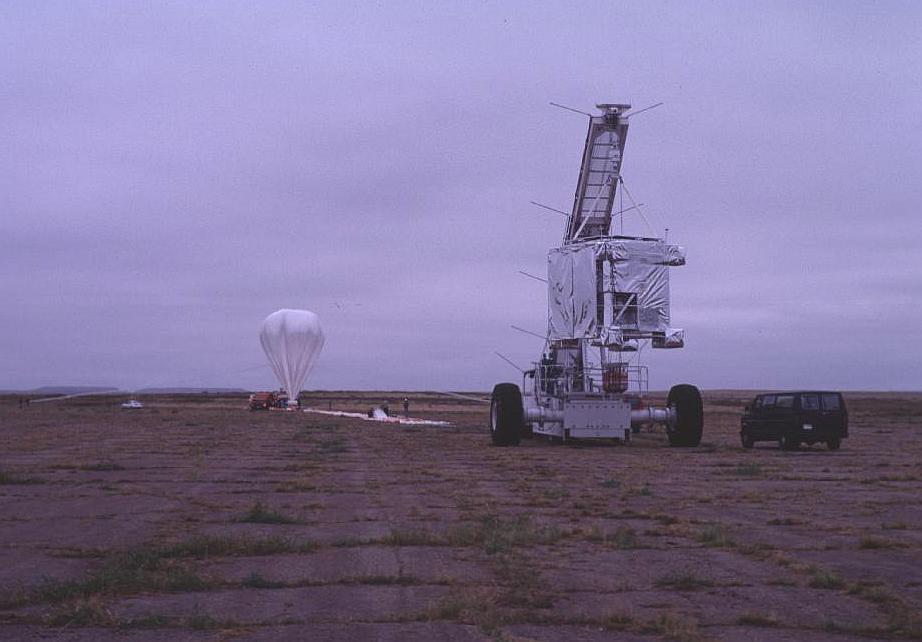
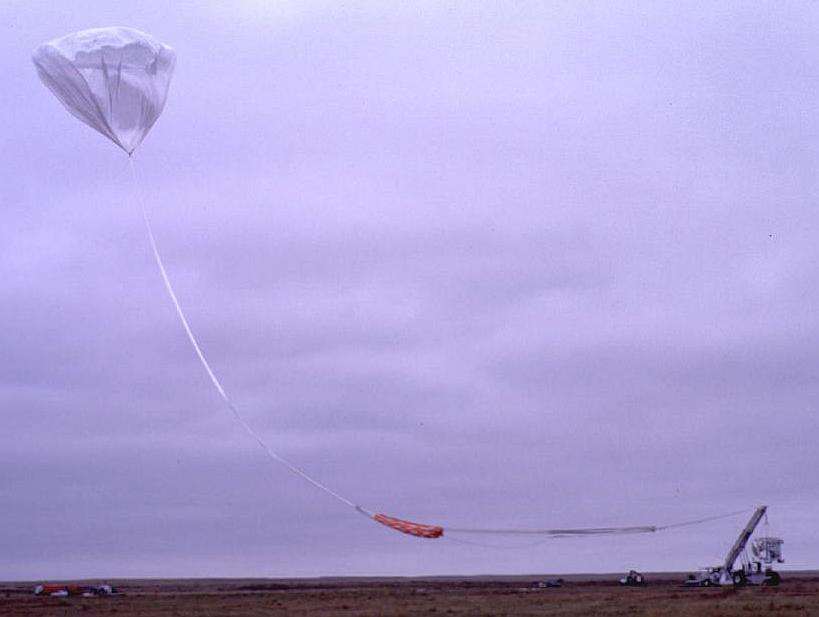
The launch (by dynamic method using launch vehicle) was complished at 16:36 utc. on September 20th.
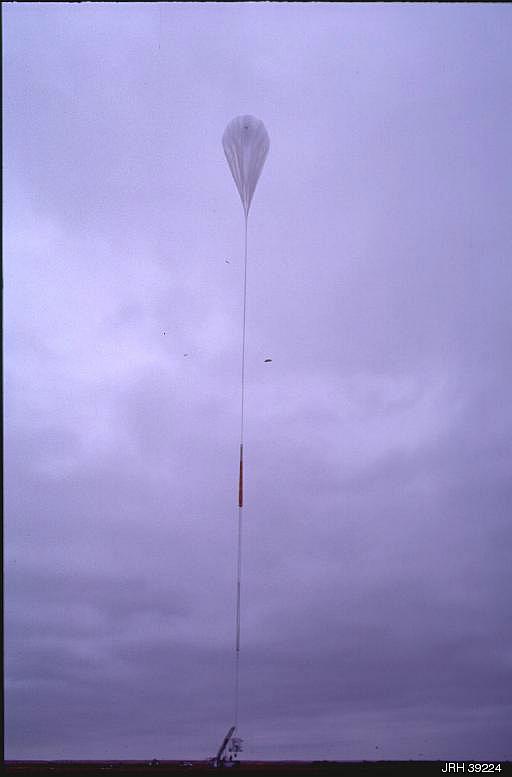
After a nominal ascent phase at an average speed of 833 fpm, the balloon achieved float altitude of 121.000 feet, and then started a flight path heading east (click in the map at left to see the balloon flight path).
At the middle of the flight the balloon course changed slightly to the southeast and fliyng over west Texas. Then the final course was due west entering again to New Mexico by the south.
Finally, after near 32 hours of flight, the balloon was terminated when the cutdown command was sent.
The payload touched ground 13 nm Northwest of Artesia NM, without damage, being recovered by the NSBF team on september 23th.
This was TRACER's first flight as a previous step before planned long duration balloon flights.
During this test the instrument design worked well allowing the measurement of the intensities of heavy cosmic ray nuclei like Oxygen, Magnesium, Silicon & Iron up to 1 TeV/nucleon.
The results from the flight are consistent with previous measurements made by CRN in an energy regime with few comparable measurements.
External references
- TRACER website University of Chicago
- A New Detector for Measurments of the Composition of Heavy Cosmic Ray Nuclei beyond TeV-Energies 26th International Cosmic Ray Conference 2005, Salt Lake City, Utah
- A new Measurement of the Energy Spectra of Cosmic Ray Nuclei 27th International Cosmic Ray Conference. 07-15 August, 2001. Hamburg, Germany
- A New Measurment of the Intensities of the Heavy Primary Cosmic Ray Nuclei Around 1TeV The Astrophysical Journal, Volume 607, Issue 1, pp. 333-341
- Cosmic Ray Nuclei at High Energies: Recent Results from TRACER and Future Prospects 27th International Cosmic Ray Conference 2005, Hamburg, Germany
- Energy Spectra and Relative Abundances of Heavy Cosmic-Ray Nuclei around 1 TeV/Nucleon 28th International Cosmic Ray Conference. July 31-August 7, 2003. Trukuba, Japan.
- Large Area Transition Radiation Detectors for Cosmic Ray Observations in Space 27th International Cosmic Ray Conference 2005, Hamburg, Germany
- Propagation and Source Energy Spectra of Cosmic-Ray Nuclei at High Energies Submitted to Astrophysical Journal
- The Elemental Composition of High-Energy Cosmic Rays: Measurements with TRACER MPLA, Volume 23, Issue 25, Pages 2031-2045 (2008)
Images of the mission
If you consider this website interesting or useful, you can help me to keep it up and running with a small donation to cover the operational costs. Just the equivalent of the price of a cup of coffee helps a lot.