
Purpose of the flight and payload description
The High Energy X-ray Imaging Spectrometer (HEXIS) program is developing position sensitive Cadmium Zinc Telluride (CZT) X-Ray detectors for use in X-ray astronomy and mission concepts for both balloon and satellite based telescopes.
In a balloon based version of HEXIS, the scientific objectives are to study hot plasmas, non-thermal and accelerated particles, and nuclear and electromagnetic processes in the hard X-ray regime (20-200keV). These processes occur in astrophysical source regions characterized by compact objects, high magnetic fields, high gravitational potentials and general relativistic phenomena. Such sources are known to occur in X-ray pulsars, black hole candidates, active galactic nuclei (AGN) and regions emitting nucleosynthetic gamma rays. CZT detectors are capable of very fine position resolution, to detect this sources.
Details of the balloon flight

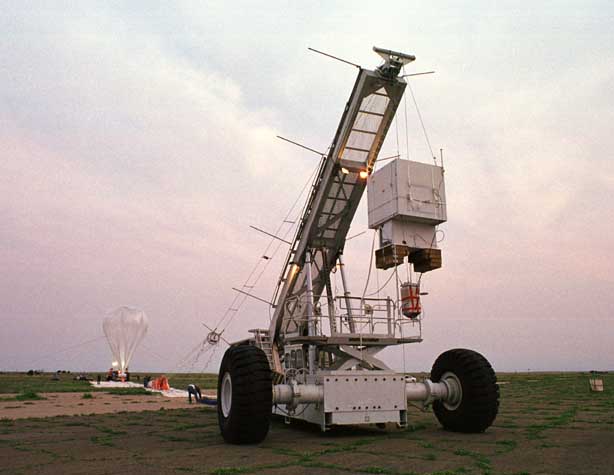
Balloon launched on: 5/21/1998 at 12:34:13
Launch site: Scientific Flight Balloon Facility, Fort Sumner, (NM), US
Balloon launched by: National Scientific Balloon Facility (NSBF)
Balloon manufacturer/size/composition: Zero Pressure Balloon 4.000.000 cuft - SF3-4.001-.8/.8/-NA
Balloon serial number: R 4.00-1-13
Flight identification number: 450N
End of flight (L for landing time, W for last contact, otherwise termination time): 5/22/1998 at 12:55 utc
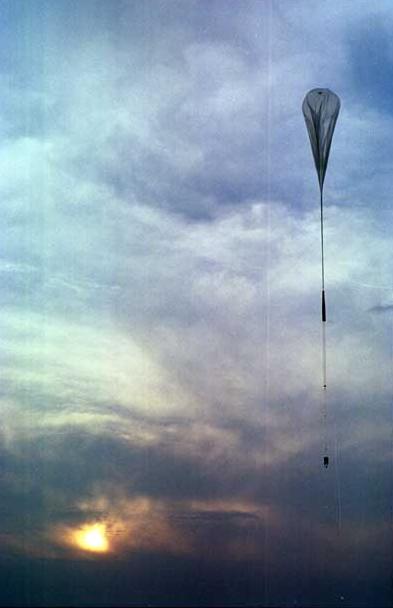
Balloon flight duration (F: time at float only, otherwise total flight time in d:days / h:hours or m:minutes - ): 22 h
Landing site: 15 miles SE of Claude, Texas, US
Normal launch. Normal Flight
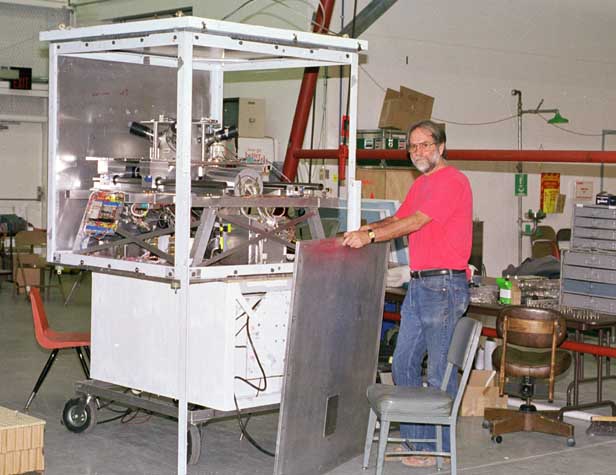
As part of the program development, this was the second balloon flight and the first with a long duration flight at float. The primary goal was to test various active and passive shielding configurations. The same cross strip and planar CZT detectors used on the October flight were flown on this flight. The readout electronics were also the same with the exception of a more distant location of the preamps relative to the CZT detectors, about 50 cm. The shielding, however, was different. This time the pressure vessel was surrounded by an annulus of CsI and had a second CsI crystal under it as a rear active shield. A NaI collimator over the detectors provided a 20° field of view to the two detectors.
This flight also had a calibration source of 241Am that could be commanded in or out of the field of view of the two CZT detectors, occurring nine times throughout the flight.
This series of balloon flights had significantly improved the understanding of the background properties of CZT, including background rejection techniques based on the physics of CZT detectors. Shielding effects are being extensively studied with this unique data set comprising seven different shielding configurations using the same two detectors and readout systems. These data will contribute great insight into optimal shielding for the next generation hard X-ray instruments.
External references
- Background Studies of a Position Sensitive CdZnTe X-ray Detector at Balloon Altitudes 26th International Cosmic Ray Conference. August 17-25, 1999. Salt Lake City, Utah, USA.
- High altitude balloon flight of CdZnTe detectors for high energy X-ray astronomy Proc. SPIE, 3445, p. 169-183, 1998.
- High altitude balloon flight of CdZnTe detectors for high energy X-ray astronomy Part II Proc. SPIE, 3765, pgs. 397-406, 1999.
- Laboratory testing of the HEXIS hard x-ray imager balloon telescope Proc. SPIE 6266, Space Telescopes and Instrumentation II: Ultraviolet to Gamma Ray, 626628 (June 13, 2006)
- NASA Balloon Flights (19891998) in NASA Historical Data Book, Vol. VII: NASA Launch Systems, Space Transportation, Human Spaceflight, and Space Science, 1989-1998
Images of the mission
If you consider this website interesting or useful, you can help me to keep it up and running with a small donation to cover the operational costs. Just the equivalent of the price of a cup of coffee helps a lot.