
Purpose of the flight and payload description
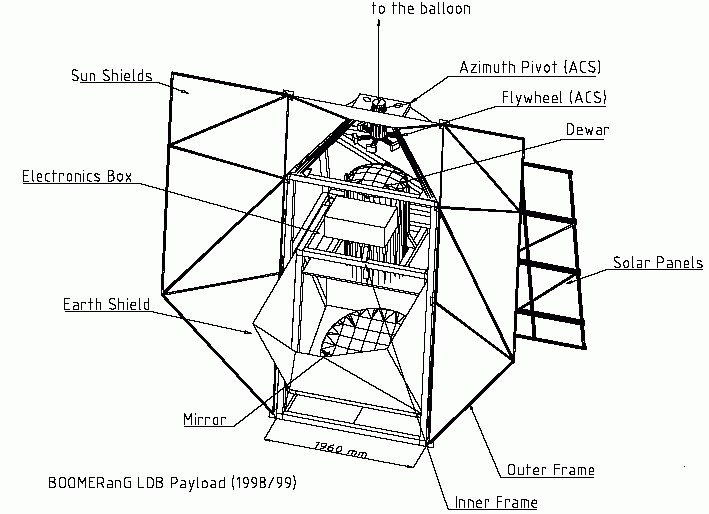
This telescope is the culmination of a great cooperative effort between Italian and American teams. It was designed to have the angular resolution and sensitivity necessary to measure the angular power spectrum of anisotropy in the cosmic microwave background at sub-degree scales, a region where there is a wealth of cosmological information.
The telescope consists of a 1.3m off-axis paraboloidal mirror feeding a pair of cold (1.5 K) ellipsoidal mirrors which reimage the prime focus onto an array of feed horns. These concentrate the incoming radiation onto bolometric detectors, cooled to 0.3 Kelvin by a helium refrigerator.
The pointing system consists of a pair of flywheels which torque the telescope against the flight train of the balloon. The rotation rate is adjusted via feedback from rate gyroscopes, a magnetometer, and tilt sensors. The telescope is fully pointable in azimuth, and can tip between 35 and 55 degrees in elevation. An on-board optical star-tracking camera allows accurate post-flight reconstruction of pointing.
Details of the balloon flight
Balloon launched on: 8/29/1997 at 19:25 cst
Launch site: National Scientific Balloon Facility (NSBF), Palestine, Texas, US
Balloon launched by: National Scientific Balloon Facility (NSBF)
Balloon manufacturer/size/composition: Zero Pressure Balloon Raven 28X - 800.000 m3 - SF3-29.47-.8/.8/.8-NA
Balloon serial number: W29.47-2X-28
Flight identification number: 1559P
End of flight (L for landing time, W for last contact, otherwise termination time): 8/30/1997 at 4:54 cst
Balloon flight duration (F: time at float only, otherwise total flight time in d:days / h:hours or m:minutes - ): F 5 h 56 m
Landing site: 18 miles SSE of Fort Stockton, Texas, US
Payload weight: 4517 lbs
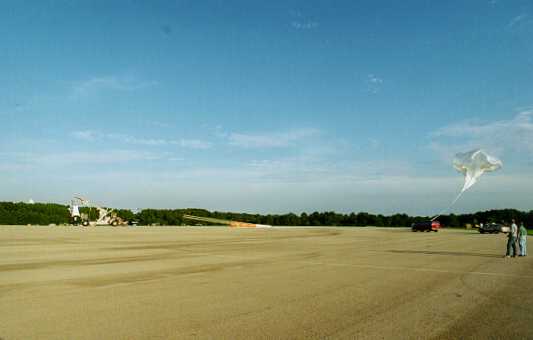
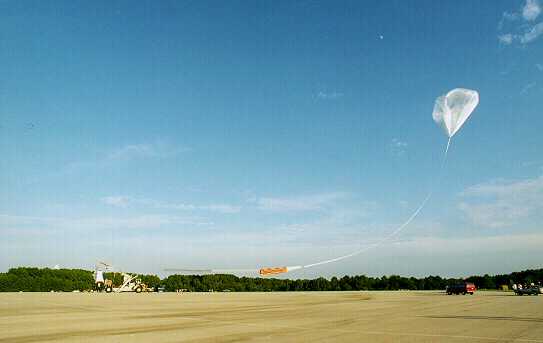
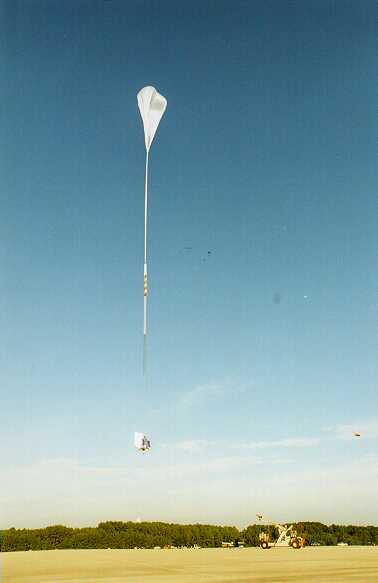
The balloon was launched by dynamic method, around 7:30 local time on August 29, after which the balloon took two and a half hours to reach its float altitude of 38.5 km when it started to flight to the west.
After a flight of 5 hours and before the package moves out of telemetry range of the base, was decided to terminate it. The payload landed safely near Fort Stockton, Texas.
This flight was the second try after a failed flight on August 12.
This test flight -in preparation for a Antarctic long duration flight- proved the robustness of the pointing and data acquisition systems, the feasibility of the scan strategy, and the performance of the cryogenic systems at float altitude, as well as yielding important scientific data.
External references
- BOOMERANG web site (Italy) University of Rome "La Sapienza"
- BOOMERANG web site (USA) Caltech Observational Cosmology Group
- A measurement of Omega from the North American test flight of BOOMERANG Ap. J. Letters, 536, L63, (2000).
- BOOMERANG: A Balloon-borne Millimeter-Wave Telescope and Total Power Receiver for Mapping Anisotropy in the Cosmic Microwave Background The Astrophysical Journal Supplement Series, Volume 148, Number 2
- Mapping the CMB sky: The Boomerang Experiment New Astronomy Reviews, 43, 289, 1999
- Measurement of a Peak in the Cosmic Microwave Background Power Spectrum from the Test Flight of Boomerang Astrophys.J. 536 (2000) L59-L62
- NASA Balloon Flights (19891998) in NASA Historical Data Book, Vol. VII: NASA Launch Systems, Space Transportation, Human Spaceflight, and Space Science, 1989-1998
- The BOOMERANG experiment Space Sci Rev (1995) 74: 145.
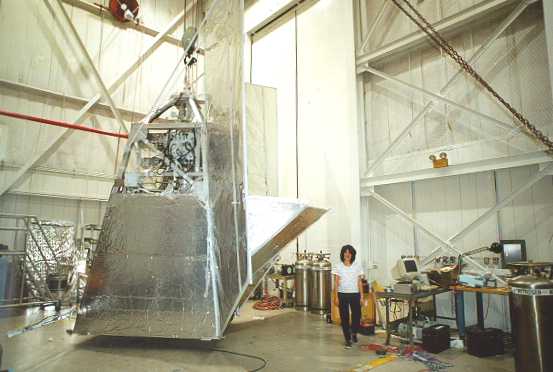
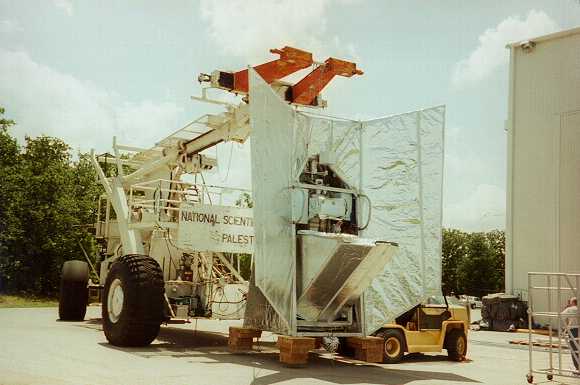
Images of the mission
If you consider this website interesting or useful, you can help me to keep it up and running with a small donation to cover the operational costs. Just the equivalent of the price of a cup of coffee helps a lot.