
Purpose of the flight and payload description
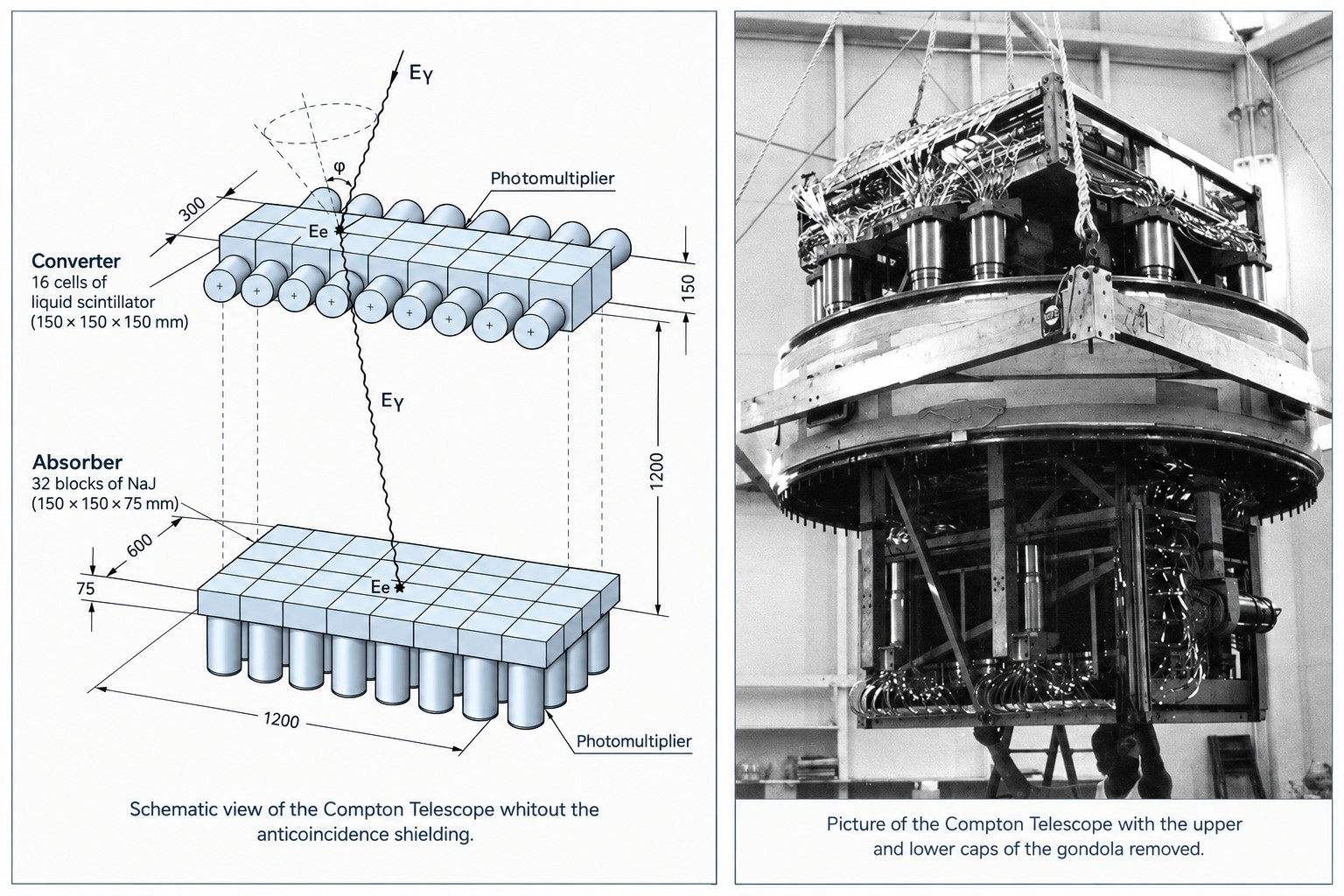
The Large Compton Telescope was developed at the Max-Planck-Institut für Physik und Astrophysik from Germany, to perform astronomical observations of gamma rays in the approximately 1~20 MeV energy range. The instrument consisted of two large, area-scintillation detectors arranged in an upper and a lower plane, separated by 1.20 m. The upper detector was constructed from liquid scintillator NE 213, while the lower detector used NaI(Tl) scintillator. The arrangement was designed to identify gamma rays through successive interactions in the two detector planes, measuring the energy deposited in each interaction and the time of flight between them. These measurements were used to determine the direction of incident gamma rays and to discriminate against background events.
In the scheme at left we can see a view of the Compton Telescope whitout the anticoincidence shielding (click for more details)
The upper detector consisted of 16 liquid-scintillator cells, each measuring 15 × 15 × 15 cm³. Each cell was viewed by one RCA 8854 photomultiplier tube, and the outer cell walls were made of 2 mm-thick aluminium. The lower detector consisted of 32 NaI(Tl) blocks, each measuring 15 × 15 × 7.7 cm³. Each block was viewed from below by one RCA 4522 photomultiplier tube. Both detector assemblies were completely surrounded by plastic-scintillator anticoincidence shields made from NE 110 material and 8 mm thick. Light from the photomultiplier tubes was transmitted through plexiglas light guides. For inflight calibration, two radioactive cobalt-60 sources were positioned between the detectors, outside the beam of scattered gamma rays. Each source was enclosed in a plastic-scintillator detector and viewed by an RCA 4516 photomultiplier tube.
During normal operation, an event was accepted when a delayed coincidence occurred between the upper and lower detectors, with no signals from the anticoincidence shields. The instrument recorded the energy deposited in the upper detector, the location of the interaction, the upper-detector scintillation pulse shape, the energy deposited in the lower detector, the lower-detector interaction location, the time of flight of the scattered gamma ray, and the event time measured by an onboard quartz clock. The upper-detector trigger threshold was 50 keV, with a measurement accuracy of 3.3 keV per channel below 1.5 MeV and 36.5 keV per channel above 1.5 MeV. The lower-detector trigger threshold was 600 keV, with corresponding measurement accuracies of 7 keV and 61.1 keV per channel below and above 1.5 MeV, respectively. The time-of-flight measurement had an accuracy of 0.5 ns per channel.
The telescope employed time-of-flight discrimination to distinguish upward-scattered background events from downward-scattered gamma rays, pulse-shape discrimination in the upper detector to reject neutron-induced events, and restrictions on the Compton scattering angle to reduce incorrectly reconstructed events. The standard scattering-angle restriction was energy-dependent, with accepted angles limited to 3°~30° for the specified energy ranges. The telescope achieved an angular resolution of approximately 3.6° for 1.275 MeV gamma rays from a sodium-24 source at a distance of 750 cm. Its effective detection area depended on gamma-ray energy and event-selection criteria, reaching approximately 75 cm² for vertical incidence in the 610 MeV interval before the additional time-of-flight and pulse-shape discrimination reductions.
During flight its axis was maintained toward the zenith by the balloon suspension system. The telescopes angular orientation was measured using two magnetometers, and the onboard time was compared with absolute ground time using a synchronized ground-based rubidium oscillator. Flight data were telemetered to the ground station and recorded on magnetic tape for subsequent analysis.
Details of the balloon flight
Balloon launched on: 5/13/1979
Launch site: National Scientific Balloon Facility (NSBF), Palestine, Texas, US
Balloon launched by: National Scientific Balloon Facility (NSBF)
Balloon manufacturer/size/composition: Zero Pressure Balloon Winzen 971.551 m3 (17.78 Microns - Stratofilm)
Flight identification number: 1137P
End of flight (L for landing time, W for last contact, otherwise termination time): 5/??/1979
Balloon flight duration (F: time at float only, otherwise total flight time in d:days / h:hours or m:minutes - ): F 19 h
Payload weight: 2183 kgs.
External references
- Gamma-ray emission from the galactic anticenter at MeV energies Astrophysical Journal, Part 1, vol. 263, Dec. 15, 1982, p. 677-689
- MeV to TeV gamma-ray observations of PSR 1957 + 20 Astrophysical Journal, Part 2 - Letters, vol. 364, Dec. 1, 1990, p. L37-L40
- National Scientific Balloon Facility Annual Report FY 1979 National Center for Atmospheric Research, September 1980
- Properties and performance of the MPI balloon borne Compton telescope Astronomy and Astrophysics, vol. 110, no. 1, June 1982, p. 138-151
- Search for MeV Gamma-Radiation from CYG X-1 21st International Cosmic Ray Conference. Volume 1, p.200
- Search for pulsed gamma-ray emission at MeV energies from 24 radio pulsars Astrophysical Journal, Part 1, vol. 273, Oct. 15, 1983, p. 681-687
StratoCat is an independent, non-commercial project maintained to preserve and share the history of scientific and stratospheric ballooning. If you find the site useful, you can help keep it running with a small donation toward its operating costs. Every contribution, even the equivalent of a cup of coffee, is greatly appreciated.