
 INDOEX (Project)
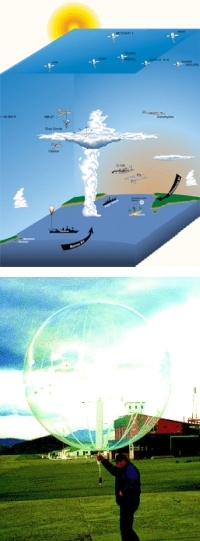
The Indian Ocean Experiment or INDOEX was a major international atmospheric research programme conducted between 1996 and 1999 to investigate the transport of aerosols and trace gases from South Asia over the Indian Ocean and to quantify their effects on regional and global climate. The Intensive Field Phase, carried out from January to March 1999, brought together research institutions from India, the United States, several European countries, and the island nations of the Maldives and Mauritius. Observations were obtained from ground stations, research vessels, aircraft, satellites and long-duration balloons, providing one of the first comprehensive datasets on aerosol transport and radiative forcing over the tropical Indian Ocean.
A significant component of INDOEX was the Indo-French constant-altitude balloon programme conducted from Goa by the Indian Space Research Organisation (ISRO) in collaboration with the French Laboratory for Dynamic Meteorology (LMD/CNRS). The balloon campaign followed successful preliminary flights during the 1998 field phase and was specifically designed to investigate the movement of continental air masses carrying aerosols and trace gases from the Indian subcontinent toward the Intertropical Convergence Zone (ITCZ) under the northeast winter monsoon circulation.
Between 16 January and 28 February 1999, seventeen super-pressure balloons were launched from Goa, fifteen of which successfully returned scientific data. The balloons consisted of transparent Mylar envelopes approximately 2.5 m in diameter, inflated with helium and maintained at a nearly constant density level near 900925 hPa by means of internal overpressure. Each carried an autonomous payload incorporating GPS navigation, pressure sensors, thermistors, hygrometers, onboard microprocessors, lithium batteries and an Argos satellite transmitter operating at 401.65 MHz. Position, pressure, temperature and relative humidity were sampled every thirty minutes and transmitted through NOAA satellites, allowing continuous monitoring throughout flights that typically lasted about one week.
Flying as pseudo-Lagrangian tracers, the balloons followed atmospheric motions over the Arabian Sea and the equatorial Indian Ocean, providing direct measurements of boundary-layer transport over distances impossible to achieve with conventional radiosondes. Their trajectories documented the export of polluted continental air masses across the ocean and identified three principal low-level transport pathways originating from the Indian subcontinent, the Arabian Peninsula and eastern Africa. The observations also revealed mesoscale anticyclonic eddies, variations associated with the Madden-Julian Oscillation, and marked contrasts in temperature and humidity between dry continental outflow and the more humid air surrounding the ITCZ.
The balloon observations complemented simultaneous measurements from ships, aircraft, ground stations and satellites, confirming the existence of a vast aerosol haze extending over the northern Indian Ocean during the winter monsoon. The campaign demonstrated the long-range transport of aerosols and trace gases from South Asia and provided valuable information on their influence on atmospheric radiation, regional climate and boundary-layer dynamics.
List of flights of the INDOEX campaign
 Goa
GoaAbout StratoCat
Some Statistics
+ 20 articles from different contributors
+ 16006 balloon launch records already published
+ 16103 balloon launch records in the full database
StratoCat is a non-profit, educational and informative website created, developed and programmed by Luis E. Pacheco. It is based on an idea first conceived by the author in 2001 and is online since September 17th, 2005.
This website is an independent initiative, and thus is not endorsed, supported or have any relationship with any governmental or private agency or company in the balloon field.
Page generated on 18-Jul-2026 - 01:38:18pm  © StratoCat 2005~2026 - All Rights Reserved.