
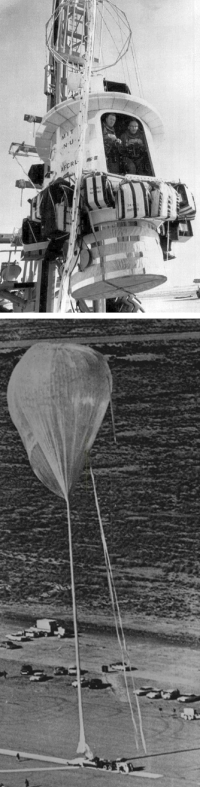
 STAR GAZER (Project)
Project Stargazer was a United States high-altitude manned balloon research program developed to determine the feasibility of conducting astronomical observations from the stratosphere, above most of the Earth's atmosphere. Conceived in 1957 by astronomer Dr. J. Allen Hynek of Northwestern University under the sponsorship of the Air Force Office of Scientific Research and the Smithsonian Astrophysical Observatory, the project sought to bridge the gap between ground-based observatories and space telescopes by placing a stabilized telescope aboard a manned balloon platform. The program was managed by the Air Force Cambridge Research Laboratories (AFCRL), with major contributions from the Massachusetts Institute of Technology (MIT), Wright-Patterson Air Force Base, and the U.S. Naval Ordnance Test Station at China Lake.
The flight system consisted of a sealed aluminum gondola, originally designed for a high-altitude escape research program, measuring approximately 13 feet (4 m) in height and 7 feet (2.1 m) in diameter. The cabin was pressurized to an equivalent altitude of about 22,000 feet, while the crew wore CSU-4/P partial-pressure suits as a precaution against cabin depressurization. Life-support equipment included liquid oxygen and liquid nitrogen converters, and Baralyme was used to remove carbon dioxide and water vapour from the cabin atmosphere. Mounted on top of the gondola was a 12-inch (30.5 cm) Cassegrain reflecting telescope installed on a gyro-stabilized platform developed by MIT. Using two gyroscopes and two star trackers, the system compensated for balloon motion and enabled precise pointing of the telescope. The balloon itself, manufactured by the J.T. Schjeldahl Company, had a volume of 3.2 million cubic feet (about 90,600 m³) and was constructed of Mylar laminated to Dacron scrim. A 100-foot (30.5 m) diameter parachute was suspended between the balloon and gondola to ensure immediate deployment in the event of structural failure.
The only crewed Stargazer mission was launched from Holloman Air Force Base, New Mexico, on 13 December 1962. The crew consisted of Captain Joseph W. Kittinger Jr., serving as pilot and project engineer, and civilian astronomer William C. White of the U.S. Naval Ordnance Test Station, who became the first astronomer to operate a telescope from the edge of space. The balloon reached a maximum altitude of approximately 82,000 feet (25,000 m) and remained aloft for 18 hours 30 minutes. During the flight, White successfully acquired several celestial objects, including Jupiter and the stars Capella, Rigel, Sirius, Betelgeuse and Aldebaran, while the mission also provided valuable data on atmospheric turbulence and demonstrated the practicality of balloon-borne astronomical observations.
Although the telescope stabilization and acquisition system performed successfully, a high-voltage electrical discharge disabled the star tracker and scintillation photometer, limiting the scientific return. Following landing near Lordsburg, New Mexico, strong surface winds reinflated the balloon and dragged the gondola across the desert until Kittinger separated it from the balloon. Despite these difficulties, the mission demonstrated that a manned balloon observatory was technically feasible and provided valuable operational experience in pressure suits, life-support systems and precision astronomical instrumentation.
A second crewed flight was planned for 1963, but launch attempts were unsuccessful because of balloon failures, including the premature firing of explosive separation bolts during one attempt. Budget constraints, technical difficulties and the growing emphasis on satellite-based astronomy and unmanned space missions led to the cancellation of Project Stargazer after only one operational flight. Although short-lived, the program represented the culmination of the United States Air Force's manned scientific balloon projects and demonstrated the potential of stratospheric balloons as stable astronomical platforms, an approach that would later be revived in a variety of unmanned scientific balloon observatories.
List of technical and manned flights of the STAR GAZER program
| Launch base | Date | Flight Duration | Experiment | Payload landing place or cause of the failure |
|---|---|---|---|---|
 Holloman AFB (NM) Holloman AFB (NM) | 3/3/1960 | --- | PROJECT STARGAZER - TEST FLIGHT | 35 miles E of Carlsbad, New Mexico, US |
| Holloman AFB (NM) | 3/9/1960 | --- | PROJECT STARGAZER - TEST FLIGHT | 8 miles E of Tularosa, New Mexico, US |
| Holloman AFB (NM) | 9/8/1960 | 10 m | PROJECT STARGAZER - TEST FLIGHT (MIT Cameras) | Balloon leaker |
| Holloman AFB (NM) | 9/9/1960 | --- | PROJECT STARGAZER - TEST FLIGHT (MIT Cameras) | 1,5 miles NE of Nutt, New Mexico, US |
| Holloman AFB (NM) | 4/14/1961 | --- | PROJECT STARGAZER - TEST FLIGHT | Balloon burst at 45.000 ft |
| Holloman AFB (NM) | 6/16/1961 | --- | PROJECT STARGAZER - TEST FLIGHT | Balloon burst at 41.000 ft |
| Chico (CA) | 3/??/1962 | --- | PROJECT STARGAZER - TEST FLIGHT | Failure during launch |
| Chico (CA) | 3/4/1962 | 2 h | PROJECT STARGAZER - TEST FLIGHT | Balloon failure at 42.000 ft. Payload recovered in Sierra Nevada, California, US |
| Chico (CA) | 3/12/1962 | 25 h 30 m | PROJECT STARGAZER - TEST FLIGHT | 60 miles W of San Francisco, California, US |
| Chico (CA) | 3/18/1962 | --- | PROJECT STARGAZER - TEST FLIGHT | Balloon failure at launch. Mission aborted |
| Chico (CA) | 3/23/1962 | 2 h | PROJECT STARGAZER - TEST FLIGHT | Balloon failure at 65.000 ft. Payload recovered 14 miles NE of Riverton, California, US |
| Holloman AFB (NM) | 10/30/1962 | 36 h | PROJECT STARGAZER - TEST FLIGHT | 90 miles WNW of Laredo, Texas, US |
| Holloman AFB (NM) | 12/13/1962 | 18 h 30 m | PROJECT STARGAZER I (Kittinger - White) | Near Lordsburg, New Mexico, US, USA |
| Holloman AFB (NM) | 3/26/1963 | --- | PROJECT STARGAZER II (Kittinger - White) | Aborted flight. |
| Holloman AFB (NM) | 4/20/1963 | --- | PROJECT STARGAZER II (Kittinger - White) | Aborted flight. |
Related Entries
About StratoCat
Some Statistics
+ 20 articles from different contributors
+ 16006 balloon launch records already published
+ 16103 balloon launch records in the full database
StratoCat is a non-profit, educational and informative website created, developed and programmed by Luis E. Pacheco. It is based on an idea first conceived by the author in 2001 and is online since September 17th, 2005.
This website is an independent initiative, and thus is not endorsed, supported or have any relationship with any governmental or private agency or company in the balloon field.
Page generated on 18-Jul-2026 - 01:38:18pm  © StratoCat 2005~2026 - All Rights Reserved.