
Purpose of the flight and payload description
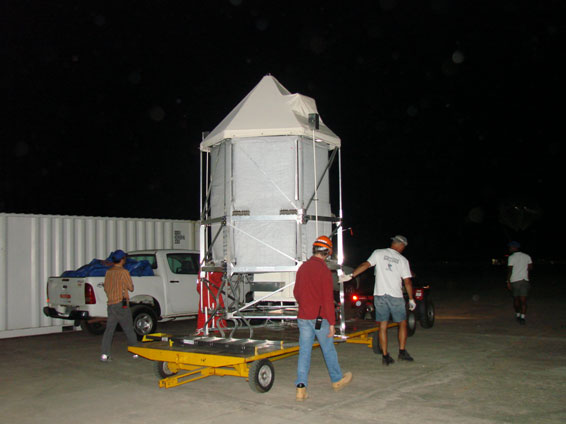
Is a spectrometer with six tunable diode lasers dedicated to in situ measurements of trace compounds in the upper troposphere and the stratosphere up to 35 km altitude.
The 6 laser beams circulate in a multipass HERRIOTT cell located below the gondola. The lower mirror of the two-mirror cell is fixed at the top of a deployable mast. The distance between mirror is about 3.50 m. Given the curvature of the two identical mirrors, two stable optical configuration can be used : first 86 reflections and 300 m optical path, second 156 reflections and 554 m optical path, by moving the lower mirror 5 mm up.
The mast is deployed during the flight to have the first measurements at the tropopause. Around the instrument, a rigid metal frame encompasses it, in order to have a instrument-safe landing.
Inside the instrument, three liquid nitrogen cryostats, hold the six diode lasers and the 12 detectors.
Vertical profiles of concentrations of a great number of species like O3, CH4, CO, CO2, N2O, HNO3, NO2, NO, HCl, HOCl, H2O2, and COF2, are measured with a very high vertical resolution, a high sensitivity and a high precision.
Also was included as piggyback payload an instrument called STAC (Stratospheric and Tropospheric Aerosols Counter) which is a particle counter dedicated to perform in-situ measurements of the aerosol size distributions from the middle troposphere to the middle stratosphere. STAC provides concentration profiles of liquid particles for diameters greater than 0.35 micrometer and of solid particles for diameters greater than 1 micrometer.
Details of the balloon flight
Balloon launched on: 6/9/2008 at 23:10
Launch site: Domingos Rego Aerodrome, Timón, Maranhao, Brazil
Balloon launched by: Centre National d'Etudes Spatiales (CNES)
Balloon manufacturer/size/composition: Zero Pressure Balloon model 150z Zodiac - 150.000 m3
End of flight (L for landing time, W for last contact, otherwise termination time): 6/10/2008 at ~ 3.00
Balloon flight duration (F: time at float only, otherwise total flight time in d:days / h:hours or m:minutes - ): 7 h
Landing site: Near Coivaras, Piauí, Brazil
Campaign: SCOUT 2008
Payload weight: 511 kgs
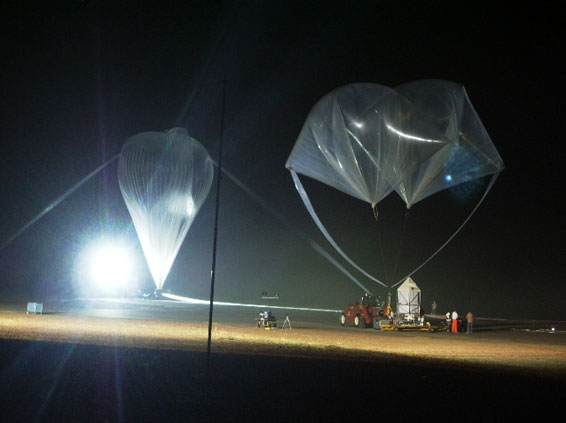
The balloon was launched successfully using dynamic method with help of auxiliary balloon at 23:10 utc (20:10 Local Time) on June 9, 2008.
The balloon remained flying in the launch area during 7 hours, reaching a ceiling of 33.6 km.
After separation the payload was recovered near the city of Coivaras in Piauí state.
During the seven hours flight the SPIRALE instrument obtained simultaneous in situ measurements with high vertical resolution (~5 m) and high sensitivity (~20 pptv) of a large number of chemical species: O3, CO2, CO, OCS, CH4, CH2O, HCl, N2O, NO2, HNO3, and COF2. The aerosol counter (STAC) studied particle size distribution between 0.35 and 2.0 µm.
For this particular SCOUT-O3 tropical balloon campaign, the results will allow characterizing the dynamical structure and chemical composition of the Upper Troposphere, the Tropical Tropopause Layer and the Stratosphere (from 9 km to 34 km height), with the influence of convection systems localized northeast and northwest from Teresina. In order to help in the interpretation of measurements of the balloon flight, modelling based on the operational meso-scale model RAMS of the Centro de Previsão de Tempo e Estudos Climáticos (CPTEC INPE, Sao Paulo, Brazil) will be used. In addition, backward trajectories of the air masses sounded by SPIRALE instrument and chemical mechanism will be coupled to this model.
External references
- SPIRALE website Laboratoire de Physique et Chimie de l'Environnement - Orleans
- Mesures du chlorure dhydrogène (HCl) et du formaldéhyde (H2CO) sous ballon stratosphérique en région intertropicale et interprétations Yassine MEBARKI Thesis, Université dOrléans, 2009
- More evidence for very short-lived substance contribution to stratospheric chlorine inferred from HCl balloon-borne in situ measurements in the tropics Atmos. Chem. Phys., 10, 397-409, 2010
- SCOUT-O3 large balloon experiment at European Ozone Research Coordinating Unit website
Images of the mission
StratoCat is an independent, non-commercial project maintained to preserve and share the history of scientific and stratospheric ballooning. If you find the site useful, you can help keep it running with a small donation toward its operating costs. Every contribution, even the equivalent of a cup of coffee, is greatly appreciated.