
Purpose of the flight and payload description

Cosmic rays are the only sample of matter from distant regions of the galaxy, and possibly elsewhere in the Universe, that can be directly observed by space experiments in the Solar System. This high energy matter consists of atomic nuclei that travel at speeds very close to the speed of light and includes electrons, the natural elements from Hydrogen and Helium to Iron and beyond as well as anti-matter in the form of positrons and anti-protons.
ATIC experiment was designed to measure the energy spectrum of individual cosmic ray elements in order to study the validity of the model that predicts that cosmic rays gain their very high energy as the result of supernova explosion shock waves traveling through interstellar gas. Several goals on regard this objective are for example to obtain energy spectra for individual elements of a broad energy range with a single instrument; to discover 'breaks' or 'bends' in the spectra, to measure the energy dependence of the H/He ratio as well determine the spectral differences between elements and obtain the composition of the cosmic ray matter.
To achieve its scientific objectives, the ATIC experiment must be capable of measuring the incident cosmic ray charge and energy over an energy range of 50 GeV to >100 TeV. A schematic of the instrument, can be seen at left (Click to enlarge).
The instrument is based on the technique of ionization calorimetry, the most practical method of energy determination for cosmic ray nuclei from H to Fe over the target energy range. The fully active ATIC calorimeter is composed of 10 layers of Bismuth Germanate (BGO) scintillating crystals and is located on the bottom of the instrument. Above the calorimeter is the target section consisting of three plastic scintillator strip hodoscopes to define the instrument aperture and provide redundant charge and trajectory measurements, as well as layers of inert carbon (between hodoscopes) to provide a volume for the incident particles to interact.
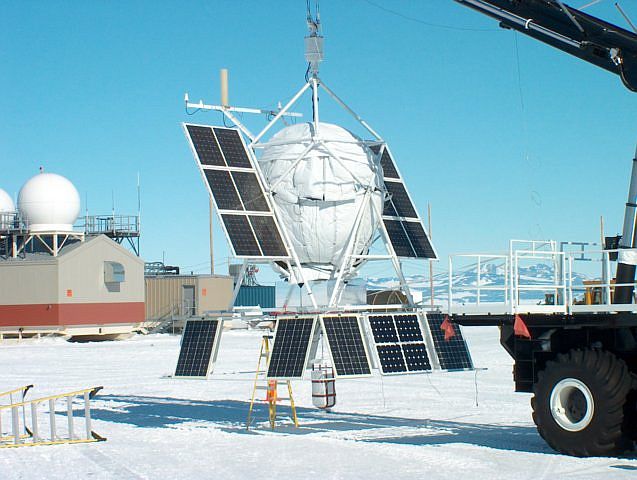
On the top of the detector stack is the highly segmented silicon matrix detector that provides an accurate measure of the incident particle charge even in the presence of shower particles backscattered from the calorimeter. Surrounding the detector stack, electronics bays hold the flight computers, readout electronics, power system boards and other instrument electronics. Finally, on each of the four corners three struts transfer the loads of the experiment through the pressure vessel ring to an external structure that attaches to the balloon.
The total weight of ATIC is about 1,500 kg (3,300 lbs), the total power consumed is less than 350 Watts (including power conversion efficiency), and the payload is designed to be quickly field stripped under Antarctic conditions.
Details of the balloon flight
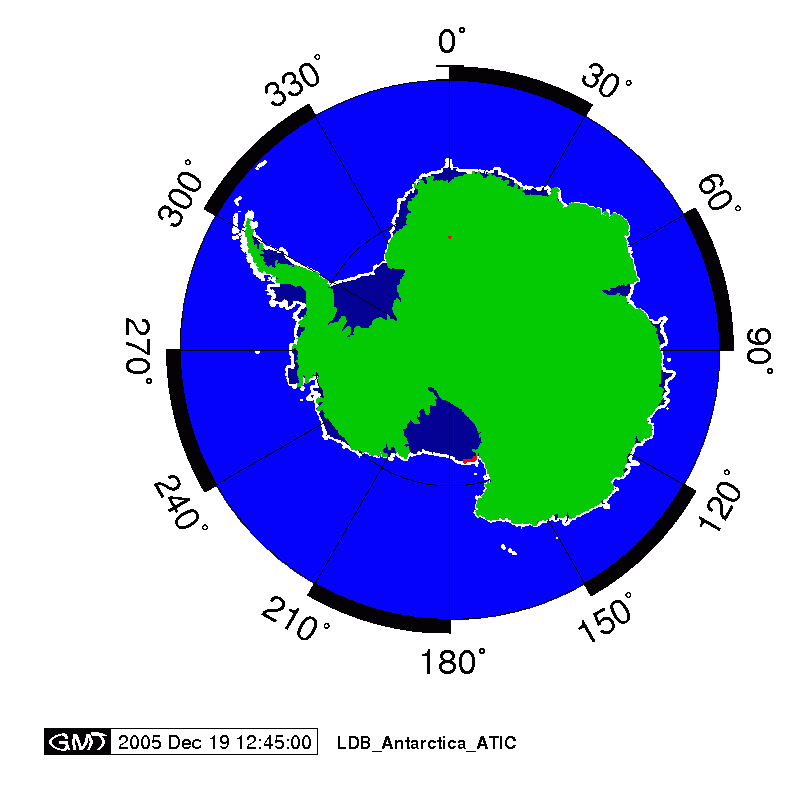
Balloon launched on: 12/19/2005 at 5:18 utc
Launch site: Williams Field, McMurdo Station, Antarctica
Balloon launched by: National Scientific Balloon Facility (NSBF)
Balloon manufacturer/size/composition: Zero Pressure Balloon Winzen - 37.570.000 cuft - (0.8 Mil - Stratofilm 372)
Balloon serial number: W 37.57-2-45
Flight identification number: 553N
End of flight (L for landing time, W for last contact, otherwise termination time): 12/19/2005 at 8:50 utc
Balloon flight duration (F: time at float only, otherwise total flight time in d:days / h:hours or m:minutes - ): 4 h 11 m
Landing site: In the Ross Ice Shelf, 70 nm E of McMurdo Station, Antarctica
Payload weight: 4159 lbs
Overall weight: 5812 lbs
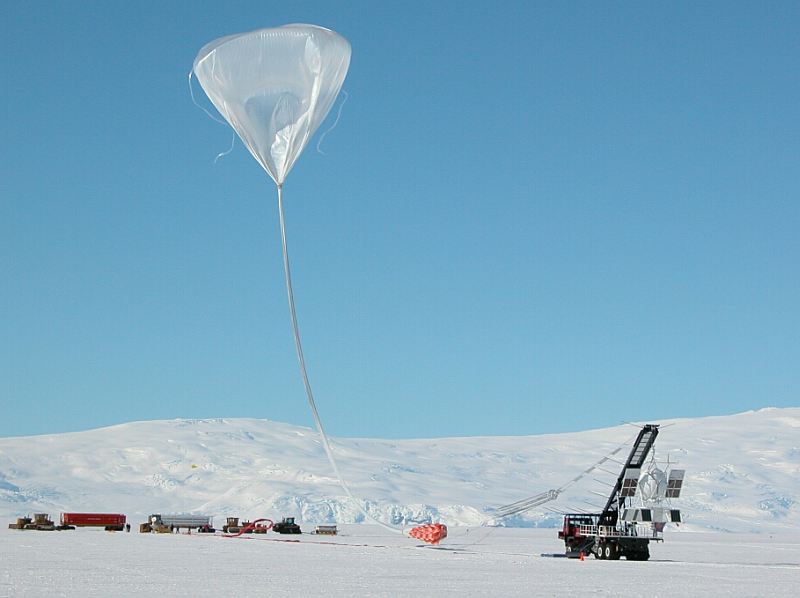
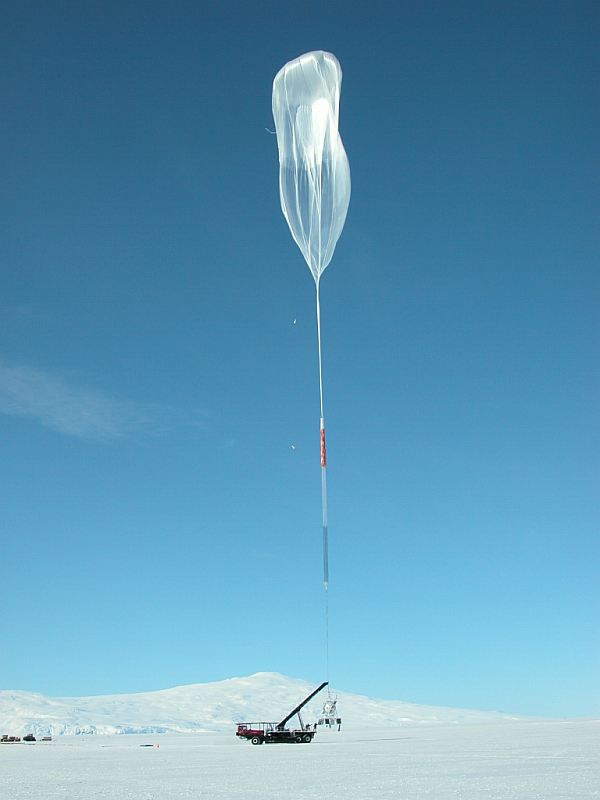
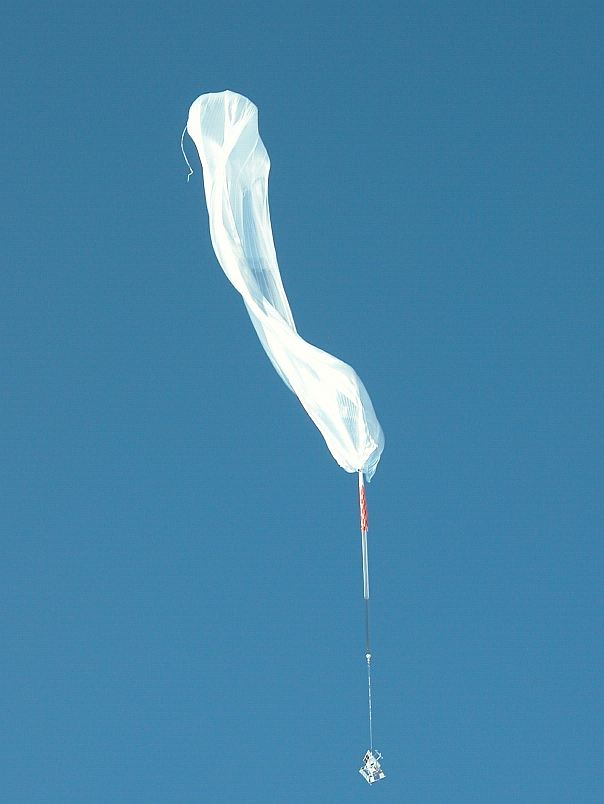
The balloon was launched by dynamic method on December 19th, 2005 at 5:17 UTC under difficult conditions. The balloon appeared to be ingesting air immediately following launch and during the ascent to reach float altitude it stopped ascending at ~80 kft when started an steady descent.
The flight was continued until an unsatisfactory balloon condition was completely confirmed and was terminated using normal line of sight termination procedures at 8:50 utc. The gondola impacted ground 40 minutes later at coordinates 77º 34.8 South / 172º 22.8 East in the Ross Ice Shelf, 70 nm east of McMurdo Station.
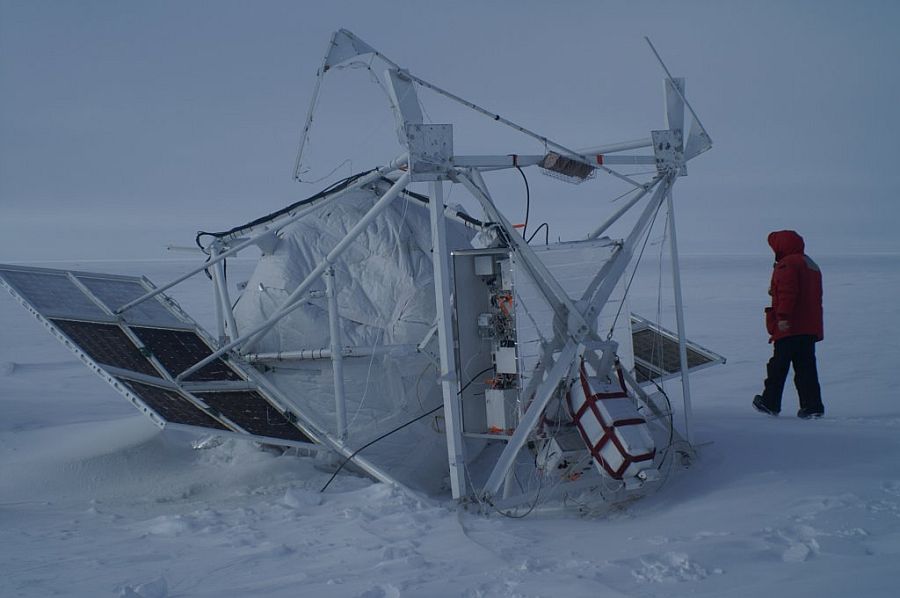
There were indications that the payload would landed safely as the Iridium modem continued to transmit. A Twin Otter plane was sent to the impact zone on December 21. Once there the recovery crew found that the parachute separated successfully, but there was evidence of some wind during impact.
As a result of this, the gondola frame suffered significant damage among which the most important was that the pressure vessel containing the instrument was deflated. After the ATIC team assessed the damage they concluded that they would not be able to attempt an ATIC re-flight during that season.
An investigation was started to try to find the reason of the balloon failure and concluded that the balloon failed during launch immediately after collar release due to severe launch dynamics. When the collar was released, the balloon was in a sailing condition. This caused the reefing sleeve to immediately unzip farther down, exposing more material and causing more sailing, and causing a tear (hole) to develop in the gore material.
The tear was apparently caused by the over stressing of the gore material, either from sailing after collar release, or from the rapid deployment of the tightly folded balloon material.
Additionally during the launch manouver the launch vehicle THE BOSS experimented troubles on regard the terrain. After the payload was launched, the vehicle was utterly stuck, and dozers were required to pull it from the payload release area. The tires had sunk to the wheels and the outriggers were contacting the ground.
Later that season, the instrument was fully recovered, refurbished at Louisiana State University and sent again to Antarctica for a long duration balloon flight in 2007.
In this flight were not obtained scientific results due to balloon failure.
External references
- ATIC website Louisiana State University (no longer available - retrieved via Archive.Org)
- Dark Matter Signals In Cosmic Rays? Memorie della Società Astronomica Italiana, v.81, p.132 (2010)
- Dark matter signals in cosmic rays?. Memorie della Società Astronomica Italiana, v.81, p.132 (2010)
- Data Processing and Event Reconstruction for the ATIC Balloon Payload 26th International Cosmic Ray Conference. August 17-25, 1999. Salt Lake City, Utah, USA
- High energy cosmic rays Journal of Physics: Conference Series, Volume 171, Issue 1, pp. 012012 (2009).
- Neutrino Signals from Annihilating/Decaying Dark Matter in the Light of Recent Measurements of Cosmic Ray Electron/Positron Fluxes Phys.Rev.D79 (2009) 043516
- The Advanced Thin Ionization Calorimeter (ATIC) for Studies of High Energy Cosmic Rays 26th International Cosmic Ray Conference. August 17-25, 1999. Salt Lake City, Utah, USA
Images of the mission
StratoCat is an independent, non-commercial project maintained to preserve and share the history of scientific and stratospheric ballooning. If you find the site useful, you can help keep it running with a small donation toward its operating costs. Every contribution, even the equivalent of a cup of coffee, is greatly appreciated.