
Purpose of the flight and payload description
An experiment designed to perform direct measurements of cosmic ray composition and energy spectra cosmic rays over the elemental range from hydrogen to iron (Z = 1 to 26), through a series of long duration balloon flights. The final goal of this multi-mission experiment is to collect sufficient statistics to test the current models of cosmic ray acceleration and propagation in the Galaxy.
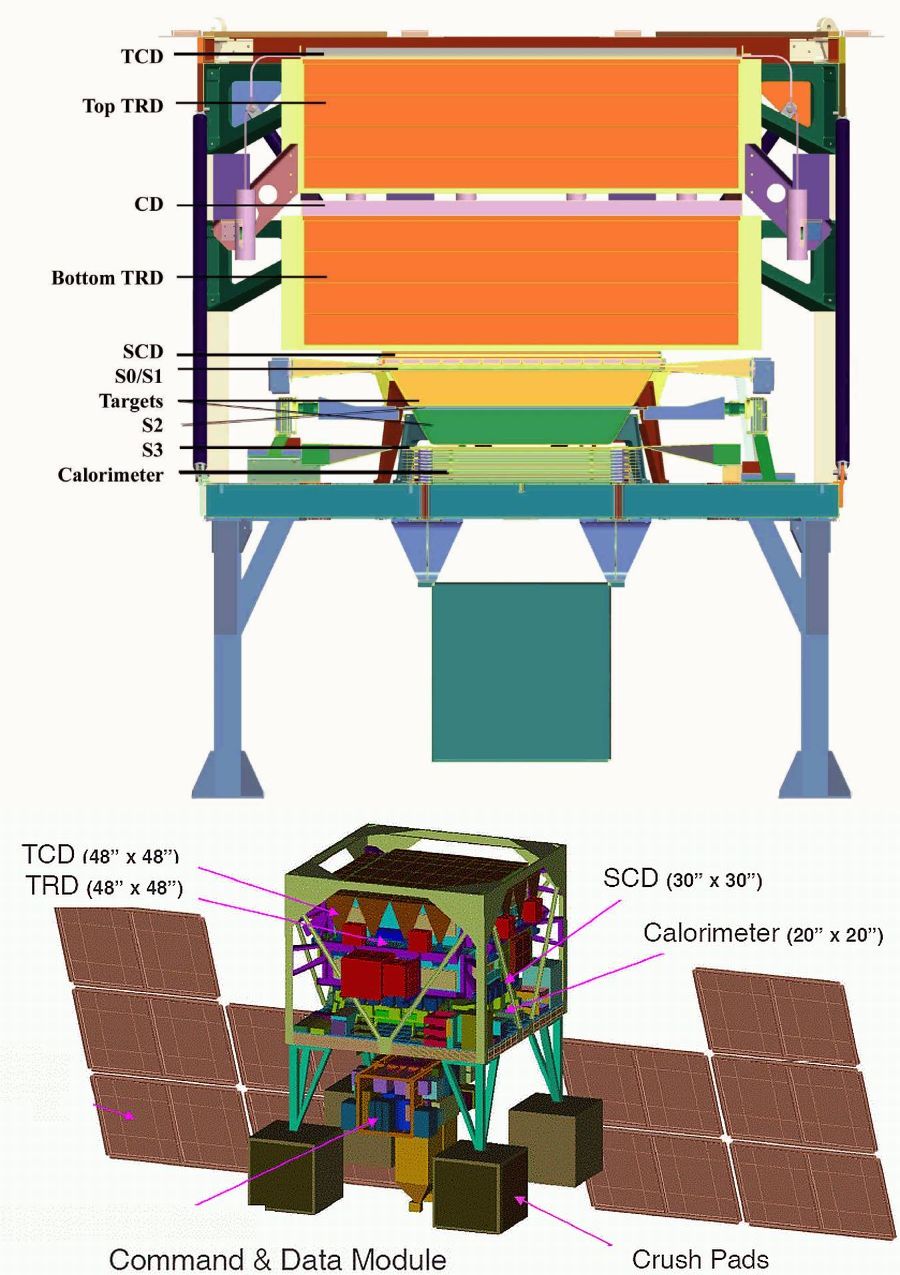
CREAM has a larger effective geometry factor for protons and helium than any previous and current experiments being one of the most complex instruments ever flown in a balloon. Is comprised of several major detector sub-systems as can be seen in the schematic view at left (click to enlarge). Due to the "modular" nature of CREAM (of which two instruments suites were built to be flown on alternate years) it's configuration can be changed from one mission to another.
Following is a summary of the instrument's composition.
At the top of the experiment is located the Timing-based scintillator Charge Detector (TCD) what we would define as the "heart" of the innovative concept behind CREAM.
The most interesting events the instrument measures are those where a high energy nucleus enters through the top, interacts in the target and exits through the bottom of the instrument. In such events a large number of secondary shower particles are back-scattered towards the upper detectors, producing and effect that can interfere severely with accurate charge measurement of the primary nucleus.
The TCD takes advantage of an aspect of such events not previously utilized: their time structure. In CREAM, the arrival of the light signal from a primary nucleus at the TCD photo-multiplier tubes (PMTs) precedes the earliest possible arrival of a light signal from a back-scatter particle by 3 nanoseconds. Thus, using an ultra-fast readout system one can separate the primary signal from back-scatter noise without resorting to high channel counts.
The TCD is comprised of two layers, each with four fast scintillator paddles side by side. The paddles in the two layers are oriented with their long axes perpendicular to each other. Each paddle has an adiabatically shaped light guide glued to each of its two ends made of UVA acrylic to reduce the effects of Cherenkov radiation generated by particles traversing it, without significant reduction of the blue scintillation signal. The entire assembly is covered with crinkled aluminum foil and black Tedlar to assure light-tightness.
To further reduce uncertainty due to back scatter, a layer of scintillating fibers is positioned at the bottom of the instrument. This detector, labeled S3, measures the time at which back scattered particles start their way back to the TCD. From simple geometry and the speed of light one can then calculate the time at which the primary particle would have traversed the TCD scintillators, with high accuracy.
Below the TCD are two Transition Radiation Detector (TRD) modules. The TRD is comprised of two essentially identical modules, with a Cherenkov Detector between the two. Each module has 4 layers of polyethylene foam serving the dual purpose of radiator and light-weight mechanical support. Each foam layer holds two layers of 256 thin-walled aluminized Mylar proportional tubes filled with a 95% Xenon, 5% Methane gas mixture. Using such tubes obviates the need for a pressure vessel, significantly reducing the weight of the detector. Gas is introduced before launch so to avoid degradation of tube's resolution once in the air if some gas is loss, the tubes can be refilled trought a system of manifolds connected to a small reserve tank.
The Cherenkov layer inserted between the two modules serves as a veto system for non-relativistic particles, reducing the High-Z trigger rate due to the low geomagnetic cutoff in Antarctica to an acceptable level. This detector is read out by eight PMTs.
Below the TRD modules lies the calorimeter module, comprised of several parts. At the top is located the Silicon Charge Detector (SCD) comprised of 26 ladders arranged in an aluminum frame each holding 7 sensors fabricated from a single high resistivity round silicon wafer. To minimize back-scatter noise each sensor is segmented into a 4x4 array for a total of 2912 channels.
The calorimeter itself is composed by a sampling tungsten/scintillating fiber device, with twenty tungsten plates each followed by a layer of scintillating fibers. At the center of each but the top tungsten layer is a stainless steel wire for mechanical support, needed to sustain the 10g parachute opening shock at flight termination. At the corners of each tungsten plate are machined tabs with mounting holes used to bolt the 350 kg stack to an aluminum honeycomb pallet at the base of the instrument.
Over the calorimeter itself are mounted two targets comprised of blocks of densified graphite cemented in carbon/epoxy composite cradles. The targets induce nuclear interactions for protons and Fe nuclei allowing the calorimeter to measure incident energy through the resulting showers.
As the calorimeter was designed as thin as possible to increase the geometric acceptance, the trajectory reconstruction lever arm is lengthened by instrumenting the volume above and between the two graphite targets with the addition of fiber hodoscopes. Directly above the upper target are 4 crossed active layers dubbed S0/S1, with each layer comprised of 360 scintillating fibers, used to aid track reconstruction and to provide supplemental charge identification. Another hodoscope with one crossed pair of fiber layers, dubbed S2 is mounted between the upper and lower graphite targets serving as another source of tracking information and helping determine if an interaction occurred in the upper target.
CREAM has a trigger system which signals the occurence of one of the two classes of events of interest: high-energy showers, and high-charge incident nuclei. It is comprised of a Master Trigger, that receive inputs from the calorimeter trigger and TCD trigger. The former was designed for high energy shower events, while the later was designed for events in which a high-charge nucleus traverses the TCD/TRD.
The normal operation of CREAM during a long duration balloon mission generates a great amount of data. This information flow circulates through 8952 channels of data which concentrates electronic signals coming from the calorimeter, hodoscopes, SCD, TCD ,TRD and CD. With a trigger rate of ~30 Hz, sending 16 bits for each of these channels through the telemetry link for each event would require a bandwidth of nearly 4.3 Mbps. This forced to implement an intricated web of algorithms in both hardware and software to reduce the data stream to fit the most interesing events detected by the instrument in the available bandwidth of 45 kbps while the remaining events are written by the science flight computer to a 43 GB flash drive, which must be recovered after the flight.
While in most cases the science functions of the experiments flown under stratospheric balloons by NASA in Antarctica are controlled through the same telemetry link used for balloon operation and monitoring from the Operations Control Center in Palestine, Texas, CREAM have his own remote Command System designed to receive orders and send data. Commands are entered in a workstation located in the Science Operations Center at the University of Maryland from which they are sent to the Engineering Support Center at NASAs Wallops Flight Facility through the internet. The commands are then forwarded to White Sands, NM to be sent up through the Tracking and Data Relay Satellite System (TDRSS) and are received in the payload by the TDRSS transponder connected to the Command and Data Module (CDM).
In case the balloon traverses a zone where none of the TDRSS satellites are in view, a backup link using the Iridium satellite system can be used for command uplink and/or to down-link a reduced stream (up to 2.4 kbps) of housekeeping data.
The entire instrument is operated and monitored via the Science Flight Computer (SFC). It consists of a single-board computer with a PC/104 interface running Linux that builds data from the different detector subsystems into a single record each time the Master Trigger signals a valid event has occurred. The SFC then splits the event record into packets that it sends to the CDM for archival and telemetry to the ground. Also hardware commands are passed through the CDM and SFC to the various modules, with the possibility of sending commands that modify how the SFC operates. Finally a Housekeeping System monitors and periodically reports the readings of nearly 400 sensors to monitor the health of the instrument.
Power of +31 VDC is provided by the balloon-craft power system and maintained by a 10 panel solar array able to generate about 1400 W at altitude. This power is feed to six separate circuits, with individual relays for the calorimeter, the hodoscopes, the SCD, the TCD, the TRD and the SFC. The total power consumption of CREAM is in the order of 379 W while the rest of the balloon support systems uses another 400 W. Any excess power generated by the solar panel array is routed in flight to shunt resistors mounted under the legs of the gondola frame where it is radiated away.
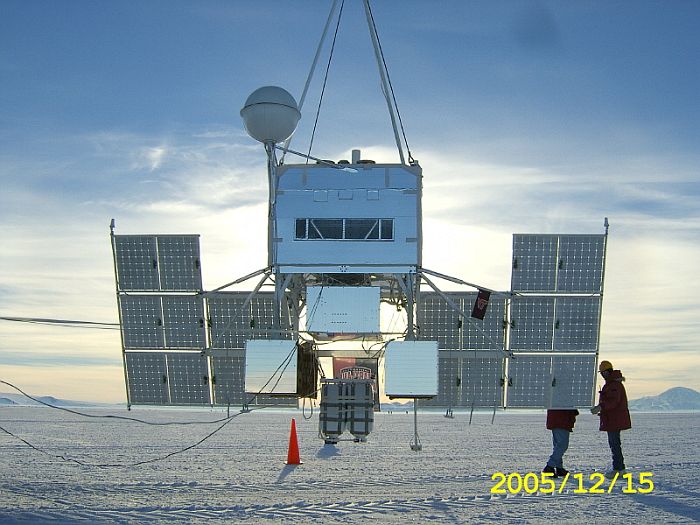
The gondola on which the instrument is mounted, with the exception of ther rotator that maintains the solar panels allways oriented to the sun, is an integrated assembly. It consists of a square metal structure designed to host the instrument and all balloon asociated systems as the command data module (CDM), instrument support structure (ISS), Solar Array panel support system, antenna support systems, ballast hopper, and crush pads. It was fabricated under NASA's balloon-flight requeriments taking in consideration the nominal shock of parachute aperture at termination, the ground impact at landing and that all instrument electronics boxes, calorimeter, carbon blocks, TRDs, hard drives and TDRSS transponder can be removed with minimal tools during recovery.
Details of the balloon flight
Balloon launched on: 12/15/2005 at 16:12
Launch site: Williams Field, McMurdo Station, Antarctica
Balloon launched by: National Scientific Balloon Facility (NSBF)
Balloon manufacturer/size/composition: Zero Pressure Balloon Winzen - 37.570.000 cuft - (0.8 Mil - Stratofilm 372)
Balloon serial number: W 39.47-2-44
Flight identification number: 552N
End of flight (L for landing time, W for last contact, otherwise termination time): 1/13/2006
Balloon flight duration (F: time at float only, otherwise total flight time in d:days / h:hours or m:minutes - ): 28 d 9 h 52 m
Landing site: 249 nautic miles Northwest from McMurdo Antarctic base.
Payload weight: 4476 lbs
Overall weight: 5676 lbs
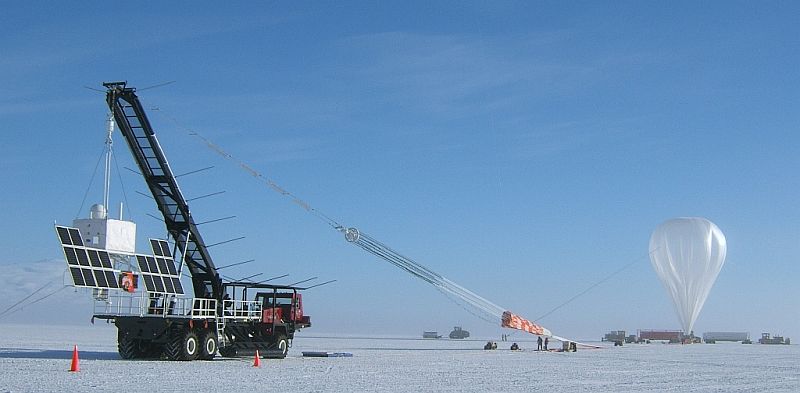
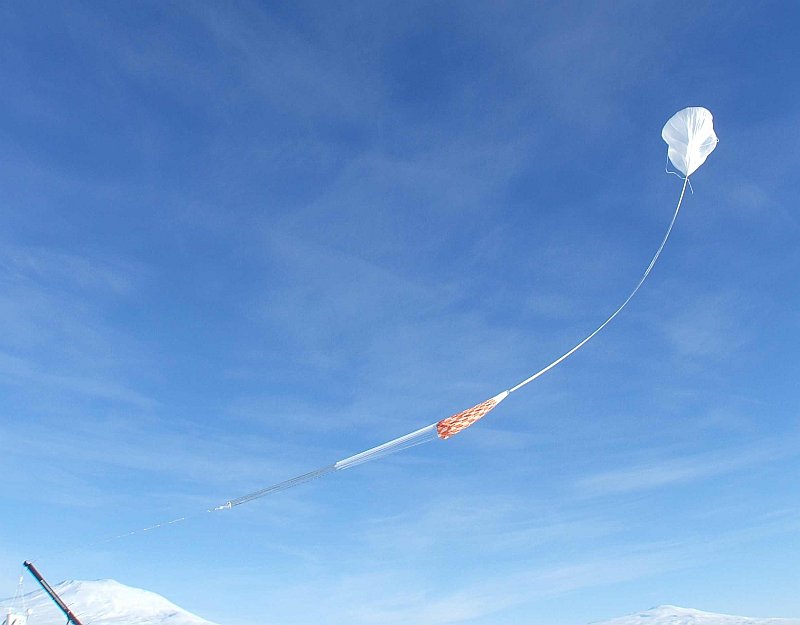
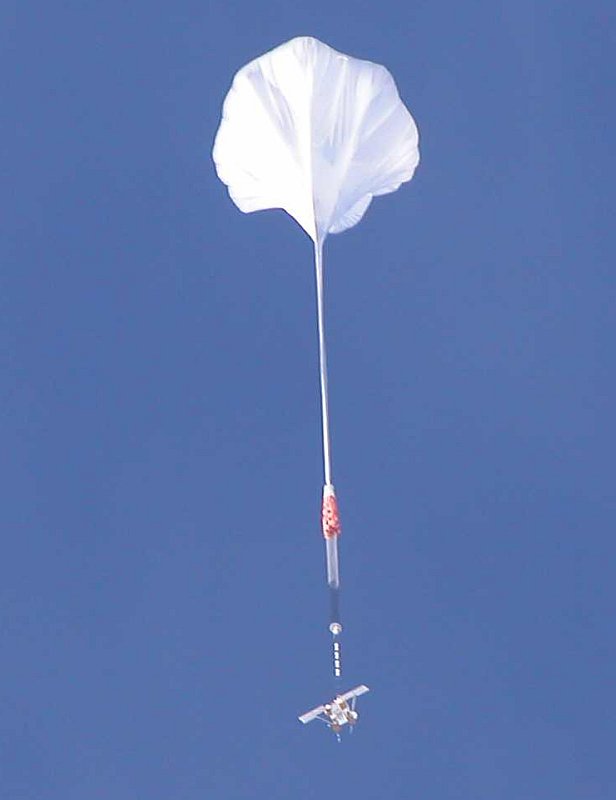
The balloon was launched at 16:12 utc on December 15th 2005, by dynamic method using launch vehicle.
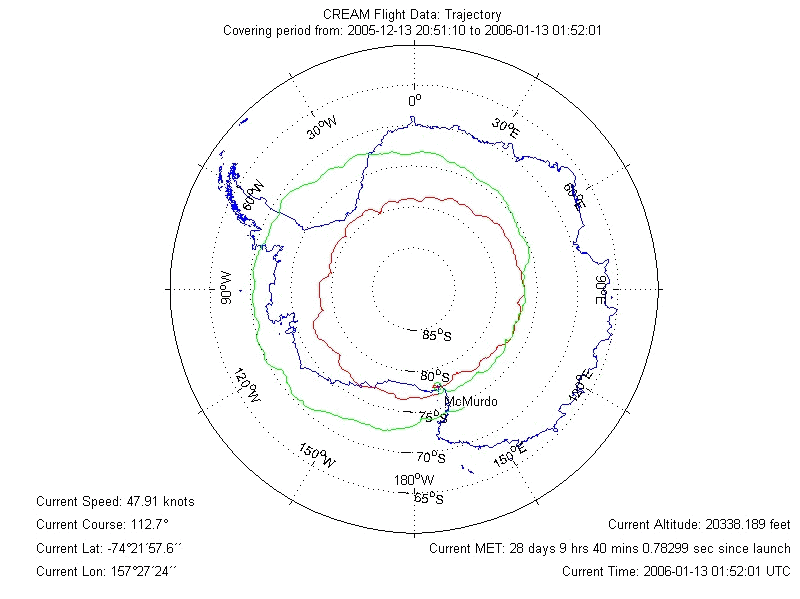
Following a nominal ascent phase, the balloon leveled at float altitude and started to travel in a counter-clockwise flight path. The flight developed without incidents and completed near two full circles to the Antarctic continent.
The balloon was terminated from an LC-130 plane using Line Of Sight commands at 1:22 utc on January 13th, 2006 after 28 days, 9 hours and 52 minutes of flight.
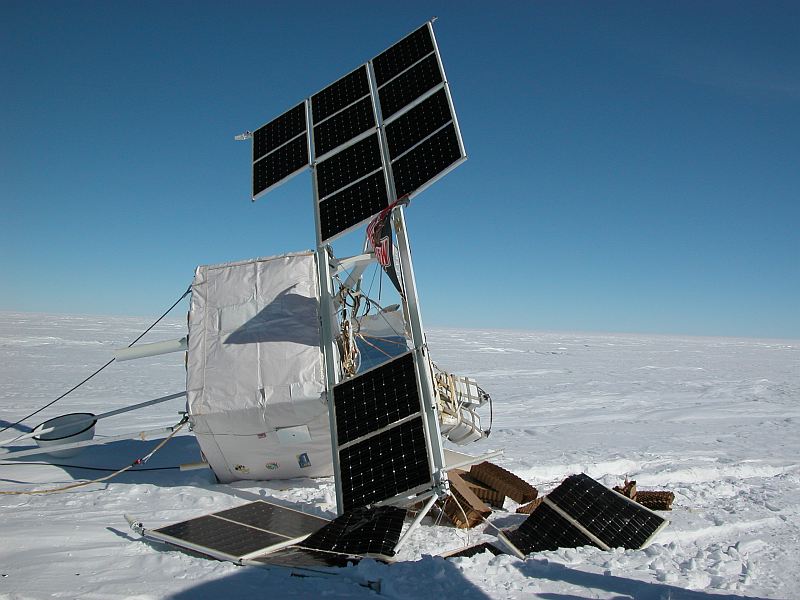
The payload landed 249 miles NW of McMurdo Station, Antarctica. At touch down there was no wind at surface so the parachute separated nicely without dragging the payload.
On January 15, was performed the first recovery trip to the landing site being recovered the Science Flash Drive, and other parts of the instrument . The next day a second flight to the payload concluded the extraction of the rest of the elements remaining on the field.
The CREAM-II instrument configuration did not included the TRD and scintillating fiber hodoscopes as in the first flight, while the charge identification performances of SCD were enhanced by the addition of a second layer of pixelated silicon sensors.
The geometry factor of CREAM-II was smaller, being limited by the acceptance of the calorimeter module. On the other hand, the instrument featured an enhanced charge discrimination (with one additional SCD layer) and was therefore more suited for studies of the spectral features of light nuclei.
57 GB of data were obtained including 27.000.000 of science events.
External references
- CREAM website University of Maryland
- Approaching the Knee with Direct Measurements Nuclear Physics B - Proc. Suppl., 175-176C, 155-161, 2007
- Approaching the Spectral Knee in High Energy Cosmic Rays with CREAM Journal of the Physical Society of Japan. A, 78, 63-67, 2009
- Beam test calibration of the balloon-borne imaging calorimeter for the CREAM experiment 29th International Cosmic Ray Conference 2005, Pune, India
- Charge Identification in the CREAM Experiment Proc. 30th Int. Cosmic Ray Conf., Merida, 2, 377-380, 2007
- CHERCAM: the Cherenkov imager of the CREAM experiment results in Z=1 test beams Proc. 30th Int. Cosmic Ray Conf., Merida, 2, 453-456, 2007
- Construction and Performance of the Silicon Beam Tracker Proc. 30th Int. Cosmic Ray Conf., Merida, 2, 389-392, 2007
- Cosmic Ray Energetics and Mass Frontiers of Science Series No. 50, 19-27, 2007
- Cosmic Ray Energetics And Mass (CREAM): A Detector for Cosmic Rays near the Knee 26th International Cosmic Ray Conference. August 17-25, 1999. Salt Lake City, Utah, USA.
- Cosmic Ray Energetics And Mass : Expected Performance 27th International Cosmic Ray Conference. 07-15 August, 2001. Hamburg, Germany.
- Cosmic Ray Energetics And Mass(CREAM) Overview Proc. 30th Int. Cosmic Ray Conf., Merida, 2, 47-50, 2007
- Cosmic ray energetics and mass: configuration and progress on construction and testing 27th International Cosmic Ray Conference. 07-15 August, 2001. Hamburg, Germany.
- CREAM - Pushing the High Energy Frontier of Directly Measured Cosmic Rays Czech. J. Phys. 56, A301-A312, 2006
- CREAM for High Energy Composition Measurements 28th International Cosmic Ray Conference. July 31-August 7, 2003. Trukuba, Japan.
- CREAM: 70 days of flight from 2 launches in Antarctica Advances in Space Research, 42, 1656-1663, 2008
- Design and Construction of the Silicon Charge Detector for the CREAM Mission 28th International Cosmic Ray Conference. July 31-August 7, 2003. Trukuba, Japan.
- Discrepant hardening observed in cosmic-ray elemental spectra Astrophysical Journal Letters 714 (2010) L89-L93
- Effect of albedo particles on charge measurement Proc. 30th Int. Cosmic Ray Conf., Merida, 2, 381-384, 2007
- Elemental energy spectra of cosmic rays measured by CREAM-II Proc. of the 31st International Cosmic Ray Conference Lodz (2009)
- Elemental Spectra from the CREAM-I Flight Proc. 30th Int. Cosmic Ray Conf., Merida, 2, 63-66, 2007
- Energy cross-calibration from the first CREAM flight: transition radiation detector versus calorimeter Proc. of the 30th International Cosmic Ray Conference Merida (2008) vol. 2, 333-336
- Energy spectra of cosmic-ray nuclei at high energies THE ASTROPHYSICAL JOURNAL, vol. 707 (2009) p. 593-603
- GEANT4 Based Model of the CREAM Timimg Charge Scintillation Detector Proc. 30th Int. Cosmic Ray Conf., Merida, 2, 385-388, 2007
- Measurements of cosmic-ray energy spectra with the 2nd CREAM flight Nucl. Phys. B (Proc. Suppl.) 196 (2009) 239-242
- Measurements of the Relative Abundances of High-energy Cosmic-ray Nuclei in the TeV/Nucleon Region Astrophys. J. , 715, 1400-1407, 2010
- Next Generation TRD for CREAM Using Gas Straw Tubes and Foam Radiators Proc. 30th Int. Cosmic Ray Conf., Merida, 2, 345-348, 2007
- On High Energy Cosmic Rays from the CREAM Instrument Dissertation presented in partial fulfillment of the requirements for the degree Doctor of Philosophy in the Graduate School of The Ohio State University by Theresa J. Brandt
- Performance of a Dual Layer Silicon Charge Detector during CREAM Balloon Flights IEEE TRANSACTIONS ON NUCLEAR SCIENCE, 54, 1743, 2007
- Preliminary measurements of carbon and oxygen energy spectra from the second flight of CREAM Proc. 30th Int. Cosmic Ray Conf., Merida, 2, 23-26, 2007
- Preliminary results from the second flight of CREAM Advances in Space Research, submitted, 2006
- Relative abundances of heavy ions measured by the CREAM Silicon Charge Detector Proc. 30th Int. Cosmic Ray Conf., Merida, 2, 39-42, 2007
Images of the mission
StratoCat is an independent, non-commercial project maintained to preserve and share the history of scientific and stratospheric ballooning. If you find the site useful, you can help keep it running with a small donation toward its operating costs. Every contribution, even the equivalent of a cup of coffee, is greatly appreciated.