
Purpose of the flight and payload description
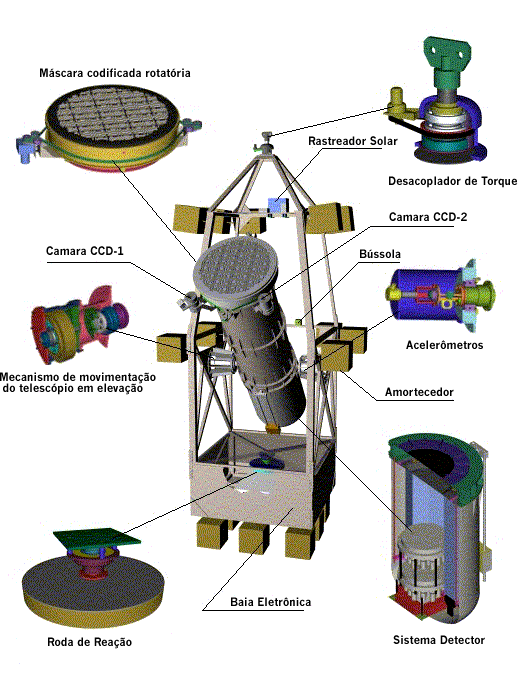
A balloon-borne gamma-ray experiment, which is an instrument designed to obtain images of cosmic sources.
The MASCO experiment employs a Modified Uniformly Redundant Array coded mask (hence her name) and a NaI(Tl) position sensitive detector.
More than simply an instrument MASCO, has been one of the most important astronomy and astrophysics projects developed in Brazil of the last decade.
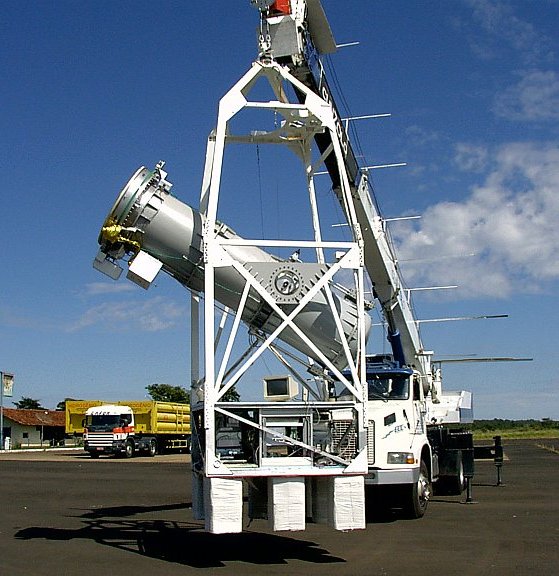
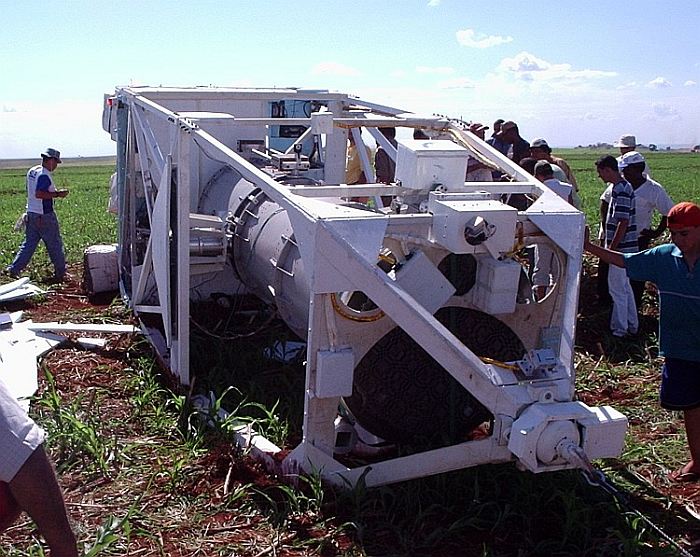
In addition to the development of the system of obtaining of images, it was necessary also to develop an automatic system that during the flight, pointed the telescope towards the target objective. This attitude control system was designed to provide a few arcminutes pointing and stabilization for a ~ 2,000 kg, 7-m high, 2-m wide, 2-m deep gondola that encompasses the telescope and its associated electronics.
Details of the balloon flight
Balloon launched on: 4/1/2004 at 2:04 local
Launch site: Nova Ponte Airfield, Minas Gerais, Brazil
Balloon launched by: Instituto Nacional de Pesquisas Espaciais (INPE)
Balloon manufacturer/size/composition: Zero Pressure Balloon Raven 1.200.000 m3
End of flight (L for landing time, W for last contact, otherwise termination time): 4/1/2004
Balloon flight duration (F: time at float only, otherwise total flight time in d:days / h:hours or m:minutes - ): ~ 12 h
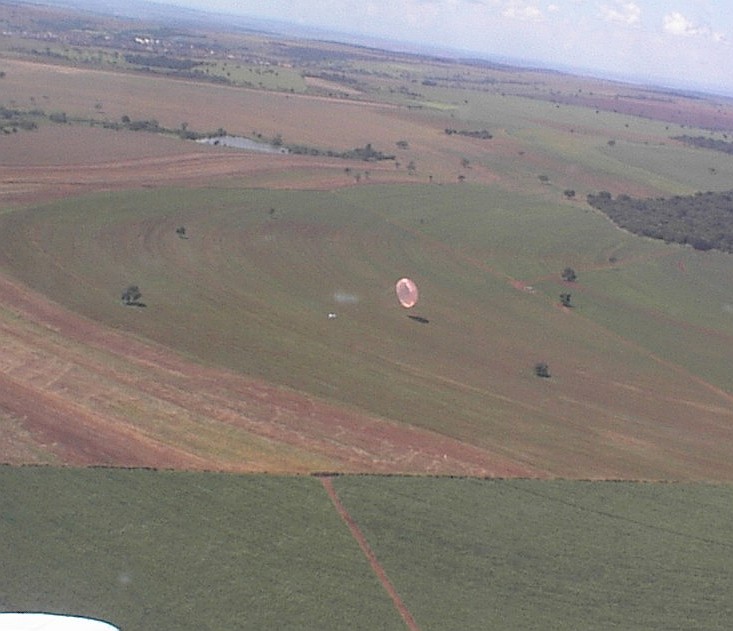
Landing site: In a farm in Capinópolis (Minas Gerais state near the border of the Goias and Mato Grosso do Sul states).
Payload weight: ~ 2000 kgs
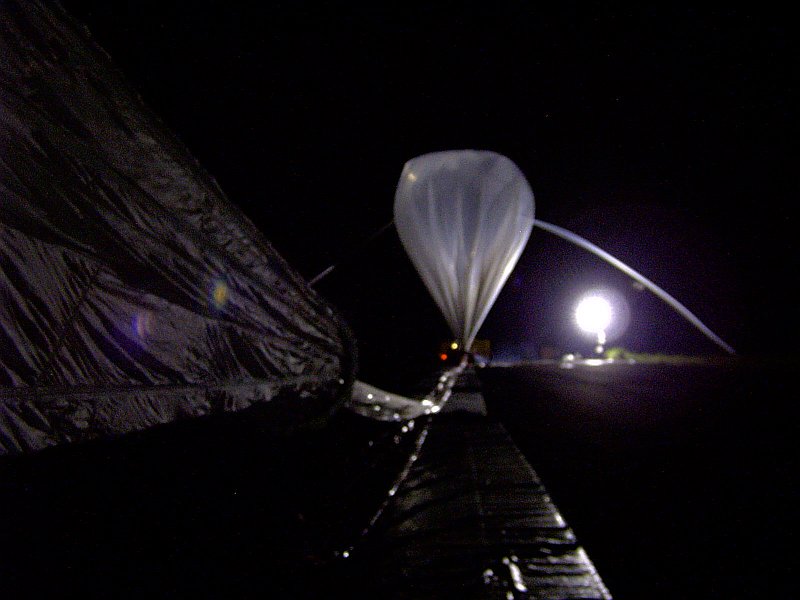
The balloon was launched at 2:04 am on April 1st, 2004, from the air strip of the Nova Ponte airfield, a tiny city of the Minas Gerais state.
The craft was launched by dynamic method with the help of a crane acting as launch vehicle.
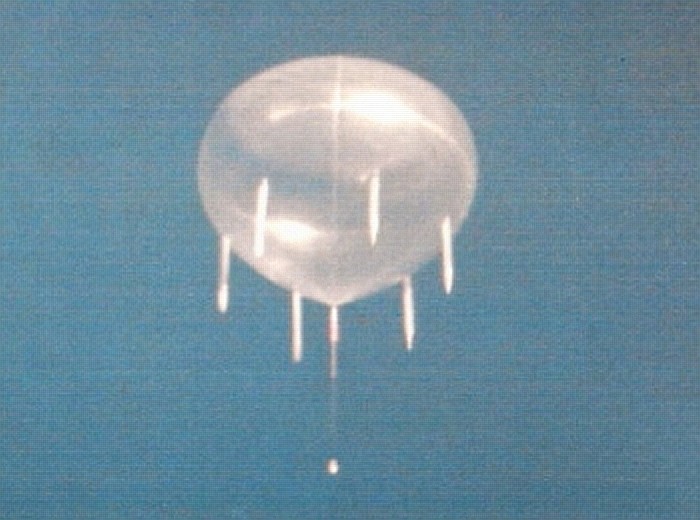
After a nominal ascent phase, the balloon achieved float altitude near 40 km of height and started a very slowly drift to the west.
At daybreak, started de telecomanded operation of the telescope and after near 11 hours of stable flight (half of the time flight expected) was sent the separation command. The payload parachuted to the ground and landed in a farm located near Capinópolis close to the border of the Goias state.
The balloon flown on this flight was the biggest one flown on all history of the brazilian scientific balloon program.
This flight had two main targets. In the technological side, essentially it was related to proving the pointing system and the mechanical system of the gondola, wich worked satisfactorily. In the scientific side it was tried to observe the sources of the Crab, of the region of the Center of the Galaxy and, depending on the development of the flight, the Great Cloud of Magallanes. This objective could not be completely fulfilled by troubles in the electronics of the system of data acquisition.
External references
- A mura-based coded mask telescope Advances in Space Research, Vol. 15 Nº 5, 1995
- An Overview of the MASCO Experiment Advances in Space Research, 30(5), 1333-1342, 2002
- Astrofísica de altas energias: desenvolvimento do telescópio MASCO e observações de GRO J1744-28 com o telescópio SIGMA Mejía Cabeza, Jorge - Tese (Doutorado em Astrofísica)
- Brasil lança telescópio para pesquisar radiação cósmica Inovação Tecnológica
- Determinação de atitude de balões estratosféricos utilizando filtros de Kalman Luiz de Siqueira Martins Filho, Programa de Pós-Graduação do INPE em Ciência Espacial
- Development of the Imaging System of the Balloon-Borne Gamma-Ray Telescope MASCO Review of Scientific Instruments, 73(10), 3619-3628, 2002
- Levantamento de técnicas de identificação de estrelas e desenvolvimento de um ambiente de simulação e testes para análise de seus desempenhos em aplicações espaciais G. B. Carvalho thesis
- Para tener otra vision del Espacio Revista Pesquisa FAPESP - 79 - Setembro 2002 - Edição 79
- Preflight tests of the MASCO telescope Advances in Space Research, 26(9), 1411-1414, 2000
- The CCD Stellar Sensor for Fine Pointing of the MASCO Telescope Thyrso Villela's home page
Images of the mission
If you consider this website interesting or useful, you can help me to keep it up and running with a small donation to cover the operational costs. Just the equivalent of the price of a cup of coffee helps a lot.