
Purpose of the flight and payload description
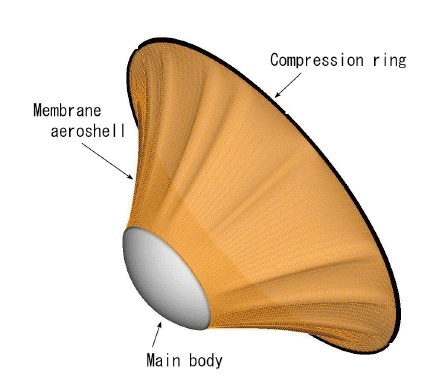
The MACFT (Membrane Aeroshell Capsule Flight Test) was an experimental demonstrator vehicle developed in the framework of MAAC (Membrane aeroshell for Atmospheric-entry Capsule) a project carried out by researchers at JAXA/ISAS and collaborating Japanese universities. The concept centered on deploying a large, lightweight flexible aeroshell before atmospheric reentry, allowing the vehicle to decelerate at high altitude where atmospheric density is low, reducing aerodynamic heating. Rather than withstanding the thermal environment of reentry as traditional capsules do with ablative materials rated to over 2000 degrees Celsius, the MAAC approach avoided it by deploying a large aeroshell in orbit before reentry begins.
In the image at left we can see a scheme of the model used in the balloon tests. The flare-shaped membrane aeroshell, supported by an inflatable torus, could be packed compactly during launch and deployed in near-vacuum conditions. Because the vehicle decelerates at high altitude using a low ballistic coefficient, it could achieve soft landing or splashdown without a parachute, and the inflatable structure provided buoyancy for ocean recovery. The system didnt depended on the shape of the payload being recovered, making it potentially applicable to a range of missions.
Details of the balloon flight
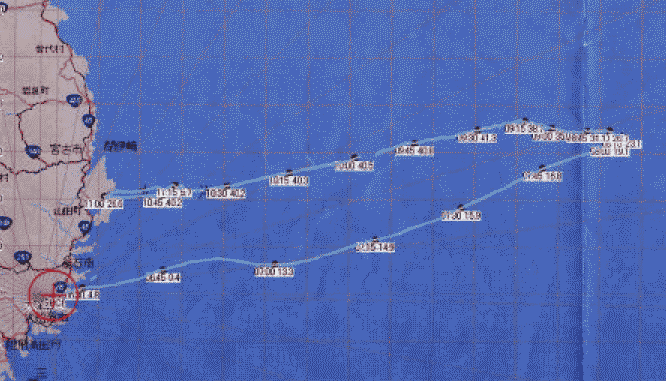
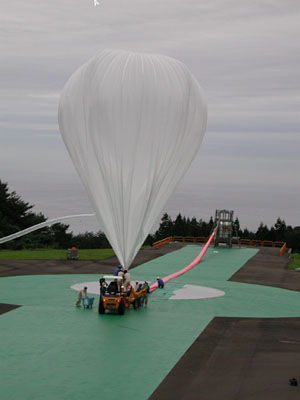
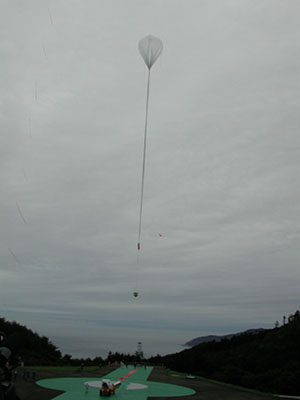
Balloon launched on: 9/1/2003 at 6:20 jst
Launch site: Sanriku Balloon Center, Iwate, Japan
Balloon launched by: Institute of Space and Astronautical Science (ISAS)
Balloon manufacturer/size/composition: Zero Pressure Balloon model B100 100.000 m3
Flight identification number: B100-8
End of flight (L for landing time, W for last contact, otherwise termination time): 9/1/2003
Balloon flight duration (F: time at float only, otherwise total flight time in d:days / h:hours or m:minutes - ): 5 h 23 m
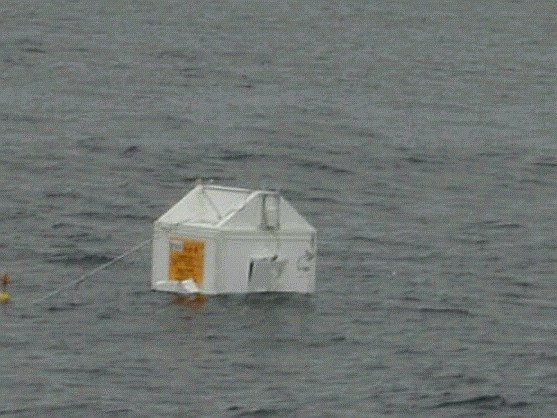
Landing site: On the Pacific Ocean, near japanese shore.
Normal launch by vertical method, ascent up to 20 km drifting to the east.
At about 200 km from the coast, the balloon is unloaded, allowing it to rise to floatation height with a drift to the West (back to the coast).
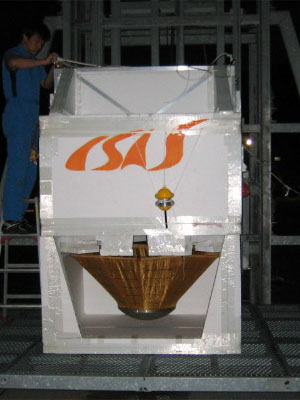
At the predetermined moment, an attempt was made to eject the test capsule, but the system failed.
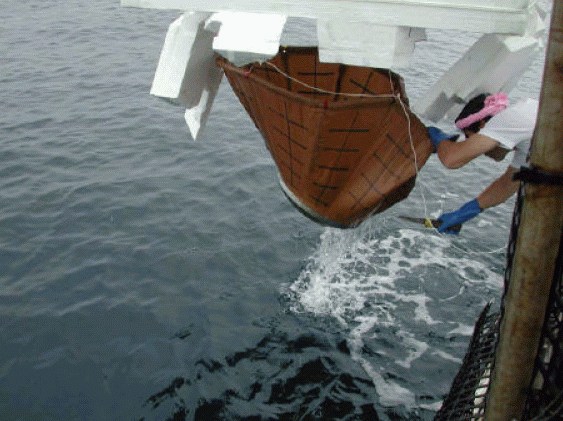
Payload recovered from the ocean next to the gondola 4 hours later.
External references
- Information on the balloon flights performed during 2003 (In Japanese) ISAS Annual Report, 2003
- MACFT web site Institute of Space and Astronautical Science
Images of the mission
If you consider this website interesting or useful, you can help me to keep it up and running with a small donation to cover the operational costs. Just the equivalent of the price of a cup of coffee helps a lot.