
Purpose of the flight and payload description
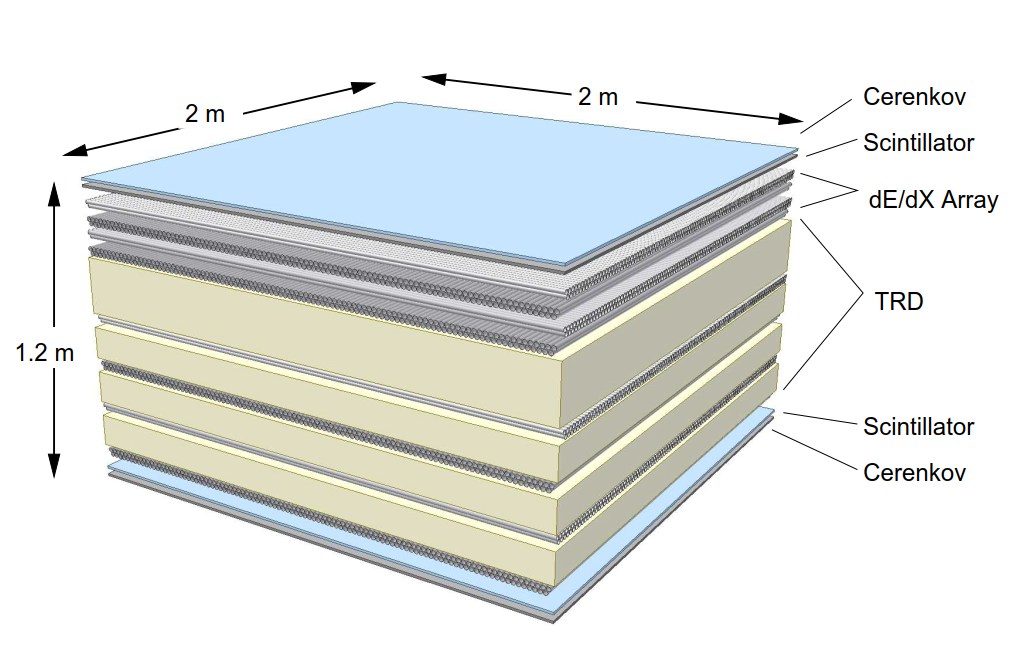
Its a instrument built to measure the intensities of the heavy nuclear species in the cosmic rays up to energies of 10 Tev/nucleon. It measures the nuclear charge, the energy, and the trajectory of the incoming particles through the instrument. The innovative aproach of TRACER is to replace the traditional Multi Wire Proportional Chambers of other detectors by layers of thin-walled single proportional tubes which can easily withstand internal overpressure. This avoid the need of using a heavy pressurized container, saving weight and thus allowing the construction of a larger area detector.
The instrument derives its heritage from the CRN detector developed at the University of Chicago for space flight in the decade of the 80's.
TRACER consists of eight double layers of proportional tubes 2 m long with a diameter of 2 cm made of aluminized mylar, filled with a mixture of xenon and methane. These are mounted in 16 sub assemblies ("manifolds"), each containing a double layer of 99 tubes oriented alternately in two orthogonal directions.
This configuration forms an 2 x 2 square meters array of proportional tubes with 16 layers and 1584 proportional tubes in total allowing to determine the particle trajectory and at the same time to correct the data pathlength variations. Printed circuit boards inside the manifolds provide high voltage for the proportional tubes and allow a capacitive read-out of the signal wires. Eight layers of tubes serve to measure ionization losses of high energy particles. The next eight layers, installed below blankets of plastic fiber material acts as a radiator to generate transition radiation. The wire signals of the proportional tubes are read with a low power AMPLEX integrated circuit. The preamplifiers are installed inside aluminum housings directly at the manifolds in order to reduce electronic noise.
Two scintillators are placed on top and bottom of the detector stack, respectively acting as instrument trigger, and measuring the specific ionization, to determine the particle's charge. Additionally a Cherenkov counter made of acrylic plastic at the bottom of the detector is used to reject non-relativistic particles. The plastic scintillators are 1 cm thick, and are read out via wavelength shifter bars with 12 photomultiplier tubes while the Cerenkov signals are measured by 24 photo multiplier tubes.
Heart of the TRACER electronics is an Intel 486 CPU inside a VME-crate. The crate is installed together with the hard drives for flight data recording, a main electronics crate as well as the high voltage supplies for the proportional tubes and the photomultiplier tubes inside a pressurized sphere. All other electronic components like the valves for the gas system and the main amplifiers and analog to digital converters for the proportional tubes and the photomultiplier tubes are mounted on the instrument frame without a pressurized shell.
The whole detector is mounted inside a 2.5 x 2.5 x 3 square meters aluminum structure without a surrounding pressurized shell. The outer skin of the instrument is a 10 cm foam layer covered with aluminized mylar acting as thermal insulation.
Details of the balloon flight

Balloon launched on: 12/12/2003 at 6:09 utc
Launch site: Williams Field, McMurdo Station, Antarctica
Balloon launched by: National Scientific Balloon Facility (NSBF)
Balloon manufacturer/size/composition: Zero Pressure Balloon Raven W 39.570.000 cuft - (0.8 mil) - SF3-39.57-.8/.8/.8-NA
Balloon serial number: W39.57-2-39
Flight identification number: 526N
End of flight (L for landing time, W for last contact, otherwise termination time): 12/27/2003 at 13:12 utc
Balloon flight duration (F: time at float only, otherwise total flight time in d:days / h:hours or m:minutes - ): 14 d
Landing site: 121 miles W of McMurdo Station, Antarctica
Payload weight: 3550 lbs
Overall weight: 5966 lbs
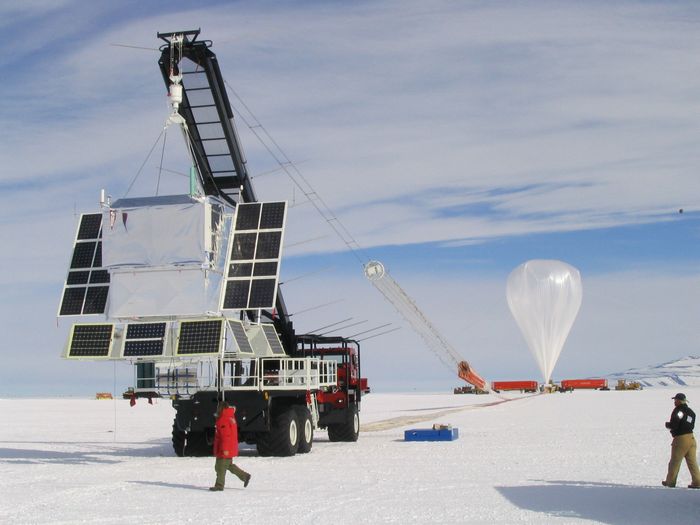
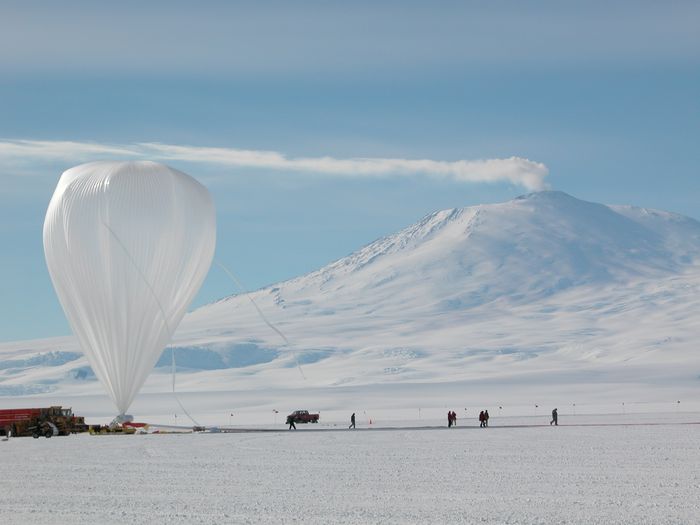
The balloon was launched on December 12th at 6:09 UTC by dynamic method assited by launch vehicle. Following a nominal ascent phase, the balloon reached float altitude of 125.000 feet at 00:30 local time starting an anti-clockwise flight trajectory over the antarctic plateau.
After a few days of flight without incidents,on december 15th the balloon cross over the Vostok lake (considered the coldest place on earth) thus the balloon get cold and droped altitude to 120,000 ft. but continuing his travel until on December 20th it passed over the Ronne Ice Shelf. The more sunlight reflected off the ice warmed the balloon and thus it regained altitude to over 127,000 ft.
Fronm there, the travel continued without troubles until December 23th when the science team lose contact with TRACER instrument apparently due to the failure of the primary power system. This led to terminate the data taking phase of the flight.
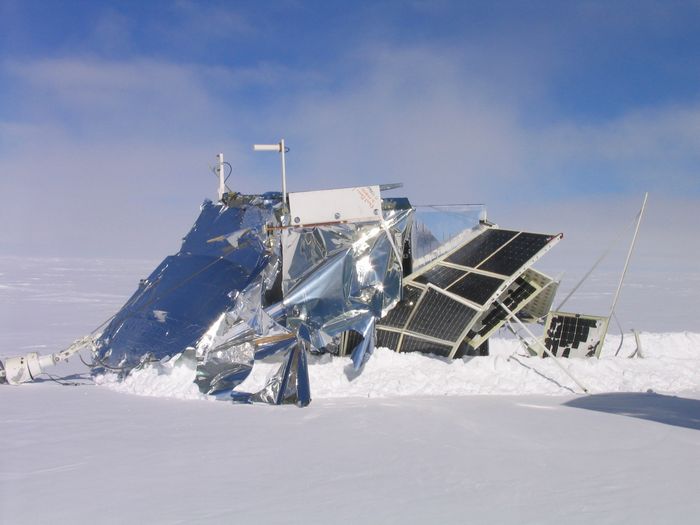
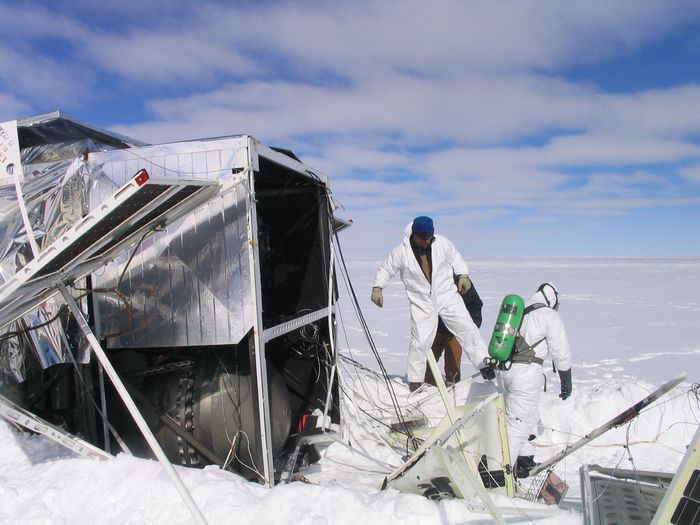
On December 26th the balloon completed the full circle around the pole and passed within 80 miles of McMurdo Station at the same level flight of 127,000 ft. It appeared as a large white object in the sky remaining almost stalled for a period of hours over the Royal Society Mountains. Finally on December 27th the flight was terminated when the balloon was over Victoria Land on the East Antarctic Plateau. After separation, the instrument parachuted to earth but after landing the parachute failed to get dettached from it, so the wind inflated again the parachute's canopy resulting in the payload beeing dragged six miles across the snow. Finally the gondola stoped his drag within 100 miles of McMurdo Station.
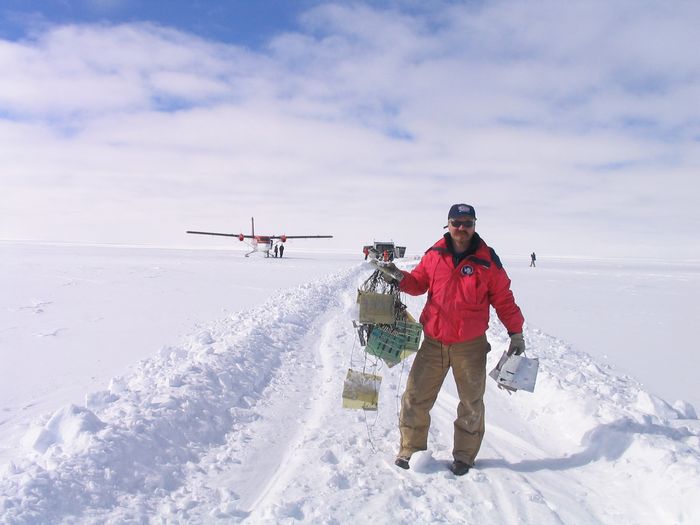
A Twin Otter plane located the gondola on December 28th thanks to the 10 foot wide furrow in the snow. Although the incident the instrument itself was intact and was secured by the rescue team wich landed nearby and recovered the science data Hard Disks. The following days, bad weather conditions prevented the recovery of the rest of the payload wich lasted in the snow until January 2004 when the operation was completed and the instrument was shiped back to United States.
This was the first long duration mission of the instrument. It was originally planned for a flight in the northern hemisphere with a launch from Alaska, but could not be conducted there because of the lack of relevant international agreements.
Therefore, an Antarctic circumpolar balloon flight was planned, but that had to wait also until 2003, when a new launch vehicle able to manage the weight of TRACER (6,000 lbs., including ballast, telemetry, and balloon-related instrumentation) became operational.
Overall, the instrument performed very well during this flight. In particular, the entirely passive thermal insulation kept the temperatures of all detector components close to room temperature, with diurnal variations of at most a few degrees C. There was no indication of a deterioration of the performance of the proportional tubes due to gas poisoning for the duration of the flight.
The data acquisition system operated very efficiently, with a dead time of just 6%, but the total time during which data could be recorded was limited to ten days, due to a catastrophic failure of the rechargeable lithium batteries (which were used to buffer the solar-power system) towards the end of the first orbit of the balloon around the South Pole.
The instrument was fully recovered and returned to Chicago, to be refurbished for another long duration mission in the Arctic.
In all TRACER sampled over 50 Million heavy Cosmic Rays during the flight.
External references
- TRACER website University of Chicago
- A New Detector for Measurments of the Composition of Heavy Cosmic Ray Nuclei beyond TeV-Energies 26th International Cosmic Ray Conference 2005, Salt Lake City, Utah
- Antarctic Balloon Flight and Data Analysis of TRACER 29th International Cosmic Ray Conference 2005, Pune, India
- Balloons up and away: TRACER takes flight Article on TRACER from the Antarctic Sun magazine
- Chicago instrument will advance study of high-energy cosmic rays Article at Chicago Chronicle
- Composition and energy spectra of cosmic-ray nuclei at high energies PROCEEDINGS OF THE 31st ICRC, LODZ 2009
- Composition of Primary Cosmic-Ray Nuclei at High Energies Astrophysical Journal (3-Jan-08)
- Cosmic ray composition at high energies: Results from the TRACER project 36th COSPAR Scientific Assembly. Held 16 - 23 July 2006, in Beijing, China
- Energy Spectra of Heavy Cosmic Ray Nuclei from 0.5 GeV/amu to 10,000 GeV/amu 29th International Cosmic Ray Conference 2005, Pune, India
- Large Area Transition Radiation Detectors for Cosmic Ray Observations in Space 27th International Cosmic Ray Conference 2005, Hamburg, Germany
- Measurements with TRACER: Discussion of Results and Future Prospects 29th International Cosmic Ray Conference 2005, Pune, India
- Propagation and Source Energy Spectra of Cosmic-Ray Nuclei at High Energies Submitted to Astrophysical Journal
- The Elemental Composition of High-Energy Cosmic Rays: Measurements with TRACER MPLA, Volume 23, Issue 25, Pages 2031-2045 (2008)
- The Response of the TRACER Detector: Design, Calibrations and Measurements 29th International Cosmic Ray Conference 2005, Pune, India
Images of the mission
If you consider this website interesting or useful, you can help me to keep it up and running with a small donation to cover the operational costs. Just the equivalent of the price of a cup of coffee helps a lot.