
Purpose of the flight and payload description

Cosmic rays are the only sample of matter from distant regions of the galaxy, and possibly elsewhere in the Universe, that can be directly observed by space experiments in the Solar System. This high energy matter consists of atomic nuclei that travel at speeds very close to the speed of light and includes electrons, the natural elements from Hydrogen and Helium to Iron and beyond as well as anti-matter in the form of positrons and anti-protons.
ATIC experiment was designed to measure the energy spectrum of individual cosmic ray elements in order to study the validity of the model that predicts that cosmic rays gain their very high energy as the result of supernova explosion shock waves traveling through interstellar gas. Several goals on regard this objective are for example to obtain energy spectra for individual elements of a broad energy range with a single instrument; to discover 'breaks' or 'bends' in the spectra, to measure the energy dependence of the H/He ratio as well determine the spectral differences between elements and obtain the composition of the cosmic ray matter.
To achieve its scientific objectives, the ATIC experiment must be capable of measuring the incident cosmic ray charge and energy over an energy range of 50 GeV to >100 TeV. A schematic of the instrument, can be seen at left (Click to enlarge).
The instrument is based on the technique of ionization calorimetry, the most practical method of energy determination for cosmic ray nuclei from H to Fe over the target energy range. The fully active ATIC calorimeter is composed of 10 layers of Bismuth Germanate (BGO) scintillating crystals and is located on the bottom of the instrument. Above the calorimeter is the target section consisting of three plastic scintillator strip hodoscopes to define the instrument aperture and provide redundant charge and trajectory measurements, as well as layers of inert carbon (between hodoscopes) to provide a volume for the incident particles to interact.
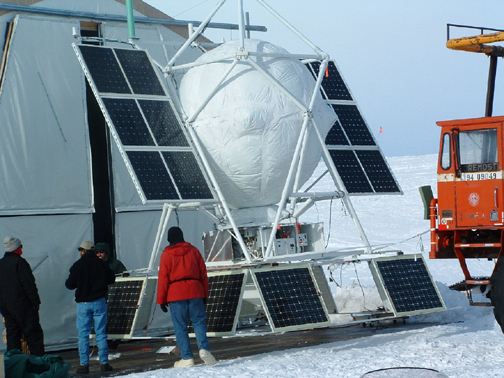
On the top of the detector stack is the highly segmented silicon matrix detector that provides an accurate measure of the incident particle charge even in the presence of shower particles backscattered from the calorimeter. Surrounding the detector stack, electronics bays hold the flight computers, readout electronics, power system boards and other instrument electronics. Finally, on each of the four corners three struts transfer the loads of the experiment through the pressure vessel ring to an external structure that attaches to the balloon.
The total weight of ATIC is about 1,500 kg (3,300 lbs), the total power consumed is less than 350 Watts (including power conversion efficiency), and the payload is designed to be quickly field stripped under Antarctic conditions.
Details of the balloon flight
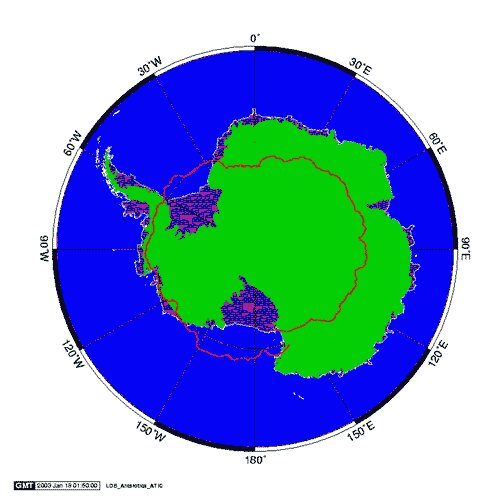
Balloon launched on: 12/29/2002 at 5:00 utc
Launch site: Williams Field, McMurdo Station, Antarctica
Balloon launched by: National Scientific Balloon Facility (NSBF)
Balloon manufacturer/size/composition: Zero Pressure Balloon Raven 29X - 1.000.000 m3 - SF3-29.47-.8/.8/.8-NAR
Balloon serial number: W29.47-2X-50
Flight identification number: 515N
End of flight (L for landing time, W for last contact, otherwise termination time): 1/18/2003 at 2:02 utc
Balloon flight duration (F: time at float only, otherwise total flight time in d:days / h:hours or m:minutes - ): 19 d 21 h
Landing site: 65 miles WSW of Terra Nova Base, Antarctica
Payload weight: 3845 lbs
Overall weight: 4927 lbs
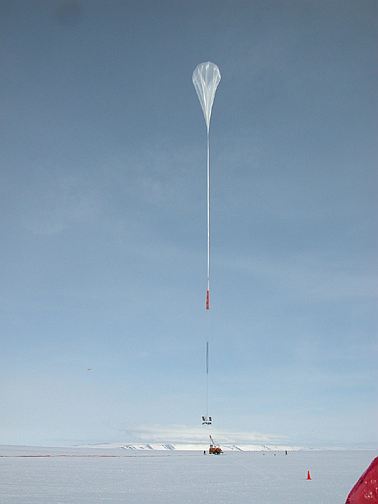
The balloon was launched by dynamic method December 29th, 2002 at 4:59 UTC and reached float altitude 8:10 UTC on the same day, strating an anti-clockwise path around the Antarctic Plateau.
After 19 days and 21 hours of flight the payload was cut down from the balloon at 2:01 utc of January 18th 2003 at 74º 40' S - 160º 19' E while flying at 124.700 ft. Impact of the payload was at 2:36 utc at 74º 38' S 160º 25' E.
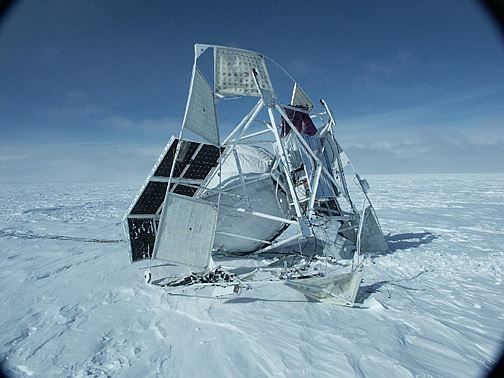
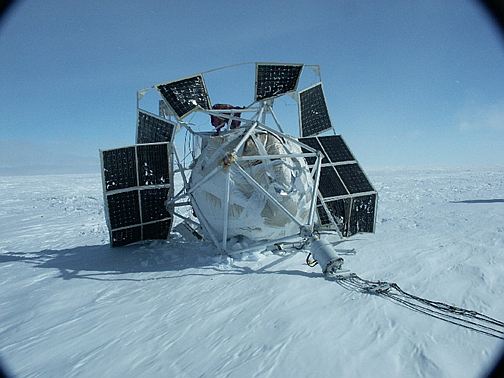
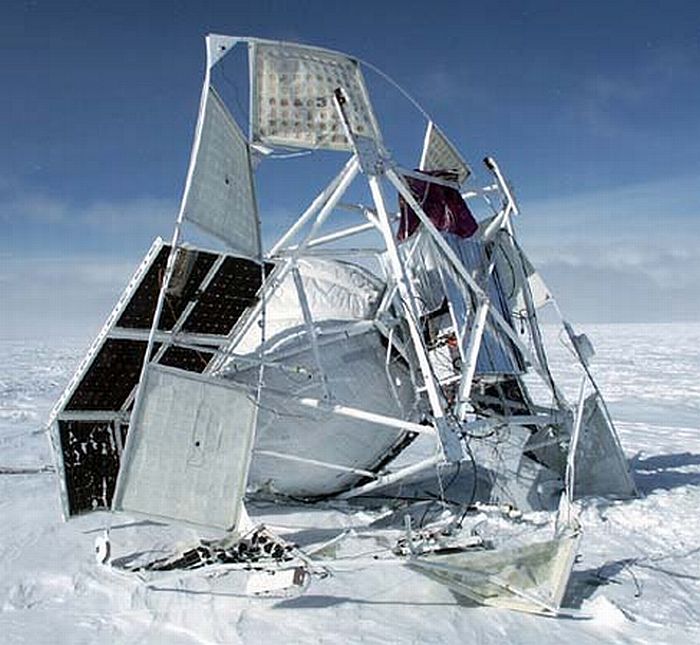
The payload tipped over on landing onto its stern, where the antenna boom was mounted and was dragged about 60 ft before the parachute was cut.
The chase plane and recovery crew landed near the payload but spent only about 10 min on the ground to disconnect the battery and the solar panels, close the gas bottles and get the disks from MSFC cut out since they were very easy to get to in that position. Were necessary another 3 trips to recover the rest of the ATIC payload.
This was the first scientific flight of the instrument, after a first test launch -which also yieled scientific results in 2000/2001-.
Nominal data collection began on 30 Dec. 2002 at 5:40 UT and continued until 18 Jan. 2003 at 1:32 UT. During this period all data was recorded on board.
The ATIC dataset obtained in this first scientific flight consumed 65 Gbytes of the 70 Gbytes available in the flight disk and contains 16.9 million cosmic ray triggers, 1.6 million calibration records, 0.18 million housekeeping records plus rate and command records.
Internal pressure (~8 psi) of the vessel decreased slightly (~0.7 psi) for 1st 10 days and then held constant. In regard the internal temperature it was between 12 and 22 ºC
External references
- ATIC website Louisiana State University (no longer available - retrieved via Archive.Org)
- A dozen days to collect cosmic rays Article on ATIC from the Antarctic Sun magazine
- Atic Experiment: Flight Data Processing 28th International Cosmic Ray Conference. Vol. 4 pag. 1833
- Atic Experiment: Preliminary Results from the Flight in 2002 28th International Cosmic Ray Conference. Vol. 4 pag. 1833
- Calculation of the atmospheric muon flux motivated by the ATIC-2 experiment 30th International Cosmic Ray Conference, Merida, MEXICO
- Dark Matter Signals In Cosmic Rays? Memorie della Società Astronomica Italiana, v.81, p.132 (2010)
- Dark matter signals in cosmic rays?. Memorie della Società Astronomica Italiana, v.81, p.132 (2010)
- Data Processing and Event Reconstruction for the ATIC Balloon Payload 26th International Cosmic Ray Conference. August 17-25, 1999. Salt Lake City, Utah, USA
- Energy Spectra of Abundant Nuclei of Primary Cosmic Rays from the Data of ATIC-2 Experiment: Final Results Bulletin of the Russian Academy of Sciences: Vol. 73, No. 5, p. 564
- Energy Spectra of H and He from the ATIC-2 Experiment 29th International Cosmic Ray Conference, India, 2005
- High energy cosmic rays Journal of Physics: Conference Series, Volume 171, Issue 1, pp. 012012 (2009).
- Relative Abundances and Energy Spectra of C, N, and O as Measured by the Advanced Thin Ionization Calorimeter Balloon Experiment 28th International Cosmic Ray Conference. July 31-August 7, 2003. Trukuba, Japan
- Relative abundances of cosmic ray nuclei B-C-N-O in the energy region from 10 GeV/n to 300 GeV/n. Results from ATIC-2 (the science flight of ATIC) 30th International Cosmic Ray Conference, Merida, MEXICO
- Rigidity Spectra of Protons and Helium as Measured in the First Flight of the ATIC Experiment 28th International Cosmic Ray Conference. July 31-August 7, 2003. Trukuba, Japan
- The Advanced Thin Ionization Calorimeter (ATIC) for Studies of High Energy Cosmic Rays 26th International Cosmic Ray Conference. August 17-25, 1999. Salt Lake City, Utah, USA
- The ATIC Science Flight in 2002-03: Description and Preliminary Results 28th International Cosmic Ray Conference. July 31-August 7, 2003. Trukuba, Japan
Images of the mission
StratoCat is an independent, non-commercial project maintained to preserve and share the history of scientific and stratospheric ballooning. If you find the site useful, you can help keep it running with a small donation toward its operating costs. Every contribution, even the equivalent of a cup of coffee, is greatly appreciated.