
Purpose of the flight and payload description
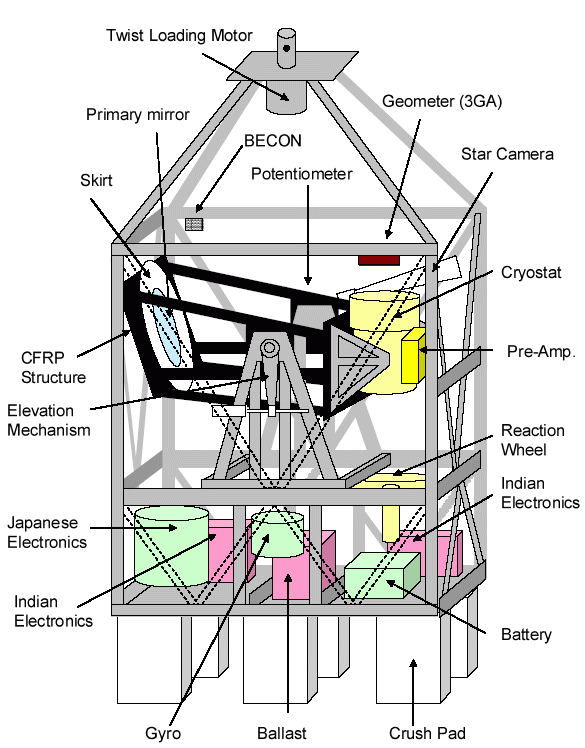
Is an instrument developed for mapping of the far-infrared emission from the Galaxy and external galaxies with the same spatial resolution as that of the IRAS (Infrared Astronomical Satellite) launched on 1983.
It has a telescope with an off-axis parabola glass mirror of 50 cm diameter and a focal length of 1200 mm. The instrument is mounted on the direct focus of this mirror. There is no other un-cooled optics. In order to reduce the instrumental infrared radiation noise from the periphery of the mirror, a ring-shape reflector is attached to the mirror.
Also was developed a far-infrared array camera dedicated for FIRBE. The array has 4 x 8 pixels, and the pixel pitch is 1.5 arcmin. The array uses stressed Ge:Ga photoconductor elements and is installed in a helium cryostat together with a cold reimaging optics.
The gondola on wich the instrument is mounted combines several aluminum pipes and angles, so FIRBE could be lighten the weight of the main frame less than about 100 kg, which also leads to reduce the total weight.
The telescope is deriven by an alt-azimuthal mounting system, the attitude stability is less than 30 arcsec. The attitude during the flight is determined with the data of three-axes fiber-optic gyro assisted by the CCD star camera and derived by a reaction wheel in azimuth and by a drive mechanism of a geared motor in elevation.
Details of the balloon flight
Balloon launched on: 9/6/1998
Launch site: Sanriku Balloon Center, Iwate, Japan
Balloon launched by: Institute of Space and Astronautical Science (ISAS)
Balloon manufacturer/size/composition: Zero Pressure Balloon model B120 120.000 m3
Flight identification number: B120-3
End of flight (L for landing time, W for last contact, otherwise termination time): 9/6/1998
Balloon flight duration (F: time at float only, otherwise total flight time in d:days / h:hours or m:minutes - ): 3 h
Landing site: On the sea, near the launch site.
Payload weight: 560 kgs
The balloon was launched from the Sanriku Balloon Center by vertical launch method on September 6th in 1998.
The launch smoothly advanced and the balloon reached without trouble the level-flight altitude near 37 km.
After a flight of 3 hours the balloon was terminated and the payload landed in the sea, from were was recovered.
The objective of this first technological flight was to test the instrument behavior. All operations necessary for remote control the balloon-borne telescope such as data transmission, command decoding, acquisition the observational data, and attitude control were executed.
However, since after a while a failure occurred in the power supply for the readout circuit of the detector, the flight was terminated.
External references
- Far-Infrared 160 µm Survey by Balloon-Borne Telescopes Star Formation, Proceedings of Star Formation 1999, held in Nagoya, Japan
- New balloon-borne telescope for far-infrared astronomy Proc. SPIE 4014, Airborne Telescope Systems, 237 (June 20, 2000);
- Scientific ballooning in Japan Advances in Space Research, Volume 30, Issue 5, 2002, Pag.1095
- Scientific observations with balloons Institute of Space and Astronautical Science Annual Handbook 1998 (In Japanese)
If you consider this website interesting or useful, you can help me to keep it up and running with a small donation to cover the operational costs. Just the equivalent of the price of a cup of coffee helps a lot.