
Purpose of the flight and payload description
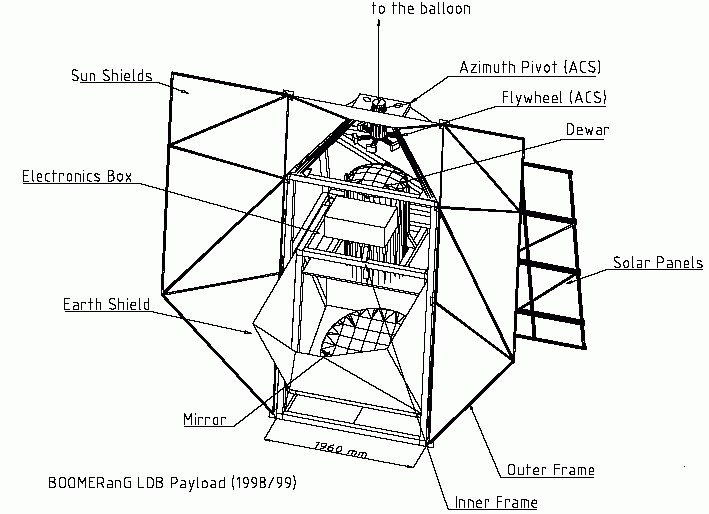
This telescope is the culmination of a great cooperative effort between Italian and American teams. It was designed to have the angular resolution and sensitivity necessary to measure the angular power spectrum of anisotropy in the cosmic microwave background at sub-degree scales, a region where there is a wealth of cosmological information.
The telescope consists of a 1.3m off-axis paraboloidal mirror feeding a pair of cold (1.5 K) ellipsoidal mirrors which reimage the prime focus onto an array of feed horns. These concentrate the incoming radiation onto bolometric detectors, cooled to 0.3 Kelvin by a helium refrigerator.
The pointing system consists of a pair of flywheels which torque the telescope against the flight train of the balloon. The rotation rate is adjusted via feedback from rate gyroscopes, a magnetometer, and tilt sensors. The telescope is fully pointable in azimuth, and can tip between 35 and 55 degrees in elevation. An on-board optical star-tracking camera allows accurate post-flight reconstruction of pointing.
Details of the balloon flight
Balloon launched on: 12/29/1998 at 3:28 utc
Launch site: Williams Field, McMurdo Station, Antarctica
Balloon launched by: National Scientific Balloon Facility (NSBF)
Balloon manufacturer/size/composition: Zero Pressure Balloon Winzen 29.470.000 cuft - SF3-29.47-.8/.8/.8-NA
Balloon serial number: W29.47-2X-30
Flight identification number: 463N
End of flight (L for landing time, W for last contact, otherwise termination time): 1/8/1999 at 17:13 utc
Balloon flight duration (F: time at float only, otherwise total flight time in d:days / h:hours or m:minutes - ): 10.5 d
Landing site: 50 km N of McMurdo Base, Antarctica
Payload weight: 3650 lbs
Overall weight: 4739 lbs
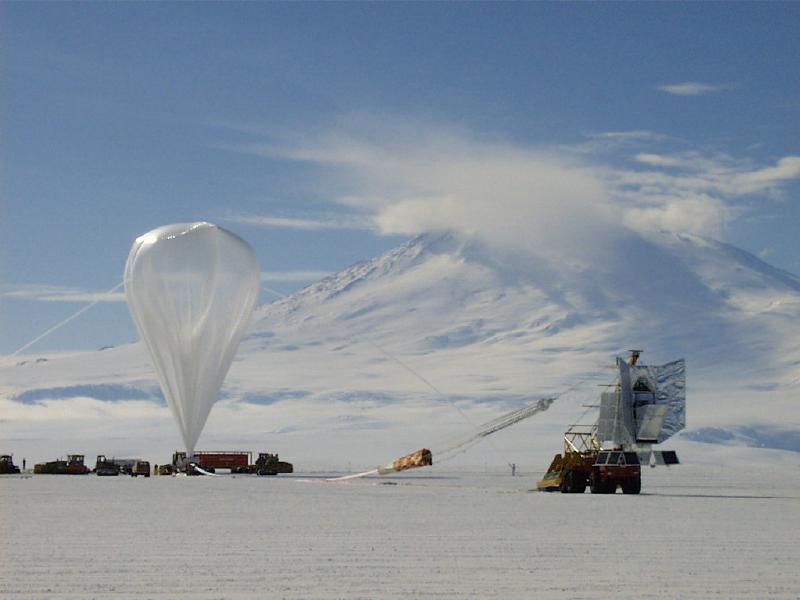
The balloon was launched from Williams Field, by dynamic method assisted by launch vehicle on December 29, 1998.
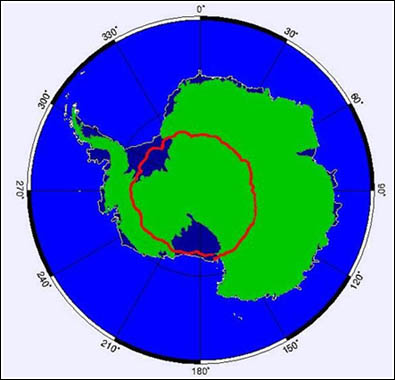
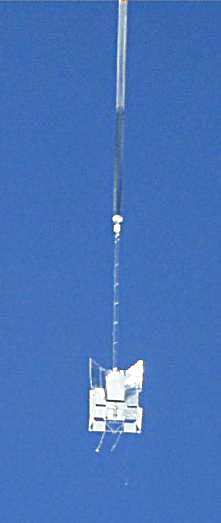
After a nominal ascent phase the balloon achieved the float altitude of 120.000 feet and for the next 10.5 days it floated slowly around the Antarctica in an anti-clockwise flight path at such altitude.
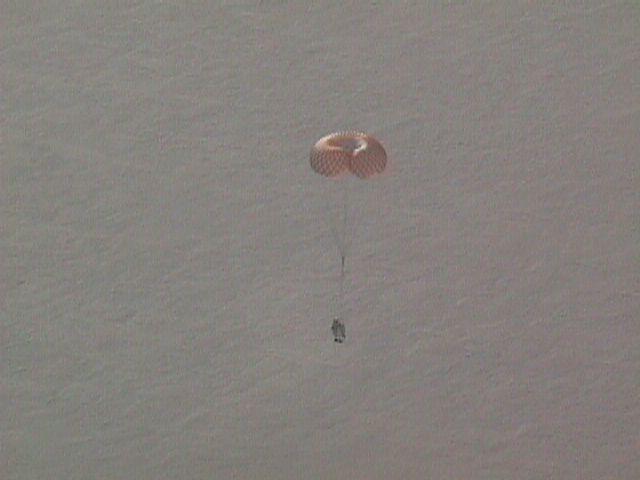
Finally, after a complete circle around the south pole, the flight was terminated and the payload landed 50 km from McMurdo base, for an easy recovery.
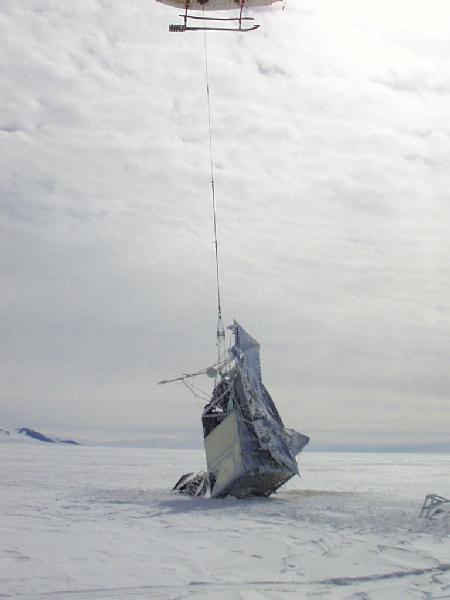
The same day the recovery crew traveled in helicopter to the landing site and readied the payload for its trip back to the base.
This long duration flight was the first to be acomplished in the Antarctic.
Very useful scientific data was obtained.
External references
- BOOMERANG web site (Italy) University of Rome "La Sapienza"
- BOOMERANG web site (USA) Caltech Observational Cosmology Group
- A flat universe from high-resolution maps of the cosmic microwave background radiation Nature, v404, p955, 2000
- A measurement by BOOMERANG of multiple peaks in the angular power spectrum of the cosmic microwave background Astrophys.J. 571 (2002) 604-614
- BOOMERANG: A Balloon-borne Millimeter Wave Telescope and Total Power Receiver for Mapping Anisotropy in the Cosmic Microwave Background ApJS, 148, p527, 2003.
- Cosmological Parameters from the first results of Boomerang Phys.Rev.D, 63, 042001, 2001
- Cosmologists Publish First Detailed Images of Early Universe University of California Press Release
- High latitude Galactic dust emission in the BOOMERanG maps Ap. J. 553, L93, 2001
- Improved Measurement of the Angular Power Spectrum of Temperature Anisotropy in the CMB from Two New Analyses of BOOMERANG Observations Astrophys.J. 599 (2003) 786-805
- Multiple Peaks in the Angular Power Spectrum of the Cosmic Microwave Background: Significance and Consequences for Cosmology Astrophys.J. 564 (2002) 559-566
- NASA Balloon Flights (19891998) in NASA Historical Data Book, Vol. VII: NASA Launch Systems, Space Transportation, Human Spaceflight, and Space Science, 1989-1998
- NASA Scientific Balloon Researchers Receive International Prize in Astrophysics INSIDE WALLOPS - Volume XX-06 - Number 34
- The BOOMERANG experiment Space Sci Rev (1995) 74: 145.
Images of the mission

If you consider this website interesting or useful, you can help me to keep it up and running with a small donation to cover the operational costs. Just the equivalent of the price of a cup of coffee helps a lot.