
Purpose of the flight and payload description
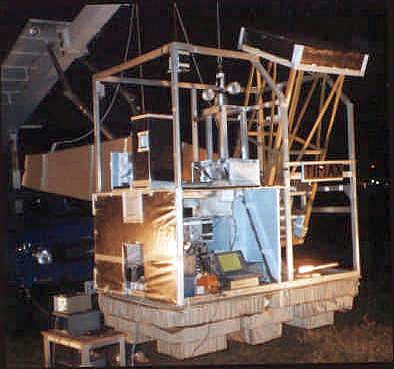
The TIMAX experiment, was the first X-ray imaging telescope entirely conceived, built and launched by a country in the Southern Hemisphere. It was a prototype for the much larger experiment MASCO flown in 2004 by the INPE.
The MASK
The mask of the TIMAX experiment consisted of a 2 x 2 cyclic repetition of a basic 7 x 5 URA pattern, attached in one of the sides of a carbon fiber wheel (material completely transparent for hard Xrays). Each opaque element was a 4.45cm side square made of 3mm thick lead and 1mm thick copper material providing a graded shield. In the opposite side of the wheel, a bar which is also part of the mask and made with the same materials is supported in such a way that it is free to rotate around the center of the mask. If the bar rotates by 90º and the mask by 180º the scientists obtained an antimask of the original mask. This was a new and elegant way to get an antimask in coded-aperture telescopes with neither addition of an extra weight to the experiment nor further mechanical complex manipulations, which have always hindered the operation of similar experiments.
Detectors
The position-sensitive detector (PSD) plane consisted of 35 cilindrical NaI(Tl) detectors, 2 mm thick and 4.45 cm in diameter, with an useful sensitive diameter of 3.18 cm, placed in a matrix array of 7 x 5 to be compatible with the URA pattern used. The total geometric area was ~400 cm2. Each detector was coupled to a photomultiplier and these were powered by five high voltage units (900 V). The detectors operated in the 30-100 keV range, set by lower-level and upper-level discriminators. The whole detector system was passively shielded on the sides and on the back by 3mm thick copper and 1 mm lead plates.
Electronics
Each PMT pulse produced by a scintillation event due to a X-ray interaction in one of the detectors was analized in 32 energy channels. The on-board electronics then identified the detector in which the event ocurred, then added the event time read from an internal clock and finally a microprocessor formated all the information, including housekeeping data (temperature, atmospheric pressure, etc) of the gondola, for subsequent transmission by telemetry. There was no data storage on-board.
Gondola
In order to allow the telescope to point at high elevation angles, the support system was designed to be placed off-center in the balloon gondola. In this way, the detector system, including the Collimator and shielding parts, and the codedmask which was attached to a carbon-fiber wheel driven by a motor, were placed in one side of the gondola in a 'tower-like' metal structural frame supported and balanced by a horizontal axis that allowed the telescope to point in a specific elevation angle. On the other side were allocated the electronics rack, the telemetry system and the batteries. The entire gondola rotated in azimuth, with the pointing in a specific azimuth angle being controlled and stabilized by a system based on a geomagnetic sensor with a accuracy of 1º. The telescope 'tower' was positioned in elevation by a shaft encoder with a 0.5º accuracy. The pointing system was operated in manual mode through commands sent from the ground or in a semi-automatic way following the source path in the sky, given its initial position and the balloon velocity vector.
The total weight of the experiment (including gondola frame, telescope, electronics and telemetry racks, magnetometer, batteries and ballast system) was 600 kg.
Details of the balloon flight
Balloon launched on: 6/8/1993 at 21:27
Launch site: Birigui Airport, Sao Paulo, Brazil
Balloon launched by: Setor de Lancamento de Baloes (SLB) / Instituto Nacional de Pesquisas Espaciais (INPE)
Balloon manufacturer/size/composition: Zero Pressure Balloon Winzen - 186.000 m3
End of flight (L for landing time, W for last contact, otherwise termination time): 6/9/1993
Balloon flight duration (F: time at float only, otherwise total flight time in d:days / h:hours or m:minutes - ): ~ 8 h
Payload weight: 600 kgs
The balloon was launched from Birigui Airport on June 8th, 1993, at 21:27 UTC, by the Balloon Launching Center of INPE. The balloon reached float altitude of 42.4 km at 24:00 UT, and remained at this altitude for near 8 hours. The conditions were excellent for a balloon flight and for the astronomical hard X-ray observations intended.
The external temperature at float altitude remained near -30º C. This was completely unexpected, since the typical average for 40 km at these latitudes is near -13º C. Due to these anomalous temperatures, even though the scientists used standard high-density styrofoam thermal insulation (which usually keeps the internal temperature 10º C above the external one), the internal temperature (at float altitude) experimented variations from -8º C to -24ºC and this caused the batteries (that is the power supplies of all detector electronics) to fail ~ 25 minutes after the float altitude has been reached (Post-flight tests of the detectors batteries in a thermal chamber showed that the batteries begin to fail at -12º C)
Nevertheless, the house-keeping batteries were different and supported the temperature variations, so the ground team was able to record several on-board parameters as well to measure the instrumental Hard X-Ray background spectrum at float altitude.
These measurements enabled the science team to calculate the sensibility of the experiment, showing that the scientific objectives of the experiment were feasible.
External references
- An overview of the TIMAX experiment Revista de Física Aplicada e Instrumentação - Volume 10 - Número 1 - Março 1995
- Calibration and performance of the hard X-ray imaging telescope TIMAX Revista Mexicana de Astronomia y Astrofisica, Vol. 26, p. 133 (1993)
- Development of the balloon-borne hard X-ray imaging experiment TIMAX Advances in Space Research, Volume 15, Issue 5, May 1995, Pages 157160
- Development of the hard X-ray imaging experiment timax: Laboratory images and first balloon flight Experimental Astronomy, Volume 5, Issue 3-4 , pp 269-278 (1994)
- Nuclear Instrumentation for Astrophysical applications
- O desenvolvimento do Projeto TIMAX: um telescópio imageador de raios-X duros Dissertação (Mestrado em Ciência Espacial- INPE - 1992
- Refined Laboratory Images and Flight Results of the Hard X-Ray Coded-Aperture Telescope TIMAX Revista Mexicana de Astronomia y Astrofisica Serie de Conferencias, Vol. 4,
StratoCat is an independent, non-commercial project maintained to preserve and share the history of scientific and stratospheric ballooning. If you find the site useful, you can help keep it running with a small donation toward its operating costs. Every contribution, even the equivalent of a cup of coffee, is greatly appreciated.