ZANDER, Rodolphe (1938 - 2015)
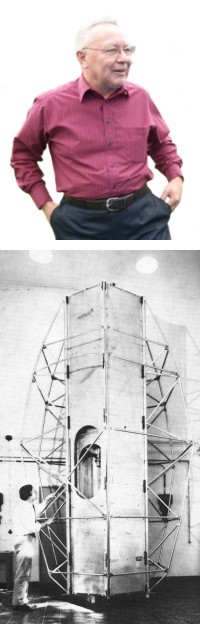
Rodolphe (Rudy) Zander was a Belgian physicist and atmospheric scientist whose work with stratospheric balloon-borne infrared spectroscopy contributed significantly to the study of the Earth's atmosphere and the development of atmospheric remote sensing. Born in 1938, he received a PhD in Physics from the University of Li&eagrave;ge in 1968 with a dissertation based on infrared solar spectra obtained from stratospheric balloon flights, which advanced the study of water vapour above 25 km altitude under the supervision of Marcel Migeotte. During his doctoral research he spent 19641965 as a visiting scientist at Johns Hopkins University, where he worked with John Strong and acquired expertise in atmospheric observations from stratospheric balloon gondolas.
Following his appointment as Senior Scientist at the University of Liege in 1969, Zander established himself as one of the leading specialists in high-resolution infrared atmospheric spectroscopy. He directed the University's infrared research group (GIRPAS) until his retirement in 2003 and later held a professorship teaching atmospheric physics and chemistry. During more than two decades he organized and coordinated 27 scientific stratospheric balloon flights using the University of Liege gondola, launching primarily from Palestine, Texas, and Fort Sumner, New Mexico. These flights supported measurements of atmospheric trace gases with high-resolution infrared spectrometers and produced some of the earliest quantitative observations of the upper stratosphere.
Among his most important ballooning achievements was the first detection of hydrogen fluoride (HF) in the upper stratosphere in 1975. This observation provided direct evidence that chlorofluorocarbons released at the Earth's surface were transported into the stratosphere, where photolysis released fluorine and chlorine atoms responsible for ozone depletion. The result became a landmark in atmospheric chemistry and demonstrated the scientific value of high-altitude balloon platforms for atmospheric research.
Zander also played a major role in extending balloon-based atmospheric spectroscopy to satellite observations. As co-investigator on NASA's Atmospheric Trace Molecule Spectroscopy (ATMOS) experiment aboard the Space Shuttle, he helped define the mission's scientific objectives, participated in the validation of flight data, analyzed infrared spectra, and published numerous studies on the composition of the stratosphere. He complemented these activities through long-term ground-based observations at the Jungfraujoch observatory in Switzerland and became a founding leader of the Network for the Detection of Stratospheric Change (later the Network for the Detection of Atmospheric Composition Change, NDACC), serving as Vice-Chair and later Co-Chair of its Steering Committee.
Over his career Zander authored more than 160 scientific publications and received several distinctions, including the Louis Melsens Prize (1976), the Agathon de Potter Prize (1988), and NASA's Group Achievement Award (1995) for his contribution to the ATMOS missions. He served on numerous international scientific committees and editorial boards and was widely recognized for his contributions to atmospheric science. His work established stratospheric balloon infrared spectroscopy as a fundamental tool for measuring atmospheric trace gases and monitoring long-term changes in atmospheric composition, making him one of the principal contributors to the application of balloon platforms in modern atmospheric research.
Zander died in Liege, on 22 October 2015 at the age of 77 years.
About StratoCat
Some Statistics
+ 20 articles from different contributors
+ 16006 balloon launch records already published
+ 16103 balloon launch records in the full database
StratoCat is a non-profit, educational and informative website created, developed and programmed by Luis E. Pacheco. It is based on an idea first conceived by the author in 2001 and is online since September 17th, 2005.
This website is an independent initiative, and thus is not endorsed, supported or have any relationship with any governmental or private agency or company in the balloon field.
Page generated on 18-Jul-2026 - 01:38:18pm  © StratoCat 2005~2026 - All Rights Reserved.