
Armstrong Limit
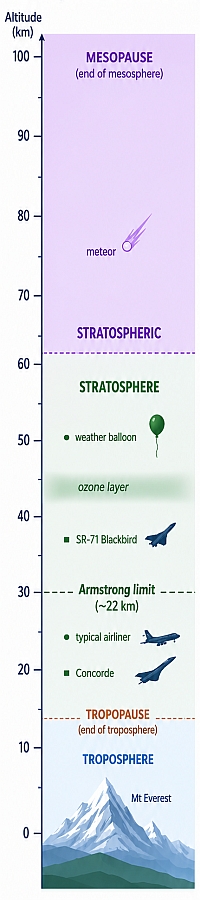
The Armstrong limit, or Armstrong line, is the altitude at which atmospheric pressure falls below the vapor pressure of water at normal human body temperature (37 °C). It is conventionally placed at approximately 19 km (62,000 ft), where the ambient pressure is about 6.3 kPa (47 mmHg). Above this altitude, body fluids exposed to the environment begin to vaporize, making unprotected human survival impossible regardless of the availability of supplemental oxygen.
The limit is named after Harry George Armstrong (18991983), an American physician, pioneer in aviation medicine, and the first Surgeon General of the United States Air Force. Armstrong's research on high-altitude physiology, decompression, and life-support systems established many of the medical principles later applied to high-altitude aviation and human spaceflight.
The principal hazard above the Armstrong limit is ebullism, the formation of water vapor within exposed body fluids and tissues due to the extremely low ambient pressure. Saliva, tears, and moisture in the respiratory tract boil, while gases dissolved in tissues expand, producing marked swelling. Blood itself does not boil because it remains under circulatory pressure. Exposure also causes rapid hypoxia, and loss of useful consciousness generally occurs within 10 to 15 seconds if the individual is not breathing pure oxygen before decompression. Survival therefore requires either a pressurized cabin or a full-pressure suit; supplemental oxygen alone is insufficient above the Armstrong limit.
For high-altitude ballooning, the Armstrong limit marks the transition from the upper atmosphere to an environment requiring full pressure protection for human occupants. Although unmanned scientific balloons routinely operate far above this altitude, all crewed balloon flights crossing the line have relied on pressurized capsules, pressure suits, or both.
Several historic balloon programs operated above the Armstrong limit. The U.S. Air Force Project Manhigh missions (19571958) carried crews to approximately 30 km in pressurized gondolas to investigate human performance in the stratosphere. The U.S. Navy's Strato-Lab program (19561961) conducted a series of manned scientific balloon flights reaching altitudes above 34 km, contributing to research on cosmic rays, atmospheric science, astronomy, and high-altitude life-support systems.
Project Excelsior (19591960) demonstrated emergency escape from the stratosphere. During Excelsior III, Colonel Joseph W. Kittinger II ascended to 31.3 km in an open gondola while wearing a full-pressure suit before completing a record-setting parachute descent. More than fifty years later, the Red Bull Stratos mission carried Felix Baumgartner to 38.97 km in a pressurized capsule, while in 2014 Alan Eustace ascended to 41.4 km suspended directly beneath a balloon in an advanced pressure suit before performing the highest freefall on record.
The Armstrong limit also features prominently in the history of unsuccessful balloon missions. Between 1965 and 1966, Nick Piantanida attempted to establish new records with the privately funded Strato-Jump program. His second flight reached approximately 37.6 km (123,500 ft), well above the Armstrong limit, but the planned parachute jump was aborted after problems with his oxygen system. During Strato-Jump III, his pressure suit suffered a catastrophic failure at about 17.6 km (57,600 ft), causing rapid decompression and severe cerebral hypoxia. Although recovered alive, Piantanida never regained consciousness and died several months later.
The Armstrong limit remains one of the fundamental operational boundaries in high-altitude ballooning and aerospace medicine. Unlike atmospheric layers defined by temperature or composition, it represents a physiological threshold determined by the pressure required to maintain liquid water within the human body, and it continues to define the minimum pressure protection required for all crewed balloon flights into the upper stratosphere.
About StratoCat
Some Statistics
+ 20 articles from different contributors
+ 16006 balloon launch records already published
+ 16103 balloon launch records in the full database
StratoCat is a non-profit, educational and informative website created, developed and programmed by Luis E. Pacheco. It is based on an idea first conceived by the author in 2001 and is online since September 17th, 2005.
This website is an independent initiative, and thus is not endorsed, supported or have any relationship with any governmental or private agency or company in the balloon field.
Page generated on 18-Jul-2026 - 01:38:18pm  © StratoCat 2005~2026 - All Rights Reserved.