
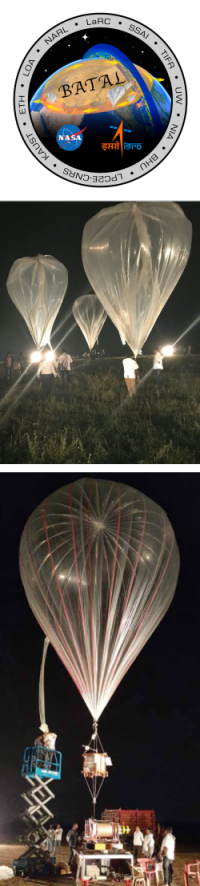
 BATAL (Balloon Measurements of the Asian Tropopause Aerosol Layer)
The BATAL campaign was a series of coordinated scientific balloon flights conducted since 2014 primarily in India and also in Saudi Arabia, to investigate the nature, formation, and impacts of the Asian Tropopause Aerosol Layer (ATAL). This persistent layer of polluted aerosols, observed in the upper troposphere and lower stratosphere (UTLS) between approximately 13 and 18 kilometers during the Asian summer monsoon, was initially detected by satellite observations. The campaign was motivated by a significant shift in atmospheric pollution, where sulfur dioxide emissions from India doubled between 2005 and 2015, coinciding with a decrease in China's emissions. The Asian summer monsoon provides a powerful vertical pathway, where deep convective storms transport boundary-layer pollutants from the surface to the UTLS, where they are then confined and circulated by the large Asian monsoon anticyclone. Understanding the ATAL is critical because these aerosols can influence the Earth's radiative balance, affect stratospheric ozone chemistry through heterogeneous reactions, and modify the properties of high-altitude cirrus clouds.
The BATAL campaigns were a multinational collaboration involving institutions from the United States, India, France, Switzerland, and Saudi Arabia, including NASA, the Indian Space Research Organisation (ISRO), the National Atmospheric Research Laboratory (NARL), and the Tata Institute of Fundamental Research (TIFR). The primary science objectives were to characterize the optical properties, size distribution, and chemical composition of the ATAL; to understand the behavior of ozone and water vapor in its vicinity; and to determine the influence of convection on its formation and variability. To achieve these goals, the campaign conducted balloon flights from four primary launch sites: Gadanki and Hyderabad in southern India, Varanasi in northern India (near the core of the monsoon anticyclone), and Thuwal in Saudi Arabia (selected to sample the westward outflow from the monsoon system).
During BATAL were performed balloon flights in different configurations, each one tailored to different measurement strategies. Heavy Flights (HF) used large, 3,000-cubic-meter polyethylene balloons to lift payloads over 30 kilograms, carrying instruments for comprehensive aerosol characterization. Zero-pressure flights (ZF) were used for extended float durations of several hours near the tropopause, enabling the collection of sufficient aerosol samples on filters for offline chemical analysis; this was achieved using a ballast system to compensate for altitude loss in the extremely cold temperatures. Light and Medium flights employed standard latex balloons for frequent, cost-effective profiling of aerosol backscatter, ozone, and water vapor. Finally, the controlled Boomerang system was used to attempt measurements within or near convective storms, featuring a valve and ballast mechanism to precisely control ascent rates and prolong measurement time in the UTLS.
The BATAL campaigns provided the first detailed in-situ characterization of the ATAL. Measurements showed that the layer is dominated by very small liquid aerosolswith a high volatile fraction and relatively low scattering ratios, consistent with satellite lidar observations. Chemical analyses revealed an unexpected composition: nitrate appeared to be a major component, while sulfate was below detection limits, raising new questions about formation pathways and the role of nitrogen oxides. Observations also indicated a decline in aerosol concentration near 18 km, suggesting an upper boundary to convective influence. Enhanced water vapor and occasional ice crystals at and above the tropopause linked the layer directly to deep convection. Trajectory and cloud-top temperature analyses showed that sampled air masses were frequently influenced by convective systems over India, the Bay of Bengal, Southeast Asia, and China, with one flight providing evidence of ice injection into the lower stratosphere by a mesoscale convective system.
Related Entries
External Links
BATAL website - at NASA Langley Research Center
About StratoCat
Some Statistics
+ 20 articles from different contributors
+ 16006 balloon launch records already published
+ 16103 balloon launch records in the full database
StratoCat is a non-profit, educational and informative website created, developed and programmed by Luis E. Pacheco. It is based on an idea first conceived by the author in 2001 and is online since September 17th, 2005.
This website is an independent initiative, and thus is not endorsed, supported or have any relationship with any governmental or private agency or company in the balloon field.
Page generated on 18-Jul-2026 - 01:38:18pm  © StratoCat 2005~2026 - All Rights Reserved.