
ATA Aerospace
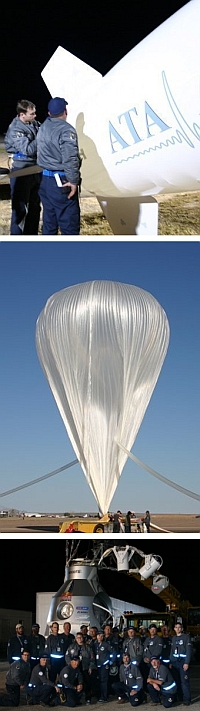
ATA Aerospace is a U.S. company specializing in spacecraft and payload systems, precision sensors, guidance and control technologies, telemetry, environmental testing, aerospace manufacturing, systems engineering, and defense test support. Its areas of expertise also include engineering and operational support for high-altitude balloon missions. Its balloon activities originated through long-term support of the U.S. Air Force balloon program, where it provided the personnel and technical capabilities required to conduct scientific, technology demonstration, and military balloon flights.
ATA Aerospace was established as a joint venture between Applied Technology Associates (ATA) and ASRC Aerospace, with ATA serving as the managing partner under the Air Force Research Laboratory (AFRL) Space Technology Research, Analysis, Integration and Test (STRAIT) contract. Applied Technology Associates, founded in 1975 in Albuquerque, New Mexico, specialized in aerospace instrumentation, sensing, and control systems. Through its AFRL contracts, the company assumed responsibility for the operational support of the Air Force balloon program.
The capabilities inherited by ATA Aerospace were developed through more than fifty years of Air Force balloon operations based at Holloman and Kirtland Air Force Bases, New Mexico. During this period the program launched more than 3,000 high-altitude balloons in support of scientific research, military technology development, and engineering tests. Balloon operations were also conducted from remote launch sites in the United States and overseas. The program supported several NASA projects, including test flights for the Viking, Pioneer Venus, and Galileo missions from Roswell, New Mexico, using the White Sands Missile Range for tracking and recovery.
Mission support was provided through facilities at Holloman and Kirtland Air Force Bases that included payload integration areas, telemetry stations, machine and parachute shops, clean rooms, thermal-vacuum chambers, and electromagnetic compatibility laboratories. The company also developed and operated the Balloon Experiment Control System (BECS), which integrated command and control, telemetry, flight safety, GPS tracking, payload monitoring, and redundant flight termination. Its telemetry infrastructure included S-band communications, auto-tracking antennas, and mobile ground stations. These capabilities were later expanded with the High Altitude Balloon Telemetry System (HABTS), a microprocessor-based command and telemetry system that increased flexibility and bandwidth for scientific payloads.
ATA Aerospace also operated mobile telemetry and mission control stations deployable to launch and recovery sites. Equipped with auto-tracking antennas, communications equipment, and independent power supplies, these units provided continuous command and telemetry coverage throughout flight operations.
Following reforms in U.S. government contracting, ATA Aerospace became able to provide complete balloon flight services directly to non-government customers while continuing its support of AFRL programs. A major milestone in the company's history was its participation in the Red Bull Stratos project, for which it was responsible for the balloon flight operations that carried Felix Baumgartner to an altitude of 38.97 km on 14 October 2012. The company conducted balloon launch operations, ascent control, telemetry, command and control, flight safety, and recovery support.
Related Entries
About StratoCat
Some Statistics
+ 20 articles from different contributors
+ 16006 balloon launch records already published
+ 16103 balloon launch records in the full database
StratoCat is a non-profit, educational and informative website created, developed and programmed by Luis E. Pacheco. It is based on an idea first conceived by the author in 2001 and is online since September 17th, 2005.
This website is an independent initiative, and thus is not endorsed, supported or have any relationship with any governmental or private agency or company in the balloon field.
Page generated on 18-Jul-2026 - 01:38:18pm  © StratoCat 2005~2026 - All Rights Reserved.