
Purpose of the flight and payload description
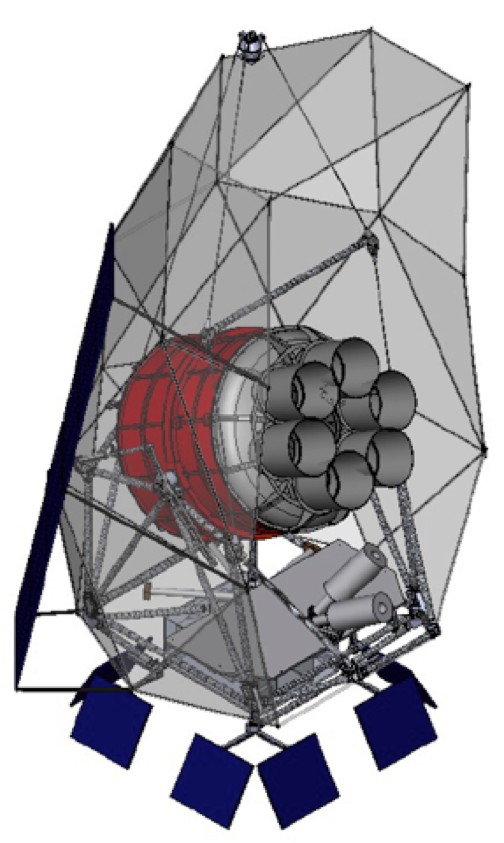
Spider is a balloon-borne experiment designed to search for primordial gravity waves imprinted on the cosmic microwave background (CMB). Measuring the strength of this signal puts limits on inflationary theory.
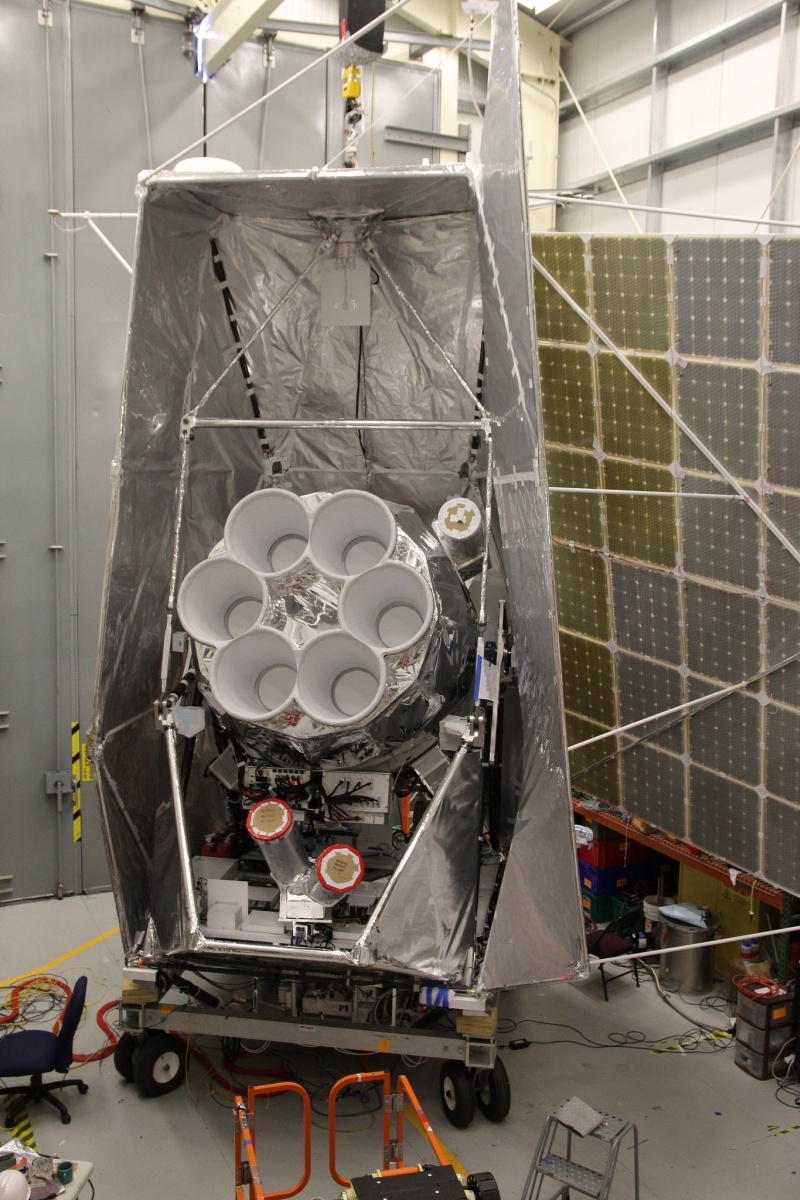
The Spider instrument (shown in figure at left) consists of six degree-resolution independent monochromatic telescopes cooled to liquid Helium temperature (4 degrees Kelvin). The telescopes which observe at frequencies of 100 GHz, 150 GHz, and 220 GHz (corresponding to wavelengths of 3 mm, 2 mm, and 1.4 mm) are coupled to a polarisation-sensitive transition-edge bolometer array cooled to 250 mK. Each telescope is housed in a single long hold time cryostat and is fully baffled from radiation from the ground and balloon by a lightway stratucture made of thin-foil. The gondola permits the instrument to scan in azimuth with a reaction wheel and a motorized pivot. The cryostat, mounted on bearings, can be adjusted in elevation.
Solar arrays provide power for the instrument and onboard instrumentation.
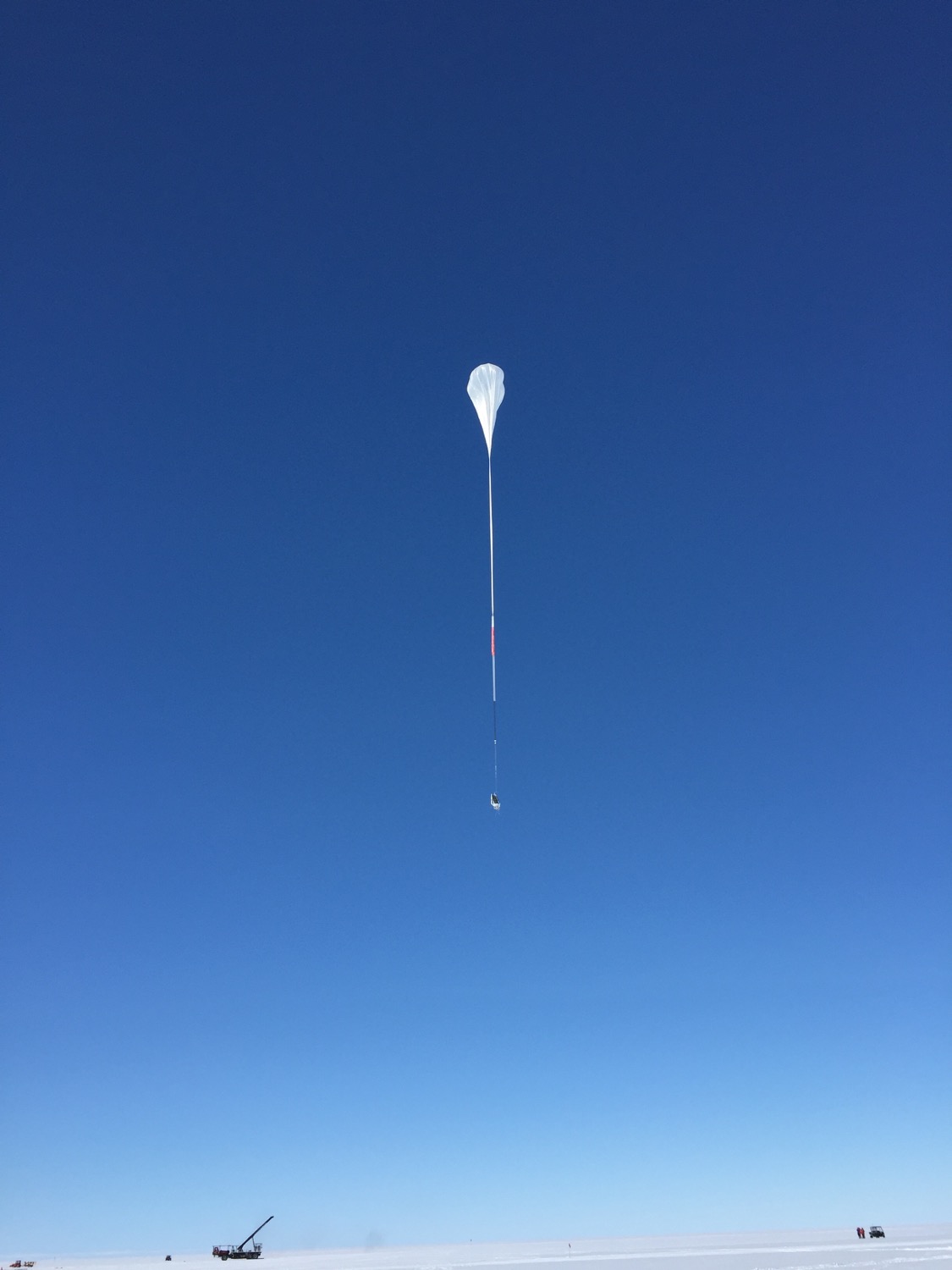
Video footage of the launch
Details of the balloon flight
Balloon launched on: 1/1/2015
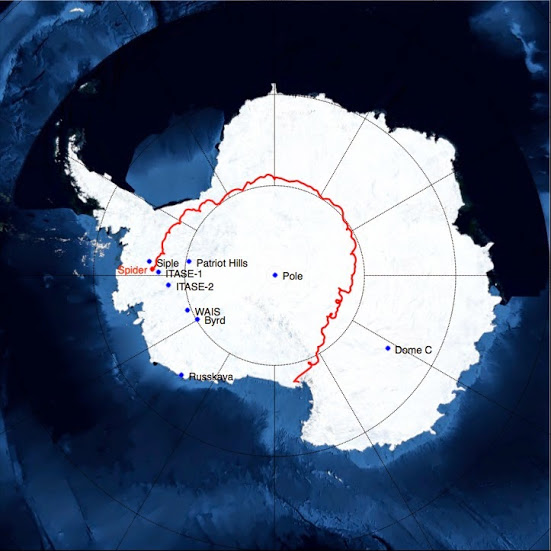
Launch site: Williams Field, McMurdo Station, Antarctica
Balloon launched by: Columbia Scientific Balloon Facility (CSBF)
Balloon manufacturer/size/composition: Zero Pressure Balloon Raven - 39.570.000 cu ft - (0.8 Mil.)
Flight identification number: 660N
End of flight (L for landing time, W for last contact, otherwise termination time): 1/17/2015 at 11:55 est
Balloon flight duration (F: time at float only, otherwise total flight time in d:days / h:hours or m:minutes - ): 16 d 12 h
Landing site: SE of Siple station, Antarctica
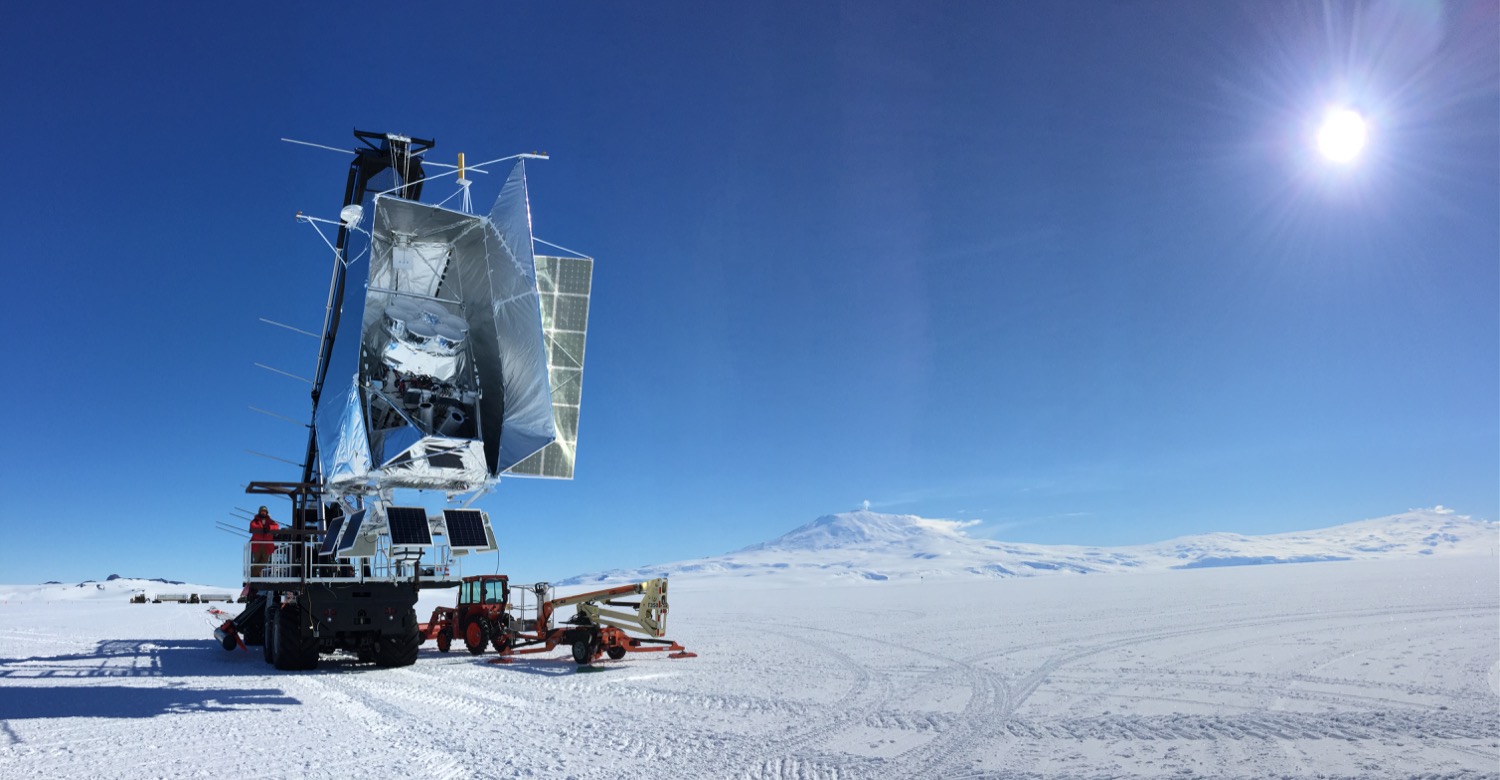
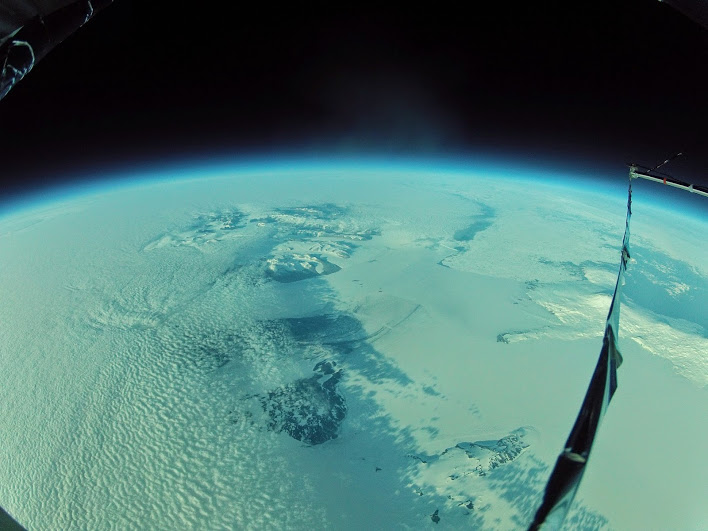
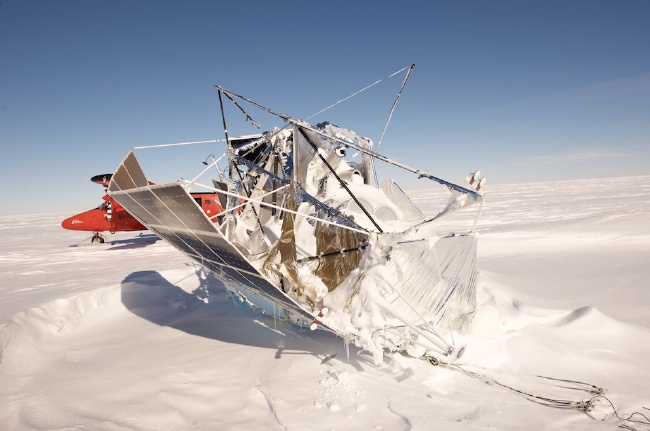
SPIDER was launched by dynamic method on January 1, 2015, from the NASA/NSF Long-Duration Balloon (LDB) facility near McMurdo Station, Antarctica. All payload systems performed well throughout the flight, with the exception of a differential GPS unit failure that had no significant impact on flight operations or pointing reconstruction. SPIDERs flight lasted 16.5 days at an average altitude of 35 km. The flight was terminated when cryogens were exhausted and the circumpolar wind system began to fail. The payload touched down in a remote region of Ellsworth Land of West Antarctica. Data drives and key flight hardware were recovered in February by personnel from the British Antarctic Survey; a second team recovered the remainder of the instrument in November.
External references
- A Constraint on Primordial B-Modes from the First Flight of the SPIDER Balloon-Borne Telescope Cosmology and Nongalactic Astrophysics (astro-ph.CO)
- A New Limit on CMB Circular Polarization from SPIDER ArXiv, Cosmology and Nongalactic Astrophysics
- A Simulation-Based Method for Correcting Mode Coupling in CMB Angular Power Spectra Cosmology and Nongalactic Astrophysics (astro-ph.CO)
- Characterization of detectors and instrument systematics for the SPIDER CMB polarimeter Dissertation (Ph.D.) by Rebecca Suzanne, California Institute of Technology (2014)
- How It All Began - For half a century Princetonians have studied the history of the universe, but the past year was among the most exciting yet Princeton Website
- Polarimetry from the Stratosphere with Spider and BLASTPol Ph.D Thesis by Jamil Aly Shariffl, University of Toronto (2015)
- Spider flies to catch an elusive wave Mail & Guardian Online
- SPIDER web site California Institute of Technology
- SPIDER Website Jón E. Guðmundsson
- SPIDER website Princeton University
- SPIDER: a balloon-borne CMB polarimeter for large angular scales Proc. SPIE 7741, Millimeter, Submillimeter, and Far-Infrared Detectors and Instrumentation for Astronomy V, 77411N (July 15, 2010)
- Spider: Mechanical Design of a Resealable Window Ph.D Thesis by Taylor G. Martin, University of Toronto (2010)
- SPIDER: Probing the dawn of time from above the clouds Proceedings of The Fourteenth Marcel Grossmann Meeting, World Scientific Publishing Co Pte Ltd, 2017, p. 2073
- The Big-Bang by balloon by Ethan Siegel at Medium.Com
- The SPIDER CMB polarimeter Dissertation (Ph.D.) by Trangsrud, Amy R., California Institute of Technology (2012)
- The thermal design, characterization, and performance of the SPIDER long-duration balloon cryostat
- This Newfoundland scientist is studying the big bang with balloons in Antarctica CBC Canada
- UKZN Astrophysicist Helps Launch Antarctic Balloon-Borne Telescope UKZndaba Online
Images of the mission
If you consider this website interesting or useful, you can help me to keep it up and running with a small donation to cover the operational costs. Just the equivalent of the price of a cup of coffee helps a lot.