
Purpose of the flight and payload description
The EPSILON AEROSOL PARTICLE SPECTROMETER was a specialized instrument designed to achieve unprecedented resolution in measuring the size distribution of stratospheric particles. Its development was initiated under a competitive bid contract awarded to GCA Corporation. Following the formation of Epsilon Laboratories, this organization assumed responsibility for further development and refinement under subsequent contracts, ultimately transferring the program to the Air Force Geophysics Laboratory's Aeronomy Division.
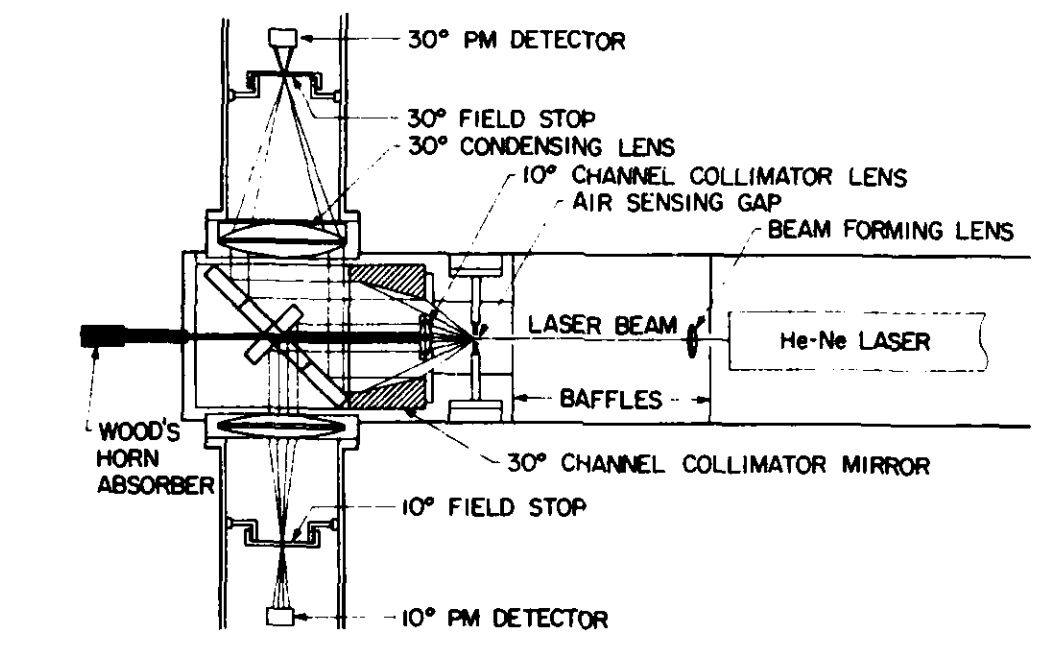
The heart of the instrument was a two-channel, high-resolution forward scattering spectrometer. In the image at left we can see an schematic view of its optical portion (click to enlarge). Its illumination source was a Spectra Physics 15-mW helium-neon laser, modified by replacing the circular beam with a Collimated ribbon-shaped beam of 6328 Å light. The laser was housed in a pressurized enclosure to prevent overheating and high-voltage arcing during high-altitude balloon flights. The redesigned beam maximized illumination of the interaction volume and improved particle sizing resolution.
Ambient air was sampled under laminar flow through a one-millimeter internal diameter tube. A three-millimeter gap in this tube served as the sensing region, illuminated perpendicularly to the airflow. Aerosol particles passing through this volume scattered light collected by two independent annular optical systems. A lens collected light at 10 ± 5 degrees, and an off-axis paraboloid mirror collected light at 30 ± 2.5 degrees. These optical paths produced collimated beams directed by 45-degree plane mirrors to photomultiplier tubes (PMTs) with condensing lenses and aligned apertures. Only light scattered from the one-cubic-millimeter interaction volume reached the photocathodes. Unused laser light was absorbed by baffles, reducing stray light to one part in 10^11. The sensitivity limit was set by Rayleigh scattering from air molecules.
Airflow was maintained with an oil-less carbon vane pump. A critical orifice at the output established sonic flow, but the actual inlet flow was determined by measuring pressure drop across the inlet tube with a differential pressure transducer. Flow varied with changing external pressure during balloon ascent and descent, sometimes stagnating or reversing on ascent or becoming higher than the orifice rate on descent. Early flights used a potentiometric transducer subject to hysteresis and damage; later flights used a variable reluctance type.
Electronic processing was designed to handle short, low-amplitude PMT signals. As particles traversed the beam, they produced pulses of ~50 µs duration. Circuits captured the peak value of these pulses. A threshold circuit tracked the DC background of each PMT, and when exceeded, a 60-µs peak detection window was triggered. Valid particle detection required coincident pulses in both channels. Optical size was derived from the sum of both signals, while their ratio provided diagnostic information such as refractive index. The system handled PMT currents from 10^-8 A to 10^-4 A. Before the 1975 flight, a calibration system was added: every fourth minute, an LED generated 256 calibrated pulses to check the detection and electronic chain.
Data were recorded on 9-track magnetic tape at 800 bpi in non-return-to-zero format. Each 20-second record contained a unique code, housekeeping data (laser power, temperatures, voltages), and 3488 characters of optical data (1744 samples). A later modification reserved every 64th sampling interval for background noise measurement.
Calibration before each flight used monodisperse polystyrene latex spheres from 0.20 to 1.0 µm diameter. Sizing accuracy was ±10 percent for particles with refractive indices between 1.33 and 1.60. An average refractive index of 1.40 was assumed for atmospheric aerosols.
The pressurized optical housing with electronics chassis and power supply were mounted in an aluminum frame gondola whose sides were covered by reflective aluminum panels for temperature control of the instrument. The total payload of the gondola package was approximately 500 pounds.
Details of the balloon flight
Balloon launched on: 5/27/1980 at 13:00 utc
Launch site: Holloman Air Force Base, Alamogordo, New Mexico, US
Balloon launched by: Air Force Geophysics Laboratory (AFGL)
Balloon manufacturer/size/composition: Zero Pressure Balloon Winzen 5.025.000 cuft (1.0 Mils Cap. 1.0 mils- Stratofilm)
Balloon serial number: 238.85 1.0 NSCR 1.0 Cap. SN:91
Flight identification number: RV-2
End of flight (L for landing time, W for last contact, otherwise termination time): 5/27/1980
Balloon flight duration (F: time at float only, otherwise total flight time in d:days / h:hours or m:minutes - ): 6 h 45 m
Landing site: 19 miles N of Socorro, Nuevo Mexico, US
Payload weight: 1762 lbs
External references
- Stratospheric Aerosol Measurements Final rept. 10 Jul 79-30 Oct 80 - EPSILON LABS INC BEDFORD MA - Dec. 1980
- Aerosol Measurements with a High Resolution Spectrometer - A Summary Report AIR FORCE GEOPHYSICS LAB HANSCOM AFB MA (1982)
- Report on Research at AFGL, January 1979-December 1980. Pag. 16 Air Force Geophysics Lab Hanscom AFB MA (1982)
- Summary of Balloon Flights launched from H.A.F.B. NM (1962 thru 1987) U.S. Gov. National Archives
StratoCat is an independent, non-commercial project maintained to preserve and share the history of scientific and stratospheric ballooning. If you find the site useful, you can help keep it running with a small donation toward its operating costs. Every contribution, even the equivalent of a cup of coffee, is greatly appreciated.