
Purpose of the flight and payload description
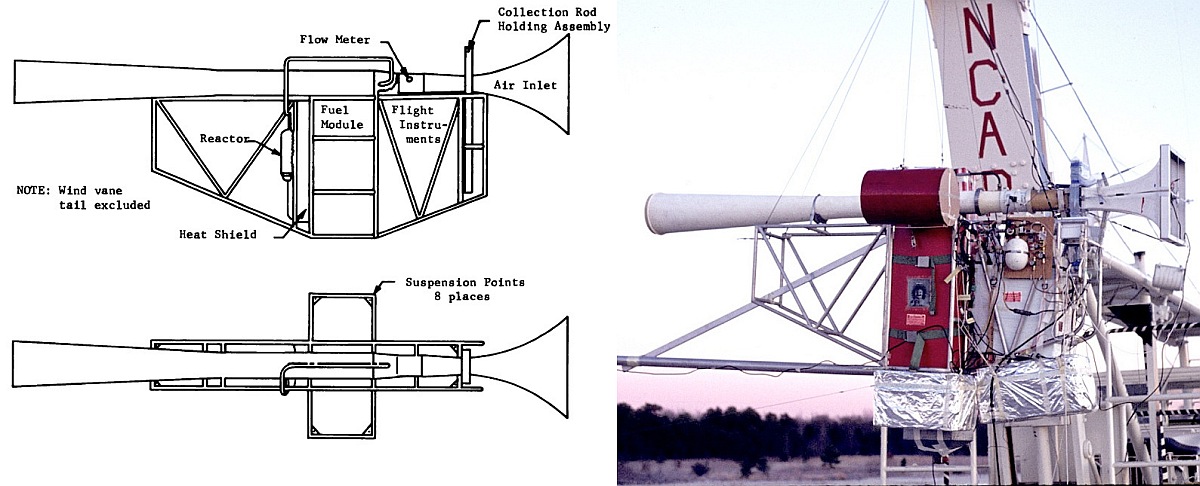
The VACUUM MONSTER was a a highly sensitive volume-sampling micrometeorite collector developed by the University of Washington, in cooperation with Litton Industries, to capture interplanetary dust particles at an altitude of 35 km. The collector, capable of sampling over 106 cubic feet of ambient stratospheric air during a five-hour period, was named after the creature in the Beatles movie Yellow Submarine that sucked up everything.
In the image at left we can see an scheme of the collector and an actual picture of it (click to enlarge). The pump that powered the collector measured four meters long and used an air ejector system driven by the catalytic decomposition of hydrazine, with 150 pounds of hydrazine stored on board. It was a modified version of the one developed by Litton for sampling stratospheric bomb debris from nuclear tests. Air was drawn through a horn-shaped inlet and passed over 22 cylindrical collection rods mounted perpendicular to the airstream. These rods, coated in silicone oil, trapped incoming particles by inertial deposition. The rods were each 0.25 inches in diameter and 2.25 inches long and were highly efficient at capturing particles larger than approximately 2 micrograms. Before and after the collection phase, the rods were sealed from contamination using a slide-gate mechanism, a butterfly valve, and a removable cover, all of which were critically cleaned in a class-100 cleanroom.
To minimize contamination from the balloon or the gondola, the collector was suspended 3000 feet below the balloon using a nylon line. A 30-foot tail boom with 400 cubic feet of deployed sail area gave the collector wind-vane-like aerodynamics, ensuring that the horn inlet always faced the incoming stratospheric wind. This setup created an environment analogous to a laminar-flow cleanroom. The orientation of the collector was continuously monitored with a flux gate magnetometer and a sequence camera. Only the upstream-facing halves of the rods were exposed to incoming particles, while the downstream halves served as controls to identify and rule out any contamination from handling or the instrument itself.
Details of the balloon flight
Balloon launched on: 5/2/1971
Launch site: NCAR National Scientific Balloon Flight Station, Palestine, Texas, US
Balloon launched by: NCAR National Scientific Balloon Flight Station
Balloon manufacturer/size/composition: Zero Pressure Balloon Winzen - 2.900.000 cuft (1.0 mil. Stratofilm)
Flight identification number: 608P
End of flight (L for landing time, W for last contact, otherwise termination time): 5/2/1971
Balloon flight duration (F: time at float only, otherwise total flight time in d:days / h:hours or m:minutes - ): F 6 h 20 m
Payload weight: 831 lbs
The balloon was launched on May 2, 1971 from the NCAR's flight station of Palestine, Texas. During the flight approximately 200,000 cubic feet of air were sampled, and the scanning techniques were 100 percent effective for particles over 5 micrograms and about 25 percent effective for particles as small as 3 micrograms. This flight yielded 306 particles on the upstream surfaces and none on the downstream, providing an excellent signal-to-noise ratio and indicating effective collection from the atmosphere. The particles were mostly spherical, with over 80 percent being spheres and 90 percent of those transparent. Many of these transparent spheres were composed of aluminum oxide, which presented a mystery as neither the pump exhaust nor the atmosphere provided an obvious source. All nontransparent spheres analyzed showed meteoritic compositions, such as Fe-Ni or Fe-Ni-S, while a subset of irregular particles had elemental compositions compatible with carbonaceous chondrites. The results supported the idea that some interplanetary dust grains resemble the most primitive meteorite types and justified further quantitative analysis to better understand their physical nature, origins, and spatial density.
External references
- Cosmic dust - Collection and research Annual review of earth and planetary sciences. Volume 13. Palo Alto, CA, Annual Reviews, Inc., 1985, p. 147-173
- Cosmic Dust webpage University of Washington
- NCAR Scientific Balloon Facility Annual Report, 1971 National Center for Atmospheric Research, February 1972
- The Physical Nature of Interplanetary Dust as Inferred by Particles Collected at 35 KM Evolutionary and Physical Properties of Meteoroids, Proceedings of IAU Colloq. 13, held in Albany, NY, 14-17 June 1971
If you consider this website interesting or useful, you can help me to keep it up and running with a small donation to cover the operational costs. Just the equivalent of the price of a cup of coffee helps a lot.