
Purpose of the flight and payload description
The Balloon-borne Very Large Baseline Interferometry Experiment (BVEX) is a balloon-borne radio astronomy instrument developed at Queen's University to demonstrate that a stratospheric radio telescope can operate as a station within a Very Long Baseline Interferometry (VLBI) network. The experiment is intended to validate the technical feasibility of incorporating balloon-borne antennas into existing ground-based VLBI arrays, extending the effective interferometric baseline into the stratosphere and providing a pathway toward future airborne and space-based interferometric observatories. The project is led by the Department of Physics, Engineering Physics & Astronomy of Queen's University in Canada and the collaboration from other institutions from Canada and USA. The program is funded principally by the Canadian Space Agency through its Flights and Fieldwork for the Advancement of Science and Technology (FAST) initiative.
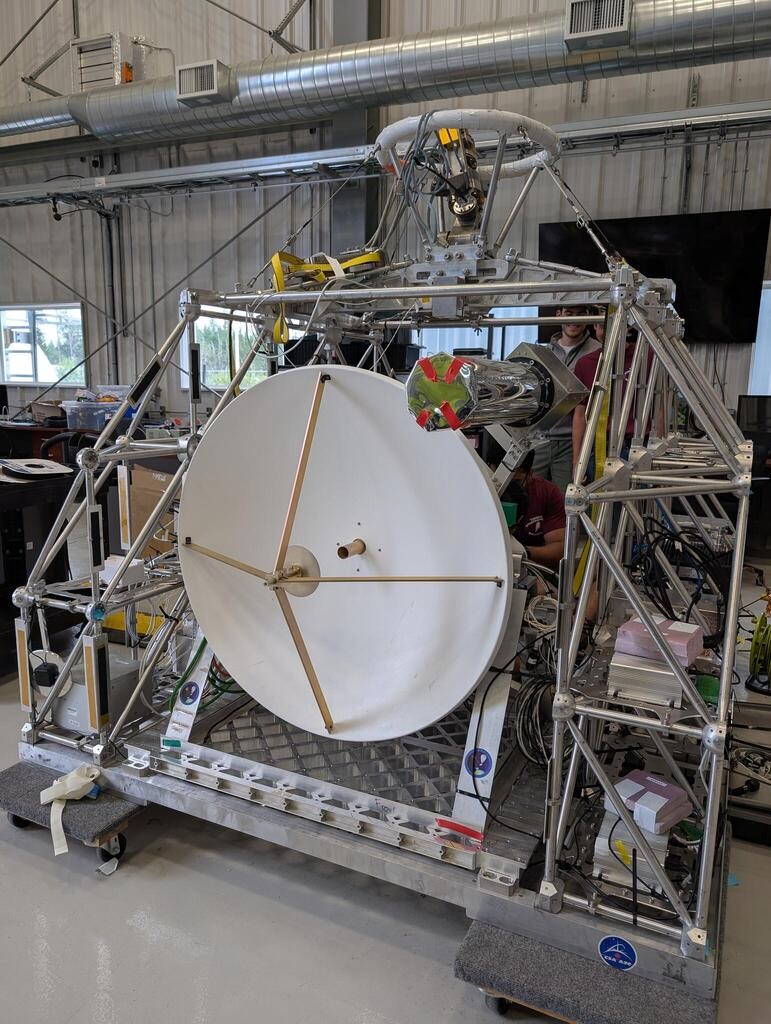
The flight instrument consists of a compact radio telescope with a parabolic reflector approximately 0.9 m in diameter. The telescope operates in the K-band between approximately 21 and 23 GHz, centered near the 22 GHz water-vapor spectral region. Although small compared with conventional radio observatories, the antenna is sufficiently sensitive to detect bright continuum radio galaxies and strong spectral-line sources when its data are correlated with those from much larger ground-based telescopes.
The receiving system incorporates a low-noise microwave front end coupled to a digital backend capable of recording VLBI data streams with accurate time synchronization. Since VLBI measures phase differences between widely separated antennas rather than total received power, maintaining timing stability is one of the principal engineering challenges. BVEX therefore employs a highly stable frequency reference together with precision timing electronics to ensure that the recorded signals remain coherent during subsequent correlation with data from terrestrial observatories. The instrument also records engineering telemetry describing the telescope status, environmental conditions and pointing information throughout the flight.
Precise knowledge of the antenna position is equally important because errors of only a few millimeters can introduce significant phase uncertainties at 22 GHz. To satisfy this requirement, the payload integrates multiple navigation and attitude sensors, including high-precision GPS receivers, accelerometers and inertial sensors whose outputs are combined to reconstruct the telescope position and orientation continuously during flight. The development program established a positional reconstruction accuracy better than 1 mm over one-second intervals, corresponding to the stability required for successful VLBI observations. The payload also carries an optical star-tracking camera that continuously images the night sky and compares the recorded star field with astronomical catalogs to determine the absolute pointing direction of the telescope. This measurement is used to calibrate the alignment between the optical and radio axes and to verify the telescope pointing during astronomical observations.
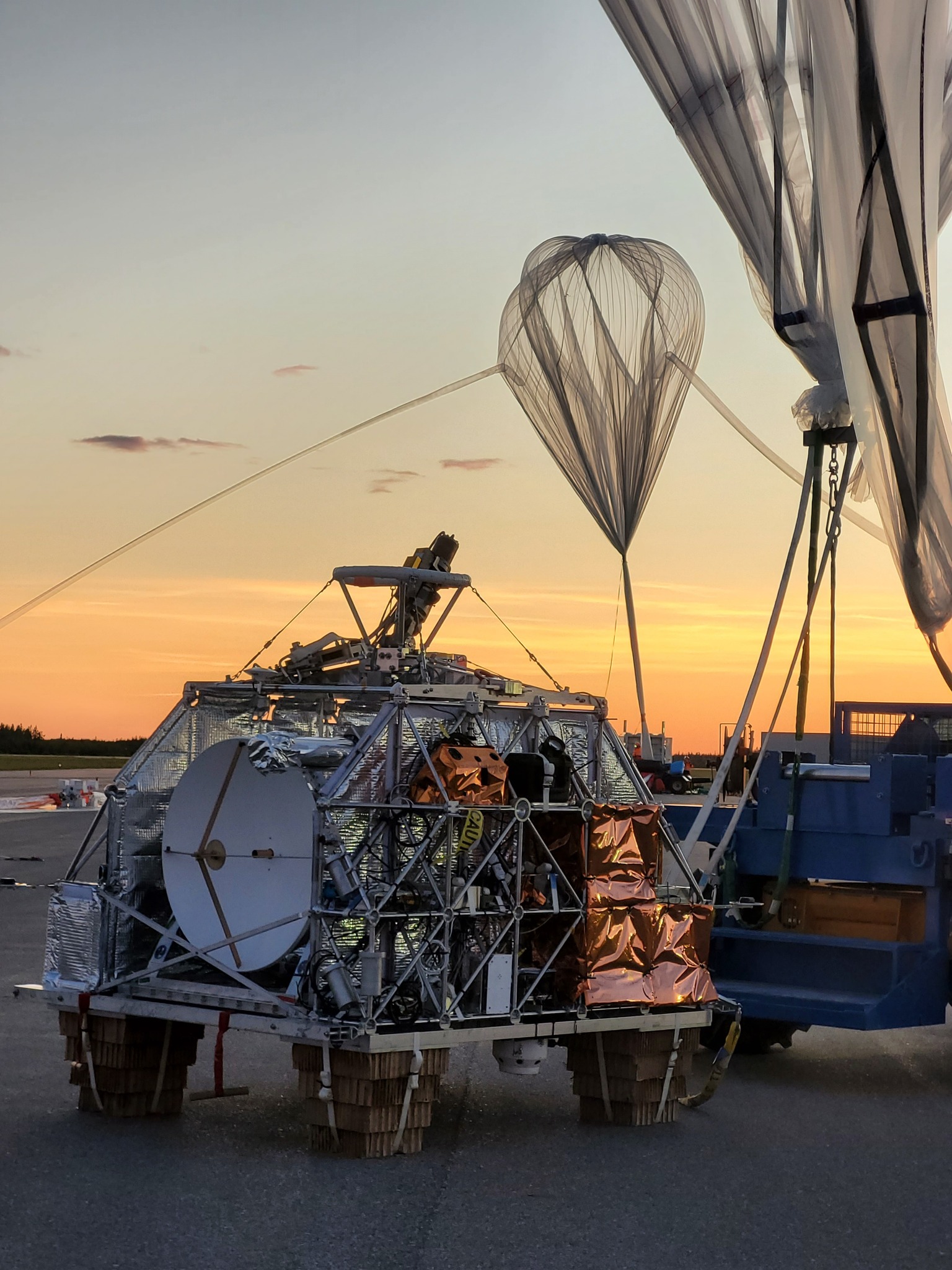
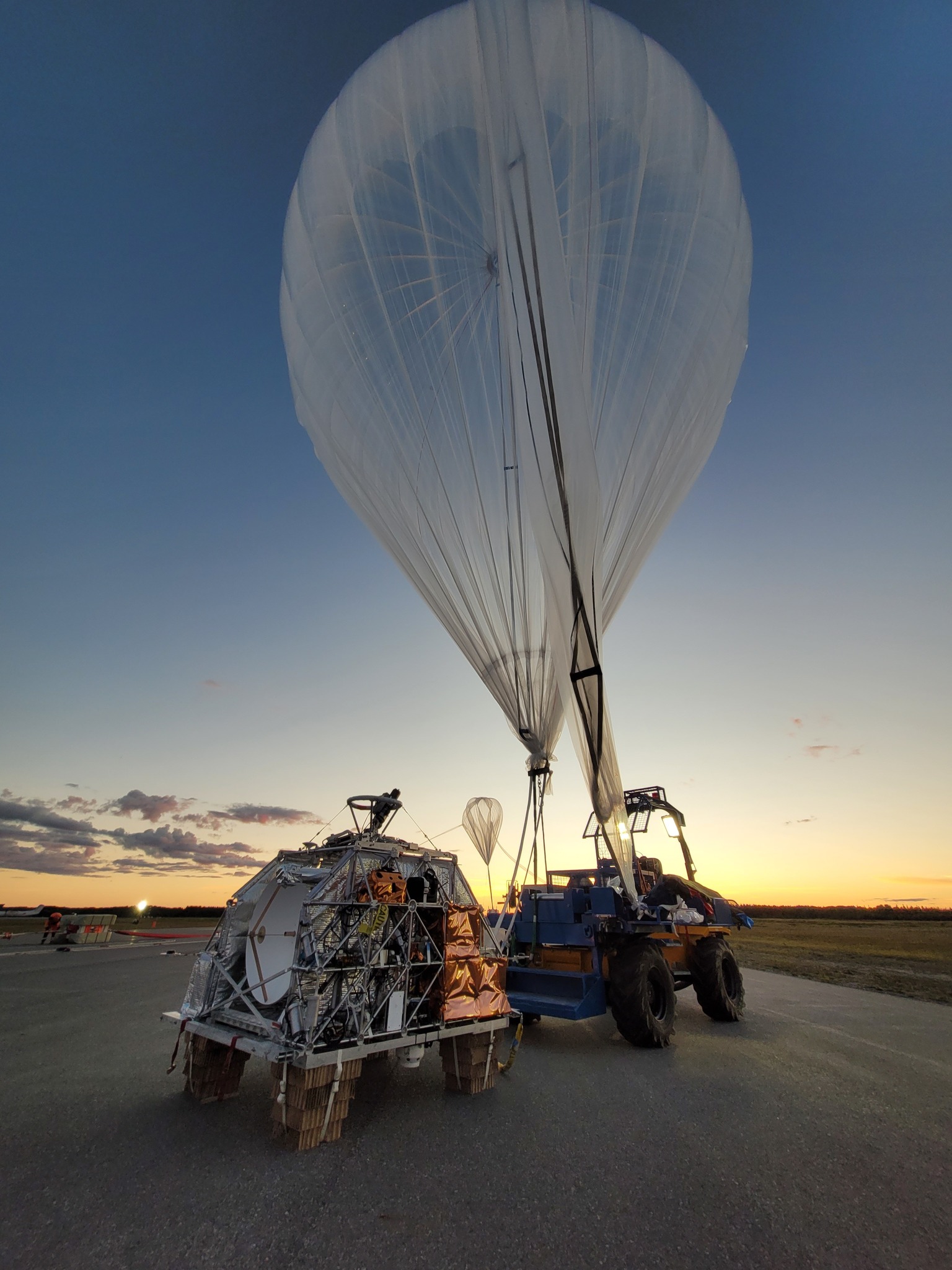
The telescope is mounted on a motorized elevation axis integrated into the Canadian-owned CARMENCITA platform a modular payload gondola built by CNES using bar-and-sphere tubular space-frame architecture. Overall dimensions are 2430 × 1846 × 2029 mm, with an internal payload volume of 2051 × 1114 × 1175 mm. Landing protection is provided by either aluminum-protected crush pads or an all-aluminum shock-absorber assembly. Command-control equipment is protected by SOLARIS multilayer thermal insulation installed on the walls, around equipment compartments and, when required, as an internal thermal partition. Integrated subsystems include electrical power distribution, batteries, telemetry and telecommand equipment, GNSS receiver, inertial measurement unit, azimuth pointing through the suspension swivel, optional reaction-wheel stabilization, temperature monitoring and optional payload elevation hardware. During flight the gongola provides azimuthal orientation, allowing full target acquisition and tracking through combined gondola azimuth control and telescope elevation control. This configuration permits continuous observations of selected radio sources while maintaining compatibility with the flight control architecture of the balloon platform.
Details of the balloon flight
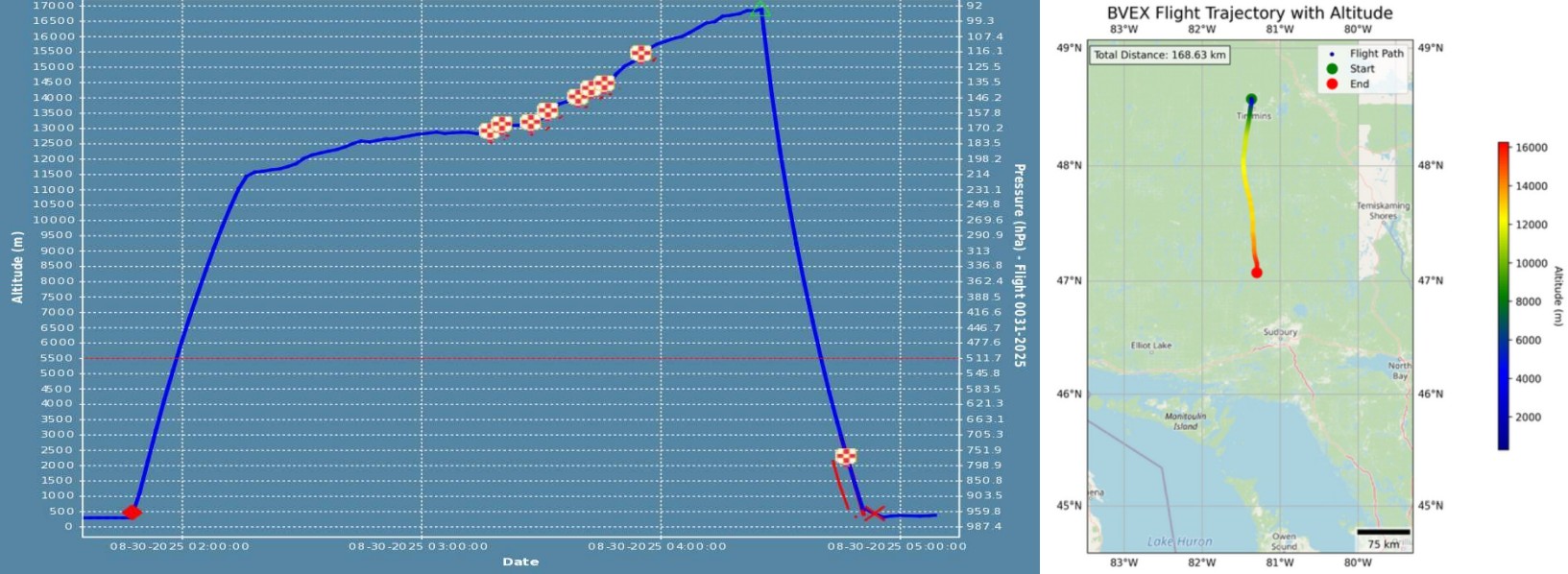
Balloon launched on: 8/31/2025 at 1:47 UTC
Launch site: Timmins Stratospheric Balloon Base, Ontario, Canada
Balloon launched by: Centre National d'Etudes Spatiales (CNES)
Balloon manufacturer/size/composition: Zero Pressure Balloon model 150z Hemeria - 150.000 m3
Balloon serial number: 150 Z Nº 98
Flight identification number: NIMBUS 3
End of flight (L for landing time, W for last contact, otherwise termination time): 8/31/2025 at 4:53 UTC (L)
Balloon flight duration (F: time at float only, otherwise total flight time in d:days / h:hours or m:minutes - ): 3 h 6 m
Payload weight: 570 kg
Overall weight: 1255 kg
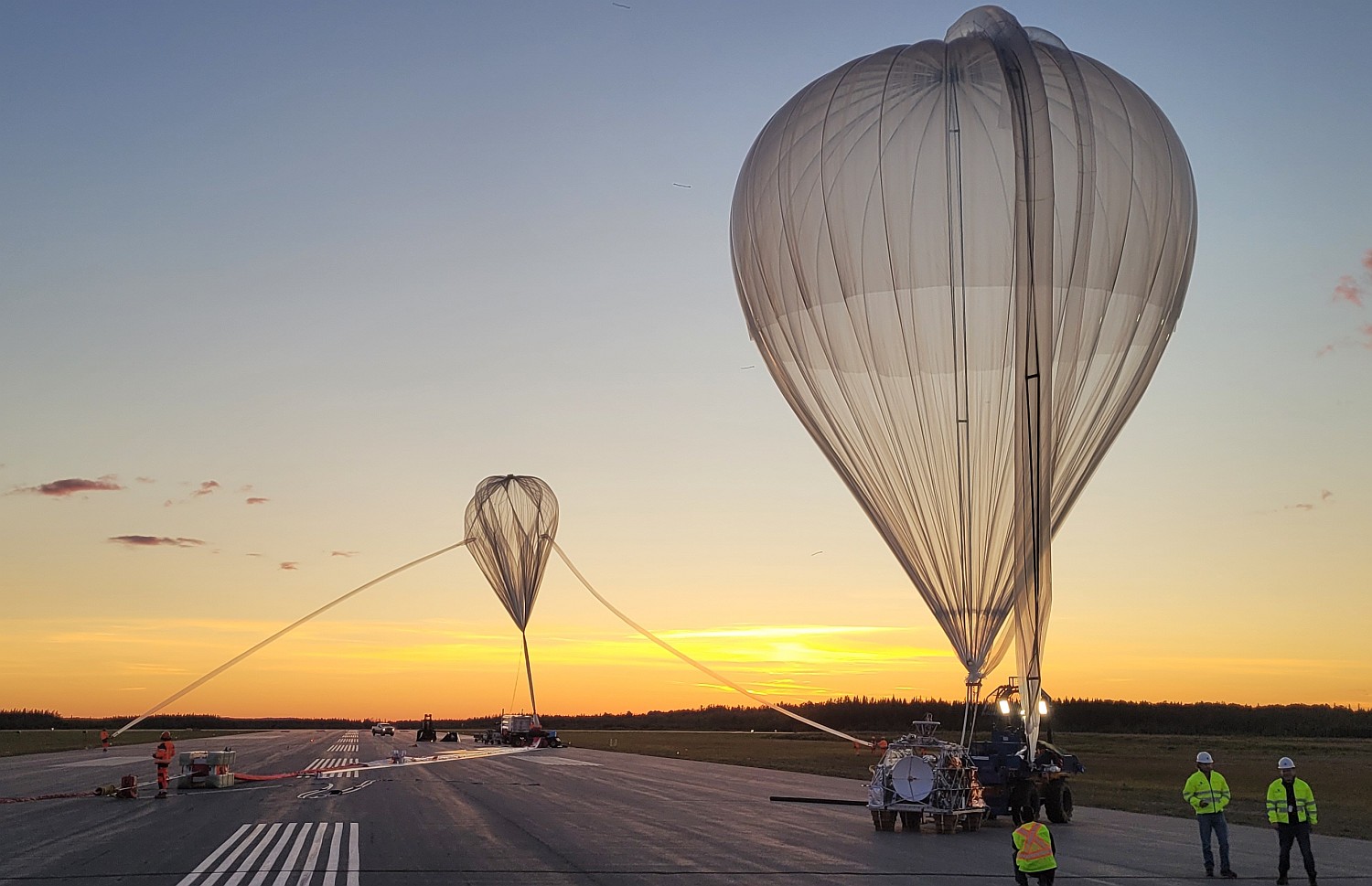
The balloon was launched from the Timmins Stratospheric Balloon base in Ontario Canada at 1:47 UTC on August 31 2025. Following launch, the science team monitored the payload while it ascended and confirmed that the telescope, computers, thermal control systems, and electronics were operating normally.
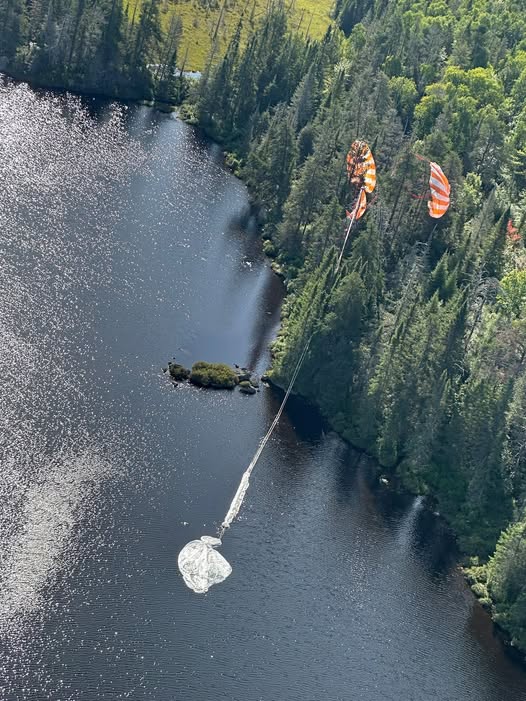
The balloon was intended to reach an altitude of approximately 3233 km but stopped climbing at about 12 km, near the tropopause. Flight controllers repeatedly released ballast to restore ascent, allowing the balloon to climb only to about 16 km before the ascent ceased again. The most likely cause was later identified as a significant helium leak. At that altitude, strong northerly winds carried the balloon toward the Sudbury area. To avoid overflying populated regions with the approximately 1,000 kg payload, the flight was terminated at about 4:30 UTC. The balloon was separated from the parachute and the gondola descended under parachute without reaching its planned float altitude.
Because the balloon never reached the required operating altitude, the gondola's pointing system was not activated and the radio telescope did not perform astronomical observations. The recovery team located the gondola the following day after it had landed in a small lake and become completely submerged. Despite the water landing, the payload was successfully recovered and returned to Timmins. The electronics were cleaned and tested, and many systems remained functional. The sealed pressure vessel protecting the timing reference and frequency-conversion electronics remained watertight, preserving the most critical and expensive components. The campaign demonstrated that the payload systems survived launch, prolonged exposure to temperatures below -50 °C, and recovery, providing confidence that the instrument could be refurbished and reflown in a future balloon campaign.
External references
Images of the mission
If you consider this website interesting or useful, you can help me to keep it up and running with a small donation to cover the operational costs. Just the equivalent of the price of a cup of coffee helps a lot.