
Purpose of the flight and payload description
PoGO+ (Polarized Gamma-ray Observer Plus) is a balloon-borne hard X-ray Compton polarimeter designed to measure the linear polarization of astrophysical sources in the 20180 keV energy range. It is an upgraded version of the PoGOLite Pathfinder and was developed to observe compact X-ray sources, primarily the Crab system and Cygnus X-1. The instrument measures polarization fraction and polarization angle by reconstructing Compton scattering events, providing information on emission mechanisms, magnetic field geometry, and source structure. The instrument was developed by the Physics Department of The Royal Institute of Technology (KTH) with collaboration from Stockholm University, Hiroshima University, ISAS/JAXA, Waseda University, the Tokyo Institute of Technology and the University of Hawaii.
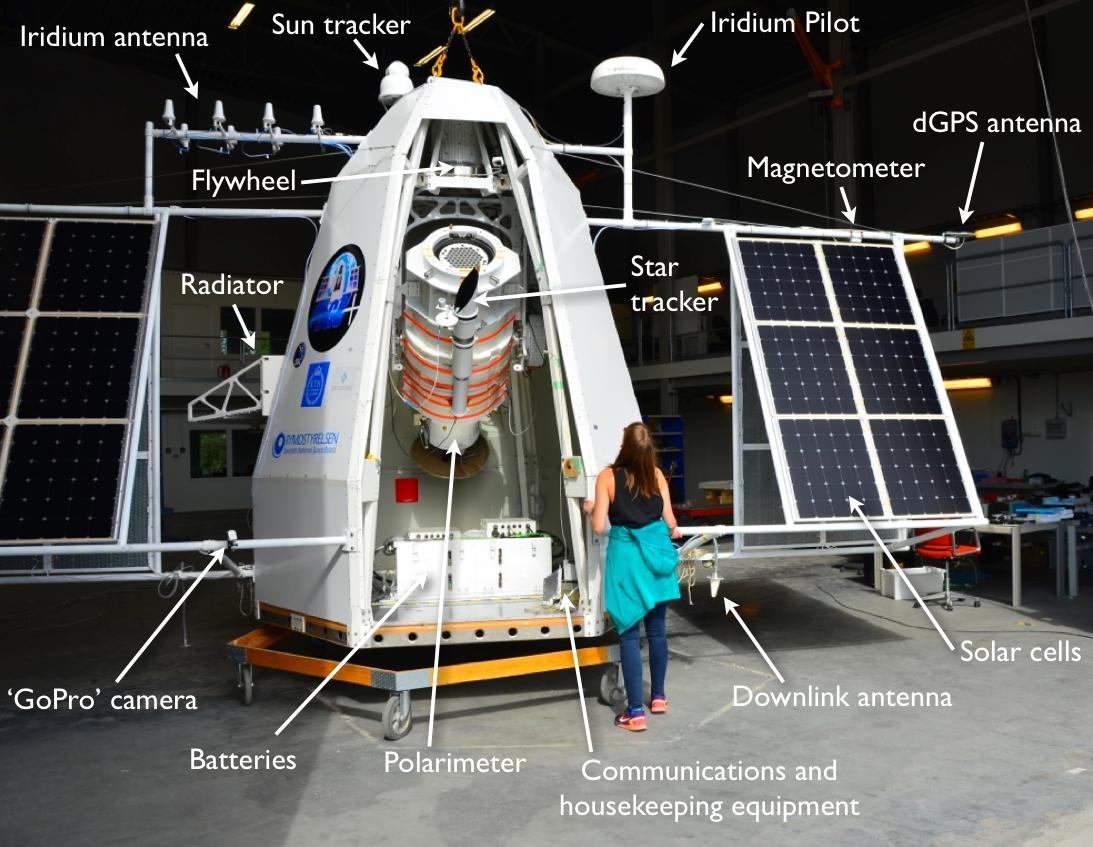
In the image at left we can see a basic sheme of the instrument (click for more details). The detector consists of 61 EJ-204 plastic scintillators arranged in a tightly packed hexagonal array. Each scintillator is approximately 12 cm high and 3 cm across. Polarization measurements are based on photons undergoing Compton scattering in one scintillator followed by a second interaction in another detector. The azimuthal distribution of these two-hit coincidence events follows the Klein-Nishina relation, producing a sinusoidal modulation with a 180° period. The modulation amplitude determines the polarization fraction, while its phase determines the polarization angle.
The detector array is Collimated using approximately 70 cm long copper tubes with hexagonal cross sections. Each Collimator is fabricated from 0.5 mm copper sheet and covered by successive layers of 200 ?m tin and 200 ?m lead, forming a graded shield that suppresses off-axis photons while minimizing secondary fluorescence. Background rejection is provided by a segmented bismuth germanium oxide (BGO) anticoincidence shield surrounding the detector sides and bottom. The shield consists of 61 lower elements and 30 side elements more than 60 cm high and over 3 cm thick. Plastic scintillators and side shield elements are read out by modified Hamamatsu R7899 photomultiplier tubes. Since atmospheric neutrons are the dominant background at float altitude, the detector assembly is enclosed within a passive polyethylene shield between 5 and 15 cm thick to reduce neutron-induced events.
The polarimeter, with a mass of approximately 600 kg, is mounted inside a two-axis gimbal assembly weighing about 300 kg. Pointing is controlled by an attitude control system developed by DST Control. Coarse azimuth control is provided by a flight train motor connected to the balloon suspension, while fine azimuth adjustments are performed using a flywheel. Excess angular momentum is transferred back to the balloon through a momentum dump system. Elevation is measured by an encoder mounted on the polarimeter axis. Absolute azimuth information is provided primarily by a differential GPS with a 10 m baseline, while a three-axis magnetometer provides redundant measurements.
The attitude determination system also includes a sun tracker added during the PoGO+ upgrade. The tracker uses a two-dimensional position-sensitive detector mounted in a free-moving gimbal to determine instrument azimuth from the Sun's position. Relative pointing corrections are obtained from a co-aligned optical star tracker that continuously compares the measured position of a selected guide star with its predicted location. An inclinometer measures gondola pitch and roll, and a micro-electromechanical inertial measurement unit provides additional attitude information and redundancy if other sensors temporarily become unavailable.
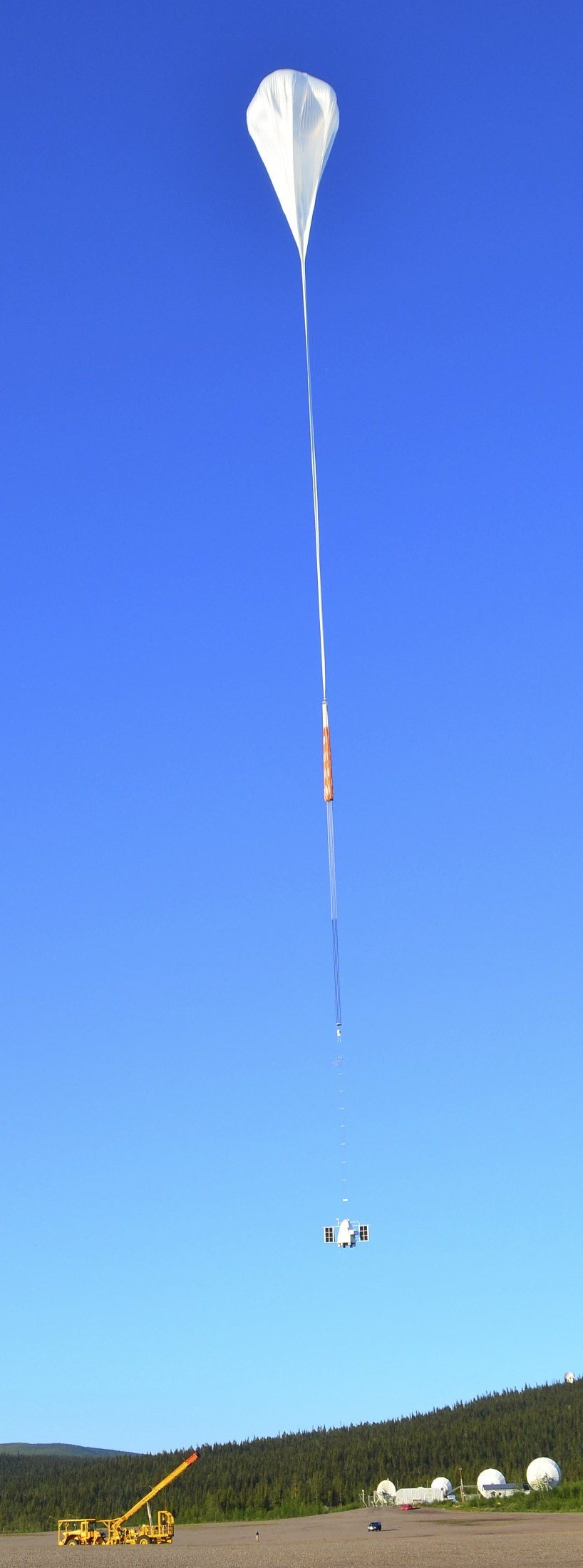
The instrument is housed inside a gondola manufactured by the Swedish Space Corporation. The structure consists of aluminum ribs and honeycomb composite panels that provide mechanical rigidity, thermal protection, and impact resistance. Solar panels, GPS antenna booms, communication antennas, and a radiator connected to a fluid-based cooling system are mounted externally. The gondola separates into upper and lower sections for integration and recovery. The upper section contains the polarimeter and gimbal assembly, while the lower section houses batteries, communication equipment, and auxiliary systems. The complete payload is approximately 4 m high, nearly 10 m wide across the GPS booms, and has a suspended flight mass approaching two tonnes, including approximately 450 kg of ballast.
Footage of preparations, launch, flight and landing of the experiment
Details of the balloon flight
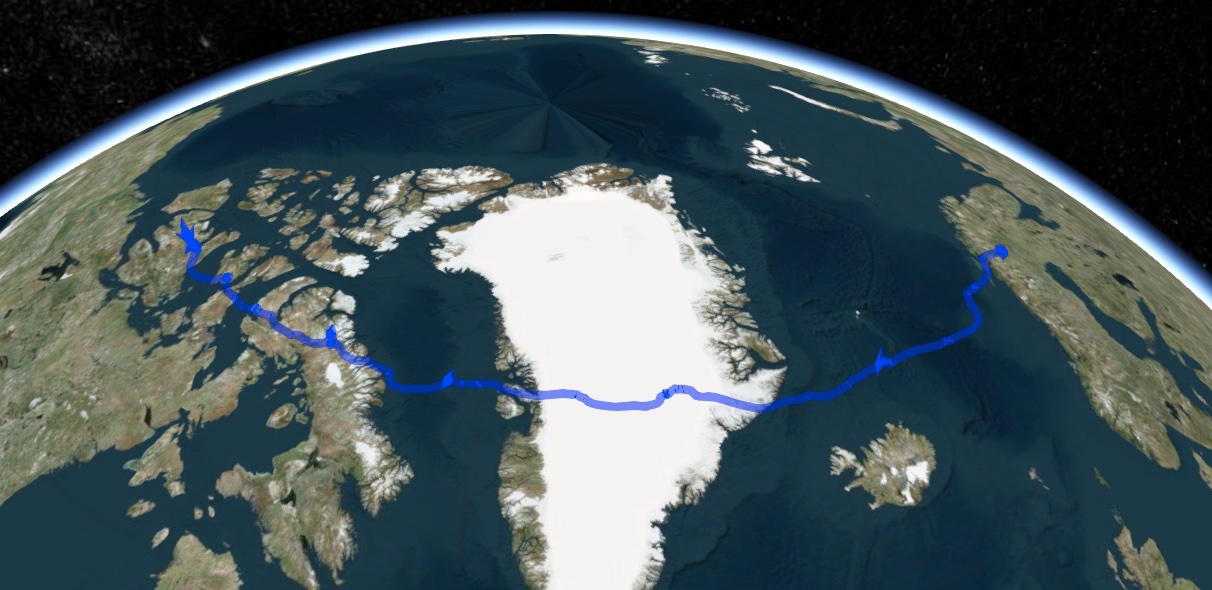
Balloon launched on: 7/12/2016 at 3:17 utc
Launch site: European Space Range, Kiruna, Sweden
Balloon launched by: Swedish Space Corporation (SSC)
Balloon manufacturer/size/composition: Zero Pressure Balloon Raven 39.570.000 cuft
End of flight (L for landing time, W for last contact, otherwise termination time): 7/18/2016
Balloon flight duration (F: time at float only, otherwise total flight time in d:days / h:hours or m:minutes - ): 6 d 20 h
Landing site: In Victoria Island, Canada
The balloon was launched from the Esrange Space Center, on 12 July 2016. The launch was conducted during the Arctic summer campaign, when circumpolar stratospheric winds at an altitude of about 40 km transport balloons westward from Sweden toward North America. The launch window was selected to provide adequate angular separation between the Crab Nebula and the Sun while maintaining stable seasonal wind conditions suitable for long-duration transcontinental flights.
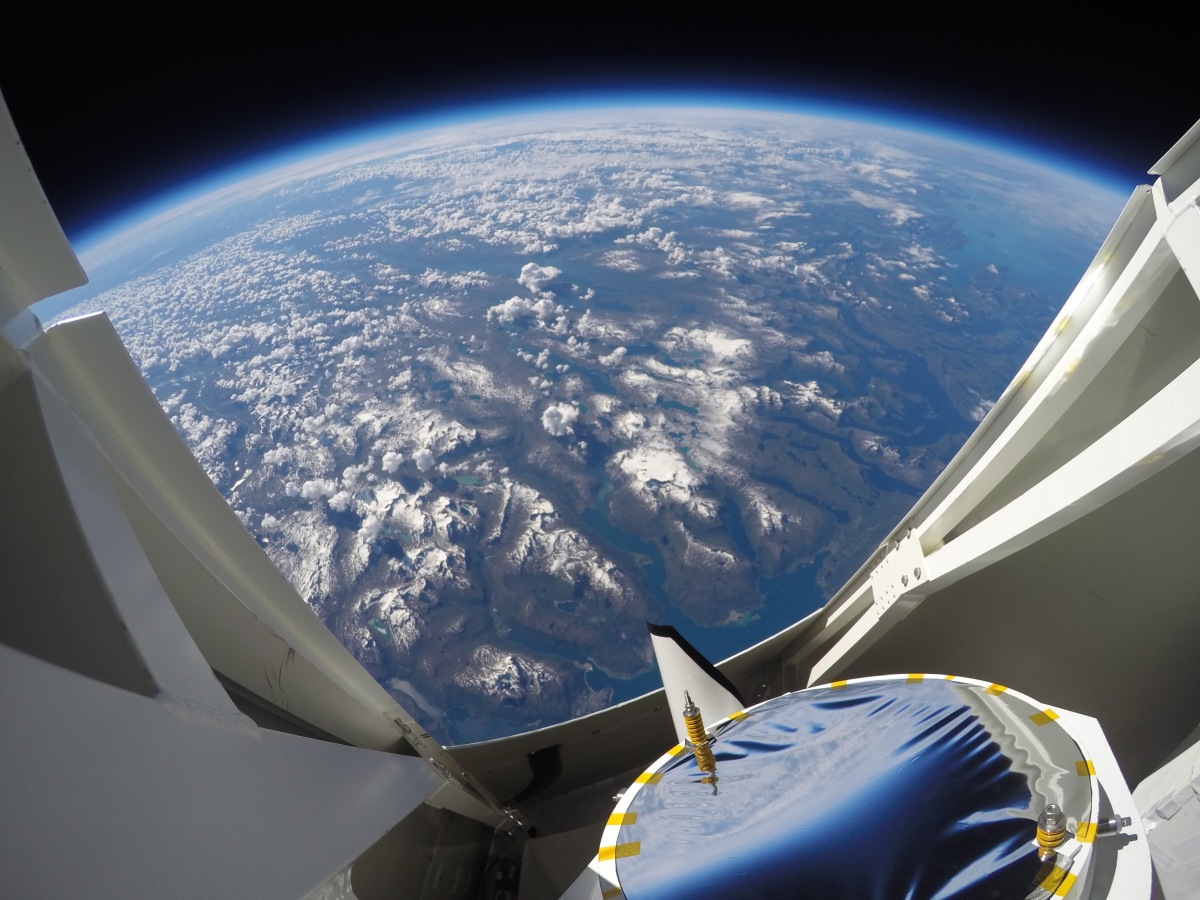
After a nominal ascent the balloon reached a float altitude of approximately 40 km. The flight benefited from operational experience gained during the 2013 PoGOLite Pathfinder mission and incorporated several improvements that increased reliability during long-duration observations. An Iridium Pilot communication system provided higher-bandwidth telemetry, remote commanding, and improved data transfer after the payload moved beyond line-of-sight communication. An additional Sun tracker was incorporated into the attitude control system, improving autonomous pointing when the observation targets were located close to the Sun, where the optical star tracker alone had previously encountered operational limitations.
The flight plan consisted of repeated observations of the Crab Nebula and Cygnus X-1. Rather than observing only the target source, the observing sequence alternated automatically between the source and nearby background fields positioned 5° east and 5° west of the target. Pointing changes occurred approximately every 15 minutes throughout the flight, with nearly equal observing time devoted to source and background positions.
Unlike the 2013 Pathfinder flight, which experienced overheating that restricted scientific observations to the first three days, the 2016 mission completed its planned observing strategy successfully. Continuous alternation between source and background fields provided accurate determination of the signal-to-background ratio throughout the flight despite temporal variations in atmospheric background intensity.
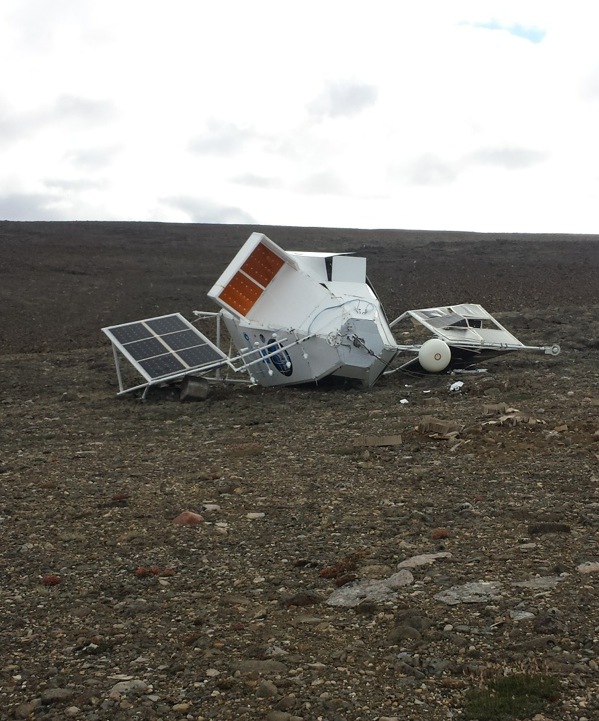
After 6 days and 20 hours of flight, the payload finally landed on Victoria Island, Canada.
External references
- PoGO+ website KTH Royal Institute of Technology
- Accretion geometry of the black-hole binary Cygnus X-1 from X-ray polarimetry Nature Astronomy, 2018
- Calibration and performance studies of the balloon-borne hard X-ray polarimeter PoGO+ Accepted for publication in Nuclear Inst. and Methods in Physics Research, A
- Høytflygende ballong vakte oppsikt NYE Troms website
- KTH team builds telescope to investigate mysterious Crab pulsar KTH Royal Institute of Technology
- List of balloons launched from ESRANGE SSC Space website (via Archive.Org)
- Optimising a balloon-borne polarimeter in the hard X-ray domain: From the PoGOLite Pathfinder to PoGO+ Astroparticle Physics, Volume 82, p. 99
- Over 200 meter bred gigantballong observert i Troms: - Høres ut som torden Nordlys website
- PoGO+ polarimetric constraint on the synchrotron jet emission of Cygnus X-1 Monthly Notices of the Royal Astronomical Society Letters
- PoGO+ stratospheric balloon mission from Esrange, Sweden, to Victoria Island, Canada 32th International Symposium on Space Technology and Science, 2017
- Skaldjurspremiär på hög höjd: PoGO+ och Hubble spanar mot Krabban Popular Astronomi Magazine
- The PoGO+ Balloon-Borne Hard X-ray Polarimetry Mission Galaxies 2018, 6 (1), 30
- The Stratospheric Balloon Mission PoGO+ from Esrange to Victoria Island, Canada AIAA Balloon Systems Conference, 2017
- Værvarslingen nedringt på grunn av mystisk ballong NRK website
Images of the mission
If you consider this website interesting or useful, you can help me to keep it up and running with a small donation to cover the operational costs. Just the equivalent of the price of a cup of coffee helps a lot.