
Purpose of the flight and payload description
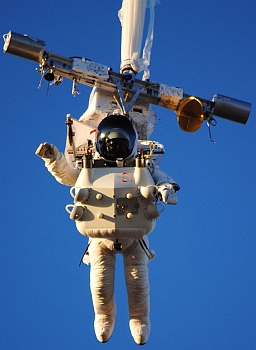
The StratEx mission, officially known as the Stratospheric Exploration project, aimed to develop a system enabling an individual to ascend to, explore, and safely return from the stratosphere. This system was analogous to a SCUBA suit designed for underwater exploration, focusing on simplicity, safety, and lightweight design compared to traditional capsule-based systems. Conceptualized in December 2011 by Alan Eustace, Senior Vice President of Knowledge at Google Inc. pilot and an avid skydiver in collaboration with Paragon Space Development Corporation, the mission sought to address the feasibility of creating a self-contained system for human stratospheric exploration.
The StratEx mission employed an intricate array of hardware to ensure a successful and safe stratospheric flight and descent. In the image at left can be seen the suit in launch position (click for more details). Central to the system was the Pressure Suit Assembly (PSA), which encompassed a pressure suit, equipment module (EM), and the flight recovery system. The suit was designed to maintain a pressurized environment at 37.2 kPa, protect the pilot from extreme stratospheric conditions, and integrate with environmental control and life support systems (ECLSS). It featured a Dual Suit Controller (DSC) to manage internal pressure, a Demand Helmet Regulator (DHR) for oxygen delivery, and a liquid thermal garment (LTG) to regulate temperature. The helmet bubble included anti-glare features and ensured clear visibility. Mounted on the pilots chest, the EM housed high-pressure oxygen tanks, batteries, and a heat exchanger system to manage temperatures, alongside avionics for navigation, telemetry, and communication.
The flight recovery system, critical for descent, included a drogue parachute for stabilization, a main parachute for controlled landing, and a backup parachute activated either manually or via an Automatic Activation Device (AAD) in emergencies. The innovative Stiff Anti-Entanglement Bridle Ejecting Rod (SAEBER) system prevented entanglement during drogue deployment. Ground support was facilitated by the Ground Cart (GC), which provided oxygen, cooling, and electrical power before liftoff, maintaining consumables and system functionality until launch.
The Flight Vehicle, a helium balloon, was engineered to lift the pilot to the stratosphere. Its envelope, constructed of specialized polyethylene, included a servomotor-controlled crown valve for helium venting and a reinforced base fitting for equipment attachment. The Balloon Equipment Module (BEM), suspended below, housed avionics, radar reflectors, and telemetry systems. It featured a destruct system for safe decommissioning post-mission, using a weighted tear mechanism or a fuse-activated release. The BEM also carried ballast to adjust ascent rates and housed video transmission systems to relay real-time visuals.
The Launch System involved extensive ground-based support infrastructure, including the balloon support equipment for safe handling and inflation, helium supply systems, and a Spork vehicle to raise the balloon into position. A launch plate and sedan ensured the balloon and pilot were securely stationed during the launch process, with equipment enabling controlled lateral movement as the balloon ascended.
Mission Control integrated hardware and software for real-time monitoring and coordination, with personnel overseeing pilot health, ECLSS performance, and flight trajectory. Redundant communication systems ensured continuous connectivity. The Chase and Recovery system utilized helicopters, trucks, and fixed-wing aircraft, supported by GPS navigation, to track and recover the pilot and equipment efficiently. The medical team and technicians were equipped to handle contingencies, including pilot extraction and post-landing support.
The StratEx mission hardware demonstrated a sophisticated balance of innovation, redundancy, and operational precision, enabling groundbreaking exploration of the stratosphere.
Details of the balloon flight
Balloon launched on: 10/20/2014
Launch site: Roswell Industrial Air Center, New Mexico, US
Balloon launched by: Paragon Space Development Corporation
Balloon manufacturer/size/composition: Zero Pressure Balloon TIFR 312.000 m3
Balloon serial number:
End of flight (L for landing time, W for last contact, otherwise termination time): 10/20/2014
Landing site: Aborted flight
This was an attempt of the third and final crewed flight of the program. The flight was aborted due to inadvertent actuation of the Tertiary balloon destruct fuse
External references
- StratEX project website Paragon SDC
- StratEx Mission Overview 45th International Conference on Environmental Systems, July 2015
If you consider this website interesting or useful, you can help me to keep it up and running with a small donation to cover the operational costs. Just the equivalent of the price of a cup of coffee helps a lot.