
Purpose of the flight and payload description

SOFCAL was the acronym for Scintillating Optical Fiber Calorimeter a balloon-borne mission aimed to measure the spectra of galactic cosmic rays, particularly protons and helium nuclei, in the energy range of 0.2 to over 10 TeV. The instrument -developed through a collaboration between NASA's Marshall Space Flight Center, the University of Alabama in Huntsville, and the University Space Research Association- was designed as a hybrid system with both active and passive detection components.
In the image at left, can be seen a scheme of the instrument (click to enlarge). SOFCAL included four vertically stacked chambers. The top chamber was a Cerenkov counter built with a Teflon radiator and photomultiplier tubes to measure the charge of incoming particles. Below this was an emulsion chamber divided into three sections: the primary section for charge identification, the target section to increase the likelihood of particle interactions, and an emulsion calorimeter that used x-ray films and emulsions to record electromagnetic cascades. Underneath this chamber was the Sci-Fi calorimeter, composed of multiple layers of lead interleaved with orthogonal layers of scintillating optical fibers, which captured detailed images of cascade development using image-intensified CCDs. The final chamber, another emulsion calorimeter, recorded high-energy cascades that penetrated the full depth of the instrument.
The experiment used thin ionization calorimetry to estimate the energy of cosmic rays based on the early development of their electromagnetic showers. The calorimeters recorded both longitudinal and lateral profiles of these cascades, with emulsions providing electron counts and the Sci-Fi system capturing light intensity profiles.
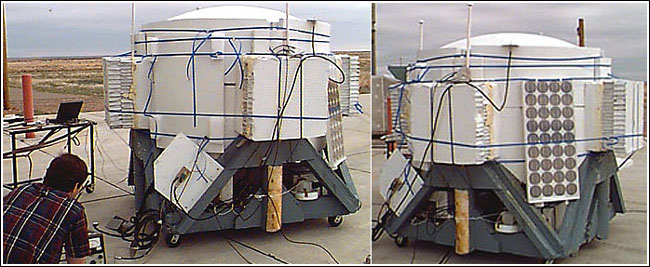
The pressure vessel that housed SOFCAL was a thin-walled, lightweight structure specifically designed to withstand the low-pressure conditions encountered during high-altitude balloon flights. It acted as both a protective enclosure for the instrument's sensitive components and as the structural frame connecting all four detection chambers vertically. The vessel ensured that the internal environment remained stable, particularly important for the proper functioning of the image-intensified CCD systems and the scintillating optical fibers, which could be affected by extreme temperature and pressure variations. Additionally, the vessel served as the flight gondola supporting the scientific payload but also all flight systems required for launch, tracking, and recovery.
Details of the balloon flight
Balloon launched on: 5/20/1997 at 13:43 utc
Launch site: Scientific Flight Balloon Facility, Fort Sumner, (NM), US
Balloon launched by: National Scientific Balloon Facility (NSBF)
Balloon manufacturer/size/composition: Zero Pressure Balloon Raven 40L - 1.100.000 m3
Balloon serial number: R39.00-2-107
Flight identification number: 432N
End of flight (L for landing time, W for last contact, otherwise termination time): 5/21/1997 at 14:56 utc
Balloon flight duration (F: time at float only, otherwise total flight time in d:days / h:hours or m:minutes - ): 26 h
Landing site: 14 miles SW of Congress, Arizona, US
Payload weight: 4500 lbs
External references
- A Geant Study of the Scintillating Optical Fiber (SOFCAL) Cosmic Ray Detector Conference paper, September 1, 1998
- A Scintillating Way to Hunt Cosmic Rays NASA Press release
- Monte Carlo Simulation of the Scintillating Optical Fiber Calorimeter (SOFCAL) Journal of the Arkansas Academy of Science: Vol. 48, Article 43
- NASA Balloon Flights (19891998) in NASA Historical Data Book, Vol. VII: NASA Launch Systems, Space Transportation, Human Spaceflight, and Space Science, 1989-1998
- The Scintillating Optical Fiber Calorimeter Instrument Performance (SOFCAL) 26th International Cosmic Ray Conference (ICRC 1999)
- The Scintillating Optical Fiber Calorimeter Instrument Performance (SOFCAL) 26th International Cosmic Ray Conference. August 17-25, 1999. Salt Lake City, Utah, USA
- The SOFCAL experiment AIP Conference Proceedings 450, 598 (1998)
Images of the mission
If you consider this website interesting or useful, you can help me to keep it up and running with a small donation to cover the operational costs. Just the equivalent of the price of a cup of coffee helps a lot.