
Purpose of the flight and payload description
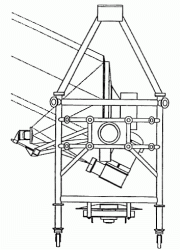
A balloon-borne instrument to make measurements of the cosmic microwave background (CMB) anisotropy on angular scales between 0.5 and 3 degrees. The experiment uses a one meter, off-axis Cassegrian telescope, coupled with a four spectral band radiometer. The pointing for the experiment is controlled by a platform which was originally built in the early 1980's by a group at GSFC to map the Galactic plane (FIRS instrument).
Details of the balloon flight
Balloon launched on: 6/5/1992 at 00:59 utc
Launch site: National Scientific Balloon Facility (NSBF), Palestine, Texas, US
Balloon launched by: National Scientific Balloon Facility (NSBF)
Balloon manufacturer/size/composition: Zero Pressure Balloon SF3-480.10-080-NSCH-04-ST
Balloon serial number: W39.96-3-11
Flight identification number: 1510P
End of flight (L for landing time, W for last contact, otherwise termination time): 6/5/1992 at 12:32 utc
Balloon flight duration (F: time at float only, otherwise total flight time in d:days / h:hours or m:minutes - ): F 6 h 39 m
Landing site: 30 miles N of Brownwood, Texas, US
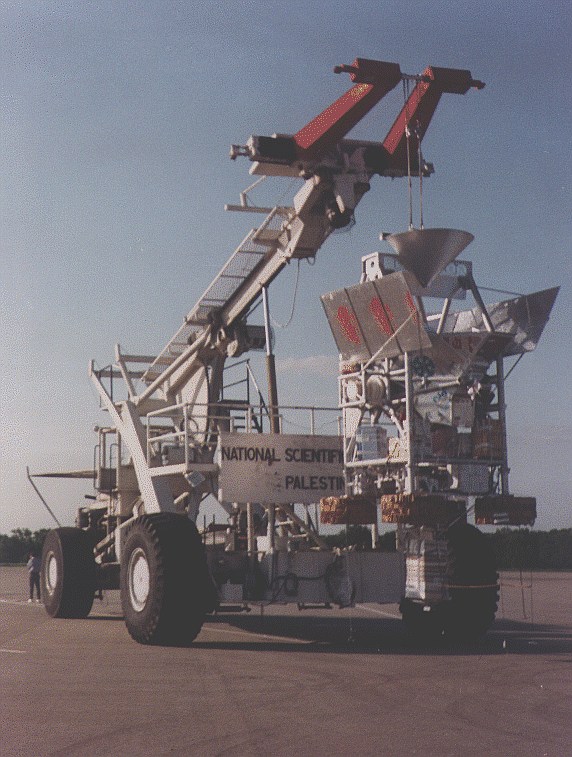
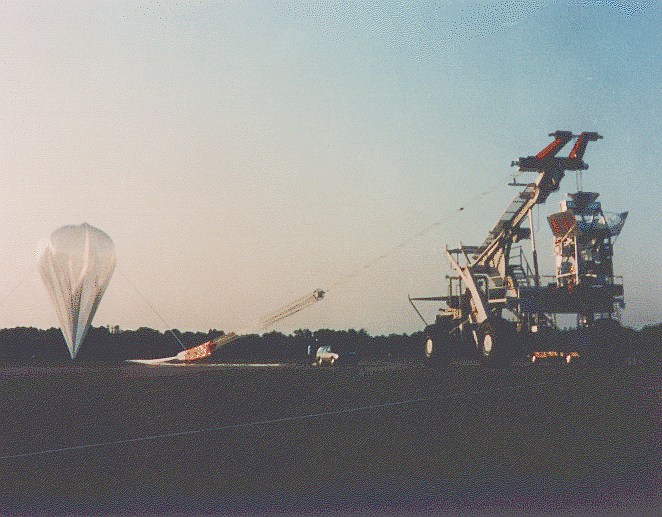
After a succesfull launch using dynamic method and assisted by launch vehicle (Tiny Tim) at 00:59 utc of June 5, 1992.
The balloon ascent was nominal abd float altitude of 38 km was achieved at 05:07 utc.
After normal flight the balloon was terminated with sunrise at 10:56 utc.
This first flight of the instrument returned outstanding results, and detected anisotropy in several points.
External references
- MSAM website (Archived) NASA Goddard Space Flight Center
- A Balloon-borne Millimeter-Wave Telescope for Cosmic Microwave Background Anisotropy Measurements Astrophysical Journal v.470, p.63
- A Measurement of the Cosmic Microwave Background Radiation (CMBR) Anisotropy at the Half Degree Angular Scale Thesis by Inman, Casey Ann (Ph. D.)--Massachusetts Institute of Technology, Dept. of Physics, 1996
- A measurement of the medium-scale anisotropy in the cosmic microwave background radiation Astrophysical Journal, Part 2 - Letters vol. 422, no. 2, p. L37-L40
- Measuring cosmic microwave background radiation anisotropy on medium angular scales Thesis by Puchalla, Jason Lee (Ph. D.)--Massachusetts Institute of Technology, Dept. of Physics, 1995
- Microwave Mappers Sweat Details SCIENCE - 25 Mar 1994 - Vol 263, Issue 5154 - pp. 1682-1684
- Mysterious Radiation Sources Add to Riddle of Early Universe Goddard News Vol. 40 Nº 8, August 1993, p. 4
- NASA Balloon Flights (19891998) in NASA Historical Data Book, Vol. VII: NASA Launch Systems, Space Transportation, Human Spaceflight, and Space Science, 1989-1998
- Preliminary Results from the Goddard-Mit Medium-Scale Anisotropy Experiment Proceedings of an International Symposium; held in Milano; Italy; 21-25 September 1992; p.497
- The MSAM/TopHat Program of Anisotropy Measurements Astrophysical Letters and Communications, Vol. 32, p.273
Images of the mission
StratoCat is an independent, non-commercial project maintained to preserve and share the history of scientific and stratospheric ballooning. If you find the site useful, you can help keep it running with a small donation toward its operating costs. Every contribution, even the equivalent of a cup of coffee, is greatly appreciated.