
Purpose of the flight and payload description
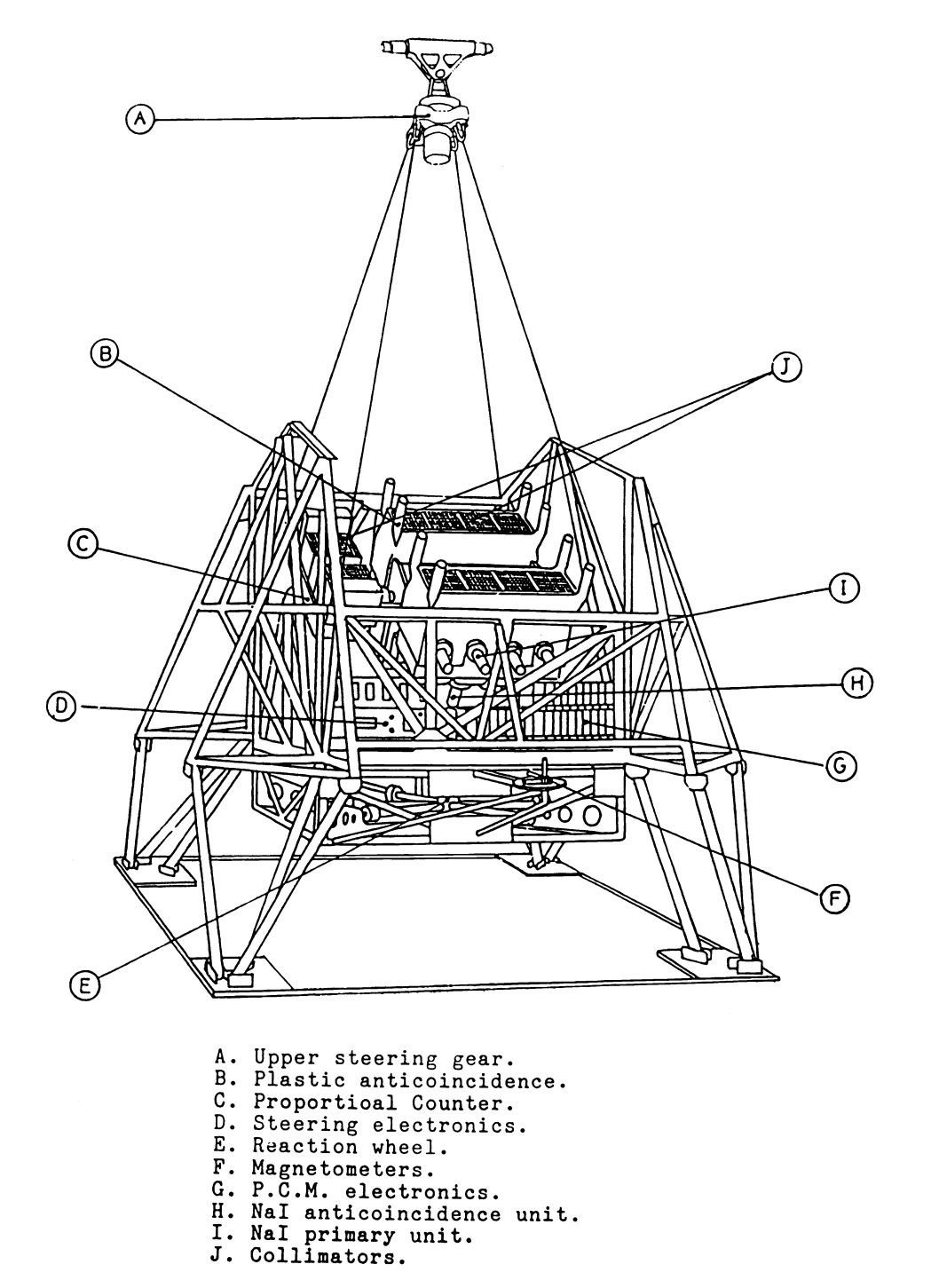
MIFRASO was a balloon-borne large-area hard X-Ray telescope for highly sensitive observations of celestial X-ray sources over the energy range from approximately 15 to 300 keV. The name's acronym came from the three institutions involved in its development: the Istituto di Fisica Cosmica (IFC) in MIlano, the Istituto di Astrofisica Spaziale (IAS) in FRAscati both from Italy, and the SOuthampton University from the United Kingdom. It was conceived to achieve very fine temporal resolution, reaching values on the order of a few tenths of a millisecond in observations of rapidly varying sources such as the Crab Pulsar.
In the image at left we can see a diagram of the instrument (click to enlarge).
The scintillator subsystem consisted of eight individual NaI(Tl) crystals, each of large area and modest thickness, arranged into two blocks. Optical photons produced within each crystal were collected using diffusive light guides positioned beneath the collimators, with the entrance window serving simultaneously as an optical window and an X-ray window. Each crystal was viewed by two photomultiplier tubes operating in coincidence to compensate for spatial non-uniformities in light collection across the large crystal area. Additional NaI(Tl) crystals acted as active shielding beneath the primary detectors to veto background events, and these crystals remained optically isolated and operated in anticoincidence with the main array. The entire scintillator assembly was further surrounded by passive graded shielding and plastic scintillator anticoincidence detectors to suppress background arising from charged particles and off-axis photons.
The gas proportional counters were constructed as large stainless-steel chambers with reinforced entrance windows capable of withstanding high internal pressures. Each detector volume was subdivided into many individual cells, each centered on a fine gold-plated anode wire held at high voltage. The counters were filled with a high-pressure mixture of xenon, argon, and isobutane in carefully chosen proportions to maximize X-ray absorption efficiency while maintaining stable gas gain. To reduce instrumental background, regions near the detector walls and base functioned as anticoincidence sections, and the anodes operated in mutual anticoincidence to reject multiple interactions.
Signal processing electronics acted separately for the scintillators and the proportional counters. In the scintillator system, photomultiplier outputs were shaped, discriminated, summed, and processed through coincidence logic to define valid X-ray events within the desired energy window. These events were then gated by signals from the anticoincidence shields to suppress background. Both photoelectric and selected Compton events were forwarded to the digital electronics for further analysis. In the proportional counter system, low-noise charge-sensitive preamplifiers and shaping amplifiers conditioned the anode signals before event validation and pulse-height analysis. In both subsystems, selected events were digitized using analog-to-digital converters. Each event carried timing information to allow high-resolution temporal studies.
Telemetry and data handling supported flexible observation modes and variable data rates. Event data, timing information, and housekeeping parameters such as voltages, temperatures, and pressures were transmitted to the ground at selectable bit rates, allowing a trade-off between telemetry load and time resolution. On the ground, dedicated support equipment decoded, recorded, displayed, and performed preliminary analysis of the incoming data during both flight operations and pre-flight calibration.
The entire assembly was mounted within a multi-stage gondola structure that separated the detection modules, steering system, and landing protection. Pointing control relied on a combination of elevation drives for the detector plane and azimuth control using a reaction wheel, guided by flux-gate magnetometers sensing Earth's magnetic field. An active torsion-relief mechanism prevented excessive twisting of the suspension cables during azimuth maneuvers and balloon rotation. An onboard processor, updated through telecommand from the ground, calculated target positions and controlled the drives using stored magnetic maps, a sidereal clock, and real-time housekeeping data. The complete steering system provided arcminute-level stability and degree-level absolute pointing accuracy.
Prior to and during flight operations, the instrument response underwent extensive calibration using radioactive sources. Detector efficiencies, energy resolutions, and gain stabilities were measured across the operating energy range, and in-flight gain checks took place by remotely positioning calibration sources into the detectors' fields of view.
Details of the balloon flight
Balloon launched on: 7/16/1989
Launch site: Base di Lancio Luigi Broglio, Trapani, Sicily, Italy
Balloon launched by: Centre National d'Etudes Spatiales (CNES)
Balloon manufacturer/size/composition: Zero Pressure Balloon model 803Z Zodiac - 830.000 m3
End of flight (L for landing time, W for last contact, otherwise termination time): 7/16/1989
Landing site: Balloon failure just after the launch. Aborted mission.
Campaign: ODISSEA 89
Payload weight: 3829 kgs
External references
- A large area telescope for balloon-borne hard X-ray astronomy Nuclear Instruments and Methods in Physics Research Section A: Accelerators, Spectrometers, Detectors and Associated Equipment Volume 228, Issue 1, 1984, Pag. 183
- Kernel density estimators applied to hard X-ray observations of the Crab Pulsar Carstairs, Ian Ruthven. University of Southampton, Doctoral Thesis. (1992)
- Les activites balloons en France 88-89 CNES brochure (1990)
- Les ballons au service de la recherche. L'aérostation scientifique des origines à nos jours. Editions Edite & IFHE (Institut Français de l'Histoire de l'Espace) 2011, Pag. 420
Images of the mission


If you consider this website interesting or useful, you can help me to keep it up and running with a small donation to cover the operational costs. Just the equivalent of the price of a cup of coffee helps a lot.