
Purpose of the flight and payload description
The Electrodynamics of the Middle Atmosphere (EMA) experiment was a stratospheric balloon-borne electric field study conducted in 1983, that launched eight superpressure balloons from New Zealand and collected over 180 payload days of electric field data, more than doubling the total amount of vector electric field data previously obtained from the stratosphere. The program was a collaborative effort among scientists from the University of Washington, Cornell University, Utah State University, Stanford University, The Aerospace Corporation, and the University of Otago in New Zealand. NCAR's Global Measurements Program provided technical support, including balloons, gondolas, power, telemetry, launches, and data acquisition while funding came from both the National Science Foundation and NASA.
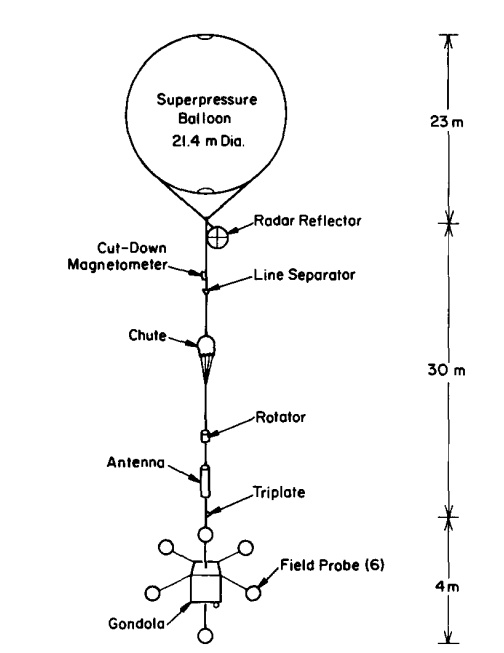
Each EMA flight used a 21.4-meter-diameter superpressure balloon carrying a flight train that included a radar reflector, parachute, line separator, cut-down magnetometer, rotator, antenna, field probes, and the gondola. A schematic of the flight train is shown in the image at left (click to enlarge).
The main detectors were electric field probes and hiss detectors, mounted on booms extending from the gondola to minimize structural interference. These sensors measured ambient electric fields and radio-frequency noise near 4.5 kHz, contributing to research on middle-atmosphere electrodynamics. Pressure and temperature sensors monitored both environmental and internal conditions, while a downward-pointing photocell detected lightning by sensing brief light flashes.
The magnetometer package included a three-axis fluxgate magnetometer for scientific data and a single-axis vertical unit serving as a geomagnetic cut-down sensor. The fluxgate units, custom CMOS designs with a sensitivity of 5 V per gauss, were optimized for low power consumption and temperature stability. The horizontal magnetometers sinusoidal signal reflected the gondolas rotation rate, analyzed by the onboard microprocessor. The cut-down magnetometer was programmed to trigger payload separation at a specific geomagnetic latitude, though none of the flights reached that threshold.
The rotator assembly maintained a stable spin rate of two revolutions per minute. A stepper motor at the top of the gondola advanced in 12-degree increments, with intermittent power to reduce current draw. The gondolas inertia smoothed the motion, eliminating the need for slip rings and simplifying the mechanical design.
The solar power system comprised four identical panels connected in parallel to provide redundancy and mitigate shading from the gondola or changes in sunlight due to rotation. Panel tilt was adjusted for flight season and latitude: about 55 degrees during testing and horizontal during the main phase. The steady rotation ensured even solar exposure, generating sufficient current to operate all instruments and charge lead-acid batteries for nighttime use.
Data handling and transmission were managed by a dual-microprocessor system and the Carlson-RCA Interface Bus (CRIB), a low-power communication and control network developed for EMA. The microprocessors managed data acquisition, storage, and transmission, while CRIB linked all subsystems, distributing timing signals, handling analog-to-digital conversion, and executing control commands.
Telemetry used the ARGOS system aboard NOAA polar-orbiting satellites. Although the standard ARGOS rate was 32 bytes every 40 seconds, the EMA team increased throughput by transmitting bursts of eight uniquely identified messages every five seconds. The 0.8 W transmitter operated continuously, ensuring global coverage regardless of satellite position.
Thermal control relied on multilayer insulation and complementary active and passive systems. The gondola walls consisted of three layers of 2.5 cm styrene foam, with an additional insulated compartment housing the batteries and transmitter. Four one-liter water bottles acted as phase-change thermal reservoirs, stabilizing internal temperature near 0°C. A key feature was the heat pipe system: two stainless-steel tubes, each 75 cm long and 12.7 mm in diameter, filled with anhydrous ammonia at 690 kPa. These conducted heat from external black-painted aluminum plates into the gondola during the day and automatically stopped heat transfer at night, functioning as one-way thermal valves.
Details of the balloon flight
Balloon launched on: 12/29/1983
Launch site: Christchurch Airport, New Zealand
Balloon launched by: National Center for Atmospheric Research (NCAR)
Balloon manufacturer/size/composition: Super Pressure Balloon 21,4 meters of diameter
End of flight (L for landing time, W for last contact, otherwise termination time): 1/12/1984
Balloon flight duration (F: time at float only, otherwise total flight time in d:days / h:hours or m:minutes - ): 15 d
External references
- Electrodynamics of the middle atmosphere: Superpressure balloon program Contractor Report (CR), 1987
- Global Circuit Variability From Multiple Stratospheric Electrical Measurements Journal of Geophysical Research, 92(D5), 5685
- In Situ Data Analysis on High Altitude Balloons Using Microprocessors in IEEE Transactions on Geoscience and Remote Sensing, vol. GE-19, no. 3, pp. 129-132, July 1981
If you consider this website interesting or useful, you can help me to keep it up and running with a small donation to cover the operational costs. Just the equivalent of the price of a cup of coffee helps a lot.