
Purpose of the flight and payload description
The objective of the XG EXPERIMENT was to check the dependence of the background level and rejection efficiency of NaI(Tl)/CsI(Na) phoswich detectors by evaluating and comparing the performances of four phoswich configurations that utilized different combinations of crystal thicknesses as well compared the phoswich detectors' performances with those of passively shielded NaI(Tl) scintillators that were included in the same detection plane. By comparing these results, the scientists sought to derive practical criteria for designing new phoswich detectors and inferring the limiting sensitivity of these detectors for hard X-ray observations of celestial sources. The experiment analyzed data collected during pointings on the Crab Nebula, during in-flight calibrations with radioactive sources, and while observing regions of the sky that contained no known sources. The detectors were developed as part of an extensive program of balloon-borne hard X-Ray observations by the Istituto di Tecnologie e Studio delle Radiazioni Extraterrestri, Consiglio Nazionale Ricerche, located in Bologna, Italy, and the Istituto Astrofisica Spaziale, Consiglio Nazionale Ricerche, located in Frascati, Italy.
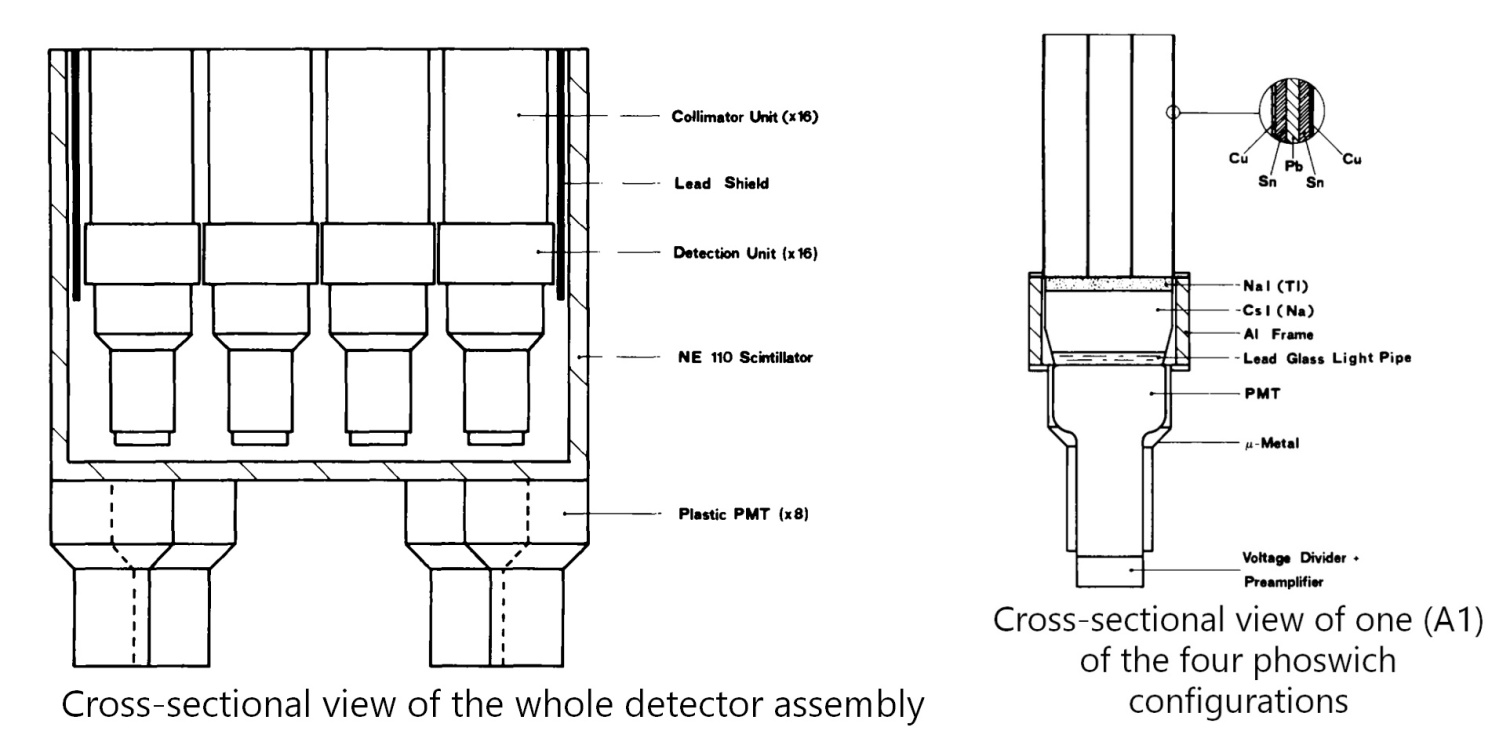
In the image at left we can see schematically the detection assembly (click on the image for more details). It consisted of an array of 4 × 4 detection elements, totaling 16 independent units. Four phoswich units were included alongside 12 other standard detection units. The phoswich design, recognized as forming the most efficient general-purpose instrument in hard X-ray astronomy (above 15 keV), typically combined efficient background rejection with large effective area, high detection efficiency, and good spectral resolution. Each phoswich unit was a primary X-ray detector consisting of a 105 mm × 105 mm NaI(Tl) square crystal. The NaI(Tl) thickness was either 10 mm (Units A1, A2) or 3 mm (Units A3, A4). CsI(Na) crystals acted as active shields and had varying thicknesses: 50 mm (A1, A3), 30 mm (A2), or 40 mm (A4). All CsI(Na) crystals shared the same surface area as the upper NaI(Tl) down to a depth of 3 cm, and if they were thicker than this, they were tapered at the bottom. Both scintillators in each phoswich unit were viewed by a 90 mm photomultiplier tube (PMT) through a light pipe. The light pipe was made of lead glass in three units (A1, A2, A4) and of quartz in the fourth unit (A3). The lead glass light pipes contained 42% lead by weight, which helped reduce the X-ray flux reaching the CsI from below. The X-ray entrance window of each unit had a surface area of 100 cm², which was slightly smaller than that of the crystal. The high voltage supply was independent for each unit and remained very stable with temperature.
The standard units, which remained in the array, consisted mostly of 10 mm thick square NaI(Tl) crystals (one was 3 mm thick) that had the same surface as the phoswiches, utilizing a bottom passive shield formed by a 3 cm thick lead glass light pipe (except one which was 6 cm thick). To minimize the background level in these standard units, events were vetoed by coincidence signals from surrounding units.
All 16 detection units and their collimators were surrounded (excluding the aperture) by an active shield made of NE 110 plastic scintillator, which was 2 cm thick and was viewed by eight 5" PMTs. A 5 mm thick layer of lead was positioned between the detectors and the plastic scintillator to limit the X-ray entrance aperture and enhance the plastic shield's rejection efficiency. The collimators provided a square field of view of 9.2° × 9.2° FWHM. The slats of the collimators were made of 0.5 mm thick lead, 20 cm high, which was covered on both sides by layers of tin (0.45 mm) and copper (0.1 mm).
In-flight calibration of the instrument was performed by 4 radioactive sources (a line at 165.85 keV and a K-fluorescence at a mean energy of 34.3 keV). These sources scanned the field of view of the telescope automatically every 4000 s or on telecommand.
The telescope was mounted in an alt-azimuth system, and the gondola was stabilized in azimuth, typically within 20'. An on-board computer, operated from the ground station, performed the pointing in the desired direction. The zenith angle of the detector was measured with an accuracy of 20'. The flight electronics and data handling system consisted of four separate chains, with Chain A processing signals from the four phoswich detectors. Signals were sent from the PMT through a preamplifier and amplification stage to both the pulse shape analyser (PSA) and the anticoincidence (AC)/energy window masks. The PSA, based on the constant-fraction discrimination (CFD) technique, analyzed events in the 20240 keV energy window that were not vetoed by coincidence signals from the plastic scintillator or the nearest units. If an event was recognized as a pure NaI(Tl) event, it was pulse-height analyzed and digitized. Data were transmitted to the ground station via a radio link using a PCM encoder.
Details of the balloon flight
Balloon launched on: 8/10/1982 at 6:30 utc
Launch site: Base di Lancio Luigi Broglio, Trapani, Sicily, Italy
Balloon launched by: Agenzia Spaziale Italiana (ASI) / Centre National d'Etudes Spatiales (CNES)
Balloon manufacturer/size/composition: Zero Pressure Balloon 850.000 m3
End of flight (L for landing time, W for last contact, otherwise termination time): 8/11/1982
Balloon flight duration (F: time at float only, otherwise total flight time in d:days / h:hours or m:minutes - ): 22 h 23 m
Landing site: In Yecla, Murcia, Spain
Campaign: ODISSEA 82
Payload weight: 1270 kgs
The balloon was launched from Trapani, Sicily on August 10, 1982, at 6:30 UTC. Float altitude at 2.4 mbar was reached after an ascent of about 2h and 20 m. Soon afterwards
two observations of about 40 min in total of the Crab Nebula were performed with a series of background measurements lasting for about 30 min. After a flight of near 23 hours, the balloon and payload landed in Spain, near the town of Yecla in the region of Murcia.
External references
- Balloon program for hard-X-ray astronomy IL Nuovo Cimento C NovembreDicembre 1984, Volume 7, Issue 6, pp 648-655
- Les ballons au service de la recherche. L'aérostation scientifique des origines à nos jours. Editions Edite & IFHE (Institut Français de l'Histoire de l'Espace) 2011, Pag. 422
- Performance of different phoswich configurations in a balloon flight experiment Nuclear Instruments and Methods in Physics Research A235 (1985) 573-581
If you consider this website interesting or useful, you can help me to keep it up and running with a small donation to cover the operational costs. Just the equivalent of the price of a cup of coffee helps a lot.