
Purpose of the flight and payload description
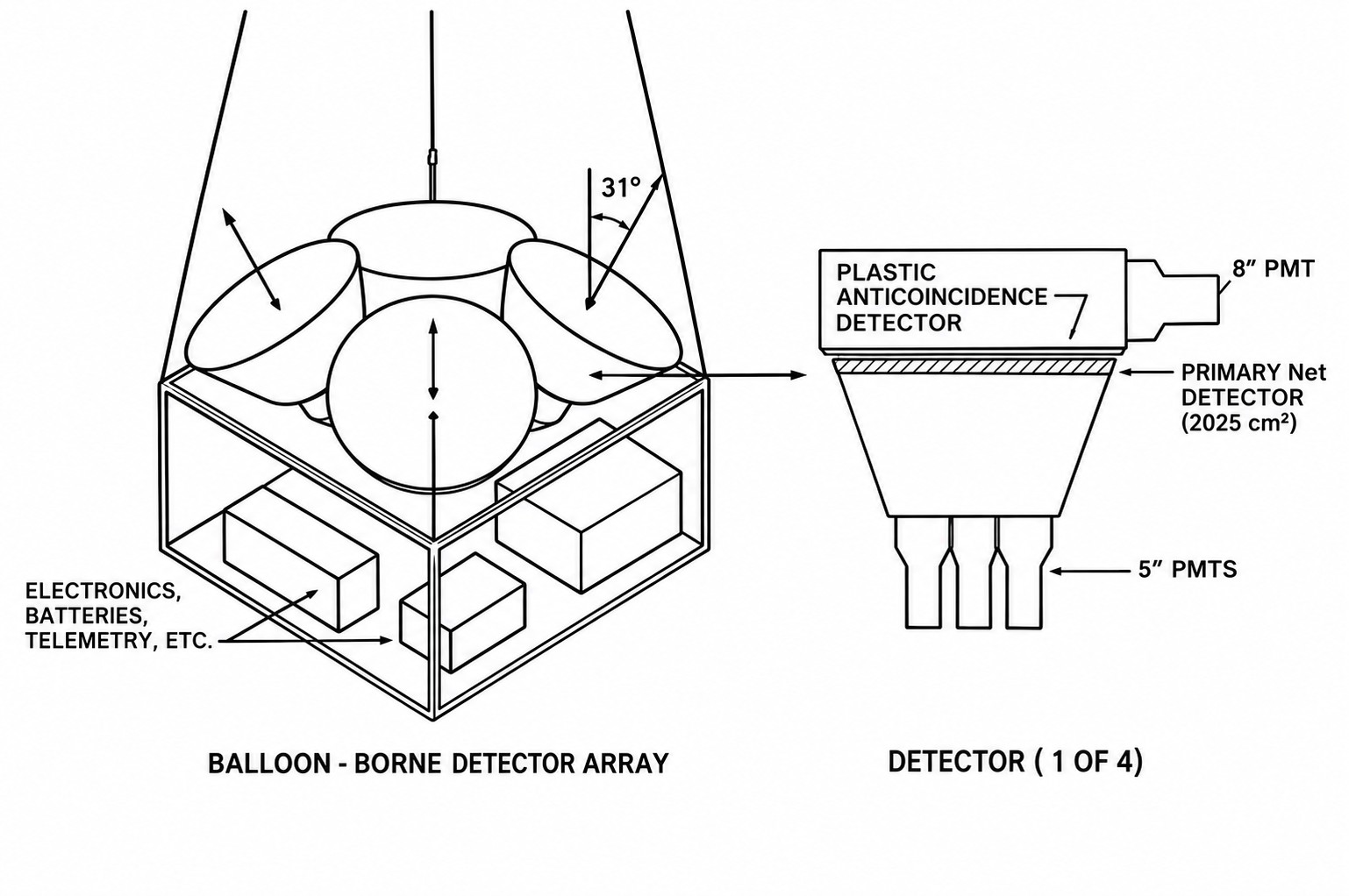
Objective of the flight was to detect and characterize cosmic gamma-ray bursts and other transient and variable high-energy sources using a balloon-borne detector. The instrument was developed by the University of Alabama in Huntsville and NASA's Marshall Space Flight Center as a balloon-borne prototype of the Burst and Transient Source Experiment (BATSE) a high energy astrophysics experiment installed on NASA's Compton Gamma-Ray Observatory and launched in orbit around Earth in 1991.
The instrument can be seen schematically on the image at left (click to enlarge). It consisted of four large-area sodium iodide scintillation detectors activated with thallium (NaI[Tl]). Each detector comprised a circular crystal 50.8 cm in diameter and 1.27 cm thick, with a geometric collecting area of approximately 2,025 cm². Three photomultiplier tubes (PMTs), each 12.7 cm in diameter, were optically coupled to each crystal through a conical, diffusely reflecting light collector. Scintillation light generated by gamma-ray interactions in the crystal was converted into electrical pulses by the PMTs. The reported energy resolution was 0.40 FWHM at 88 keV.
Each module incorporated a charged-particle anticoincidence detector consisting of a 55.2 cm-diameter, 0.64 cm-thick NE102 plastic scintillator disc. The plastic scintillator had a separate light collector and was viewed by two 12.7 cm-diameter PMTs. Signals from this detector were used to identify charged particles traversing the assembly and reject associated events from the gamma-ray measurements. The anticoincidence system could also be operated in reverse to record throughgoing charged particles for calibration purposes.
The four detector modules were arranged with their sensitive faces oriented in different directions. The normal to each face was inclined 31 degrees from the zenith, with the modules separated by 90 degrees in azimuth. The assembly was mounted on a platform that rotated about the zenith axis, completing one revolution approximately every 4.8 minutes. A small motor drove the rotation, while three orthogonal magnetometers measured the platform's angular orientation.
The data-acquisition system recorded detector counts in multiple energy intervals and at different integration times. The primary telemetered data consisted of 36-millisecond integrations in eight energy channels spanning approximately 45~180 keV and eight additional channels spanning 180~520 keV for each detector module. A separate spectral mode provided 128 energy channels distributed approximately logarithmically from 45 keV to 12 MeV, with 7.2-second integrations. Another data product used 7.2-second integrations in eight energy channels and 128 phase bins for the combined output of the four modules, supporting the analysis of periodic emission.
A high-time-resolution mode provided 4.5-millisecond integrations of the combined output of all four detectors in four energy channels between 45 and 520 keV. Approximately 23% of the data were available in this format. An onboard microprocessor adjusted the integration interval following recognition of a sufficiently strong burst.
Two in-flight calibration methods were provided. The first used a 10-microcurie barium-133 radioactive source housed in a lead-and-tin shield. The source could be exposed and retracted by command, producing a calibration peak at 350 keV. The second method used the plastic scintillator system to detect throughgoing charged particles.
Details of the balloon flight
Balloon launched on: 5/29/1982 at 10:36 utc
Launch site: Donaldson Center, Greenville, South Carolina, US
Balloon launched by: National Scientific Balloon Facility (NSBF)
Balloon manufacturer/size/composition: Zero Pressure Balloon Winzen 456.470 m3 (12.70 microns Stratofilm)
Balloon serial number: W16.12-2-01
Flight identification number: 185N
End of flight (L for landing time, W for last contact, otherwise termination time): 5/31/1982 at 23:04 utc
Balloon flight duration (F: time at float only, otherwise total flight time in d:days / h:hours or m:minutes - ): 64 h 20 m
Landing site: 22 miles N of Winslow, Arizona, US
Payload weight: 1136 kgs.
The balloon was launched from Greenville, South Carolina, on May 29, 1982, and reached an average float altitude corresponding to an atmospheric overburden of 4 g/cm². A total of 45.1 hours of data were collected before the instrument landing 22 miles N of Winslow, Arizona. The observations from this flight were combined with 18.9 hours obtained during a previous flight of the same instrument in October 1980 from Palestine, Texas, providing 64 hours of exposure for a search for weak gamma-ray bursts.
The data were searched for statistically significant, simultaneous count-rate increases in at least two detectors, using integration times from 0.1728 to 6.912 seconds. The analysis focused on a 2.76-second integration and the 60300 keV energy range. Several confirmed solar flares were identified, but no additional events exceeding five standard deviations above background in two or more detectors were found.
External references
- Measurement of the rate of weak gamma-ray bursts AIP Conference Proceedings, Volume 115, pp. 422
- NASA balloon sparks UFO reports Times Daily, 30 May 1982
- National Scientific Balloon Facility Annual Report FY 1982 National Center for Atmospheric Research, February 1983
- Flight Summary of balloons made of Stratofilm - 1981 to 1983, Technical report, Winzen Research International. Circa 1984 - Stratocat's private collection
- The frequency of weak gamma-ray bursts Astrophysical Journal, Part 1, vol. 291, April 15, 1985, p. 479
StratoCat is an independent, non-commercial project maintained to preserve and share the history of scientific and stratospheric ballooning. If you find the site useful, you can help keep it running with a small donation toward its operating costs. Every contribution, even the equivalent of a cup of coffee, is greatly appreciated.