
Purpose of the flight and payload description
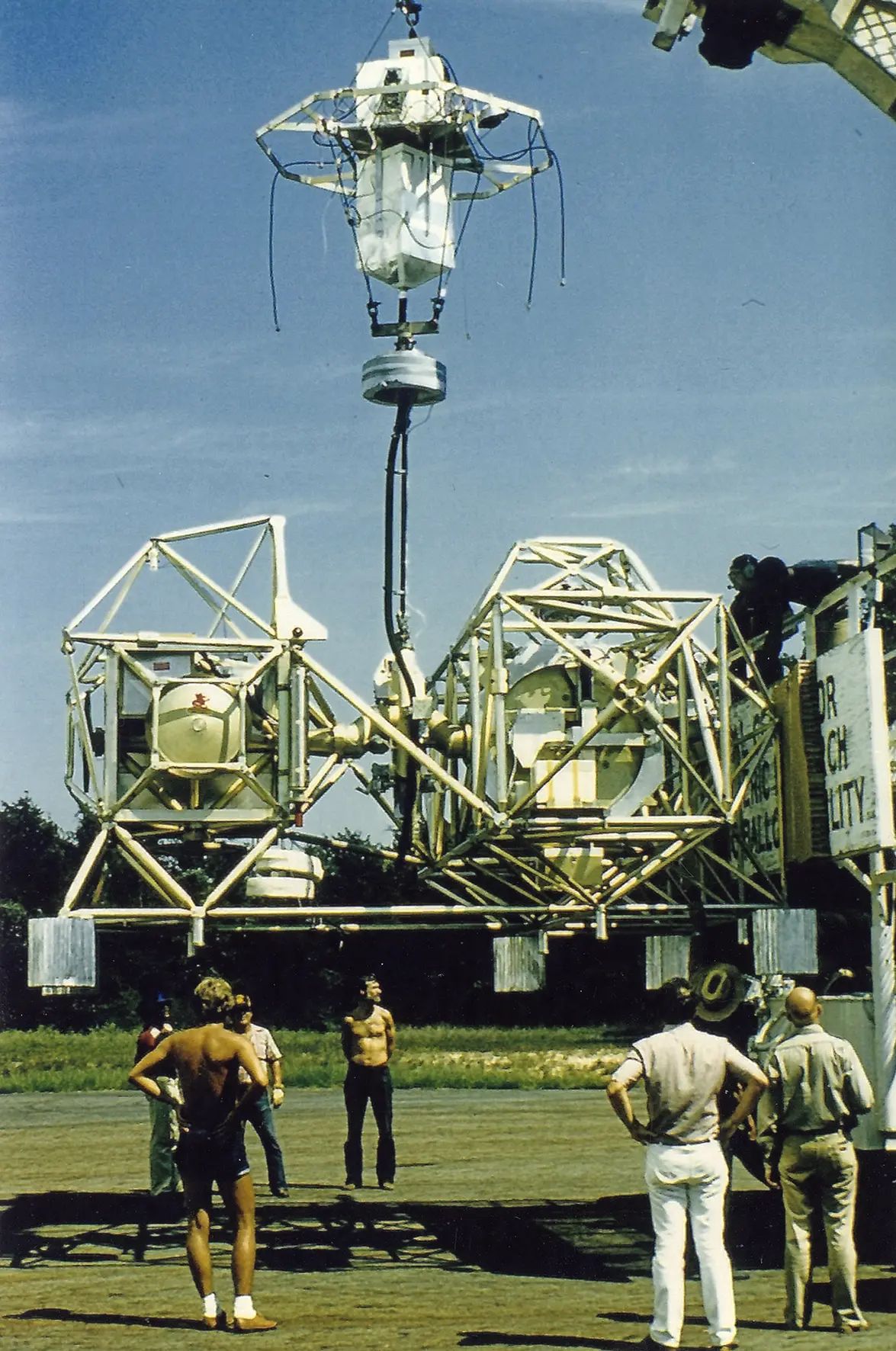
The GOLDENER DRACHE -German for Golden Dragon- was a three-axis stabilized balloon-borne platform developed iduring the late 1970s and early 1980s at the Max-Planck-Institut für Physik und Astrophysik in Garching, Germany for far-infrared astronomical observations in the wavelength range of 35 to 350 micrometers.
In the image at left we can see a picture of the gondola's structure (click to enlarge). It consisted of a framework of aluminum tubes supporting all mechanical, optical, and electronic components measuring 4.5 by 4.5 by 6.6 meters weighing approximately 2.000 kg. The structure was supported at its center of gravity by a spherical oil pressure bearing, which decoupled rotational motion from linear acceleration and pendulum motion of the balloon-gondola system. An azimuth motor provided isolation from balloon rotation. One side of the framework carried the telescope, the interferometer, two gimballed star trackers, and their associated electronics, while the opposite side held the attitude control package, which included coarse attitude sensors, reaction wheels, servo and telemetry/telecommand electronics, batteries, and the trimming system. The lower portion of the structure was built from weaker tubing with aluminum honeycomb crash pads to absorb the shock of parachute landing at the end of the flight.
The attitude control system comprised two functional blocks: a position servo loop and a trimming loop. The trimming system used sliding masses along the three principal axes to keep the total angular momentum of the gondola negligibly small. When angular momentum accumulated along a horizontal axis, the corresponding sliding mass was shifted, displacing the center of gravity and dumping the momentum into the earth through the gravitational field. Angular momentum on the vertical axis was dumped into the balloon via the azimuth motor. This arrangement protected the reaction wheels from velocity saturation and kept the center of gravity centered in the spherical bearing. The position servo system maintained the telescope's optical axis on a target by locking two gimballed star trackers onto two offset guidance stars. Three independent proportional-differential servo loops operated along the principal axes of the gondola's inertia ellipsoid. Each loop incorporated a selectable position sensor (either a magnetometer, inclinometer, position gyro, or star tracker) along with a rate gyro, a servo amplifier, and a reaction wheel. The two star trackers were gimballed in two orthogonal axes and positioned by precision wormgears driven by stepping motors. The achieved pointing accuracy was approximately 30 arcseconds.
Target acquisition began with the telescope oriented horizontally toward a magnetic cardinal point, guided by two crossed magnetometers and two inclinometers. The telescope was then slewed in azimuth, elevation, and cross-elevation under rate-integrating gyro control until the target was reached. Fine acquisition was completed by offsetting the star trackers to bring guide stars into their fields of view and switching control to the star trackers. In-flight corrections using the secondary mirror compensated for structural distortions or defocusing caused by temperature changes.
The primary infrared instrument was a 1-meter Dall-Kirkham telescope using gold-plated Cervit mirrors. The primary mirror had a diameter of 1 meter, a focal length of 1987 millimeters, and was built in a light-weighted honeycomb structure. The secondary mirror measured 155 millimeters in diameter and was designed as a two-dimensional wobbling mirror operating at 8 Hz, with its wobbling direction kept parallel to the earth's horizon via an inclinometer regardless of the gondola's cross-elevation changes. The telescope had an overall focal ratio of f/14, a one arcminute field of view, and a wobbling throw of 4 arcminutes. A motor-driven focusing device and a tilt adjustment unit were also part of the telescope assembly.
At the focal point of the telescope was located a Michelson interferometer covering wavelengths above 40 micrometers. Infrared radiation was directed into the interferometer by a dichroic mirror placed behind the telescope. For bright point sources such as planets, the visible portion of radiation transmitted through the dichroic mirror was observed by a telescope sensor array, allowing in-flight alignment verification by correlating the image position with the peak infrared signal. The movable mirror of the interferometer was driven by a harmonic-drive stepping motor with a screw drive, advancing in programmable step increments with a fundamental step size of approximately 0.16 micrometers. The detector was a germanium-gallium composite bolometer operating at approximately 1.5 Kelvin. The detector signal was synchronously demodulated against a reference from the wobbling secondary. A specially developed preamplifier discharged the coupling capacitor after each mirror step to prevent overloading and long recovery times caused by the high background radiation from the atmosphere and warm optics. All interferometer operations were controlled by a microprocessor commanded from the ground station via telecommand.
Details of the balloon flight
Balloon launched on: 10/25/1980 at 22:46 utc
Launch site: National Scientific Balloon Facility (NSBF), Palestine, Texas, US
Balloon launched by: National Scientific Balloon Facility (NSBF)
Balloon manufacturer/size/composition: Zero Pressure Balloon Winzen 152.911 m3 (22.86 microns - Stratofilm) - SF 234.85-090-NSCHR-01
Balloon serial number: W5.40-2-01
Flight identification number: 1229P
End of flight (L for landing time, W for last contact, otherwise termination time): 10/26/1980 at 13:42 utc
Balloon flight duration (F: time at float only, otherwise total flight time in d:days / h:hours or m:minutes - ): F 15 h 45 m
Landing site: 5 Miles W of Morton, Mississippi, US
Payload weight: 1943 kgs.
External references
- National Scientific Balloon Facility Annual Report FY 1981 National Center for Atmospheric Research, April 1982
- The 1m Balloon-Borne Telescope "GOLDEN DRAGON" for Far-Infrared Astronomy Mitteilungen der Astronomischen Gesellschaft, Vol. 54, p.91
If you consider this website interesting or useful, you can help me to keep it up and running with a small donation to cover the operational costs. Just the equivalent of the price of a cup of coffee helps a lot.