
Purpose of the flight and payload description
Objective of the flight was to obtain high-resolution measurements of gamma-ray emission produced during solar flares using a High Resolution Spectrometer. Main goal of the initiative was to investigate the acceleration, confinement, transport, and interaction of energetic protons and ions in the solar atmosphere. Particular emphasis was placed on the precise measurement of gamma-ray line energies and line profiles, since these features contained critical information about the energy spectra of accelerated particles and the composition of the ambient solar material in which they interacted. The project also sought to demonstrate that a balloon platform could support long-duration observations with sufficient spectral resolution, gain stability, and sensitivity to detect solar gamma-ray emissions that had previously proven difficult to observe. The payload was developed by the Laboratory for Astronomy and Solar Physics at NASA Goddard Space Flight Center, in collaboration with The Catholic University of America and Computer Sciences Corporation.
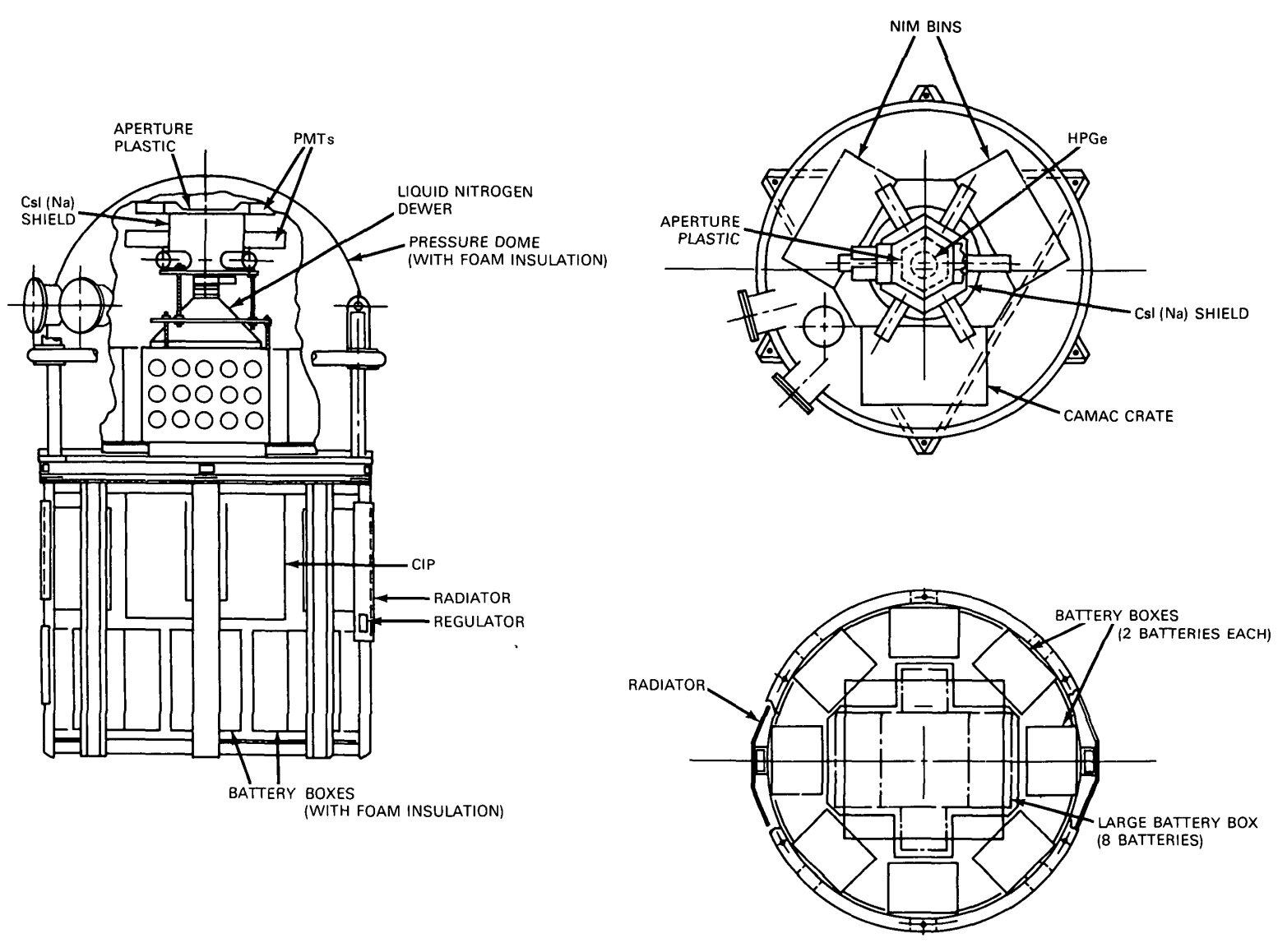
In the image at left we can see an schematic view of the instrument (click for more details). The spectrometer was centered on a high-purity germanium (HPGe) detector manufactured by Princeton Gamma-Tech. The detector measured 58 mm in diameter by 45 mm in height, operated at 3300 V bias, and achieved an energy resolution better than 2.5 keV FWHM at 1.17 MeV. The detector and preamplifier field-effect transistor were cooled to approximately 77 K using a 30-liter liquid nitrogen dewar with a seven-day operating capacity.
Background rejection was provided by an active anticoincidence system consisting of a CsI(Na) shield and a plastic scintillator aperture detector. The CsI(Na) shield surrounded the detector laterally and from below and was divided into three independent sections monitored by seven photomultiplier tubes. The aperture scintillator was 6 mm thick and was viewed by four photomultiplier tubes. Together, these systems reduced charged-particle and atmospheric gamma-ray background. The instrument field of view was approximately 120° FWHM and the detector axis was aligned with the zenith.
Signal processing was performed using NIM and CAMAC electronics. Valid events were digitized by an 8192-channel ADC, while shield signals were recorded through dedicated ADC and TDC systems. Data acquisition and payload control were managed by a DEC LSI-11/23 microcomputer. Telemetry operated at 20 kbps and transmitted detector events, timing information, count rates, temperatures, pressures, voltages, and system status. Power was supplied by twenty-eight lithium batteries feeding regulated ±6 V, ±12 V, and ±24 V electronics buses, with separate circuits for heaters and fans.
The entire instrument was enclosed within a thermally stabilized pressure gondola measuring approximately 1.3 m in diameter that contained the spectrometer and electronic subsystems while maintaining environmental conditions suitable for laboratory-grade instrumentation operating in the stratosphere. The gondola maintained an internal pressure of approximately 10^5 Pa throughout flight, preventing electrical arcing and thermal failures in sensitive components. The structure incorporated pressure-relief valves, thermal insulation, frozen thermal reservoirs, circulation fans, and controlled heaters. These systems maintained temperatures within operational limits despite the extreme thermal environment encountered at altitudes between 35 and 40 km. Internal temperatures remained between 12 °C and 34 °C during flight.
Details of the balloon flight
Balloon launched on: 11/1/1980
Launch site: Space Research Facilities, Gimli, Manitoba, Canadá
Balloon launched by: GIMLI
Balloon manufacturer/size/composition: Zero Pressure Balloon
End of flight (L for landing time, W for last contact, otherwise termination time): 11/1/1980
Balloon flight duration (F: time at float only, otherwise total flight time in d:days / h:hours or m:minutes - ): F 6 h
Landing site: The instrument was demolished when it was dropped from a helicopter during recovery.
This was the first engineering flight of the instrument. The balloon was launched from Gimli, Manitoba, on 1 November 1980. After a nominal ascent, the payload reached approximately 36 km altitude and remained at float for about six hours. After landing and while the payload was being transported by an helicopter back to the launch base, the instrument experienced a free fall and as a result of the impact it was totally destroyed.
External references
- A balloon-borne high-resolution spectrometer for observations of gamma-ray emission from solar flares NASA Technical Memorandum 86069 (1984)
- A balloon-borne high-resolution spectrometer for observations of gamma-ray emission from solar flares Nuclear Instruments and Methods in Physics Research, Sect. A, Vol. 225, No. 1, p. 195 - 208 (1984)
If you consider this website interesting or useful, you can help me to keep it up and running with a small donation to cover the operational costs. Just the equivalent of the price of a cup of coffee helps a lot.