
Purpose of the flight and payload description
The flight was part of a double scientific and technical objective: demonstrating the practical viability of a relay balloon system for extending the range and duration of stratospheric observations, and applying that system to a specific scientific measurement, in this case, mapping the electric-power fields (at both 50 and 60 Hz, the two frequencies used across Japan) propagating outward over the Pacific Ocean from Japanese power lines. The scientific questions driving the electric-field observation were whether such anthropogenic electromagnetic fields could travel significant distances from the Japanese coast and, if so, how their intensity varied with distance from the island. To capture meaningful data, the mission required the main observation balloon to fly a path exceeding 1,000 km eastward from the Sanriku Balloon Center, well beyond the reach of any conventional single-balloon telemetry setup.
To accomplish this, two balloons were flown simultaneously. The main balloon -this flight- relatively small at 600 cubic meters with a 77 kg payload, was designed to float at 16 km altitude, where strong eastward stratospheric winds would carry it rapidly across the Pacific at around 170 km/hr. The relay balloon -the balloon launched an hour after the main one- was considerably larger at 5,000 cubic meters with a 74 kg payload, and floated much higher, at roughly 27 km, where winds were slow enough to keep it nearly stationary, thus serving as an airborne communications bridge between the fast-moving main balloon and the ground station.
The telemetry link between the two balloons used 298.1 MHz VHF radio, while the relay balloon transmitted data down to the ground on 1,673 MHz. The 298.1 MHz link maintained a margin of over 10 dB at separations up to 1,200 km. The transmitter aboard the main balloon weighed 1.5 kg and radiated 1 watt, while the relay balloon carried a 5-element Yagi antenna and receiver weighing 4 kg in total. FM/FM modulation using IRIG subcarrier frequencies was used throughout. A key challenge was multipath fading caused by reflections off the ocean surface at long ranges, which degraded signal quality progressively beyond 700 km separation.
Beyond communications hardware, both balloons carried specialized equipment not typical of ordinary flights. An Omega navigation receiver on the main balloon tracked its position by receiving 10.2 kHz signals, feeding location data into the telemetry stream. Since the main balloon was expected to fly for several days and would eventually pass beyond ground telecommand range, it carried an automatic ballast system consisting of a pressure-sensitive switch that released ballast to compensate for lift losses at sunset or under other radiation effects. Flight termination was handled by a long-duration timer based on an E-cell (an electroplating-based Coulomb meter), programmable for up to 100 hours. The relay balloon carried a gondola-mounted Yagi antenna whose azimuthal direction was actively controlled so that its main beam continuously pointed toward the main balloon, guided by AGC voltage readings from the 298.1 MHz receiver and telecommand updates from the ground.
Details of the balloon flight
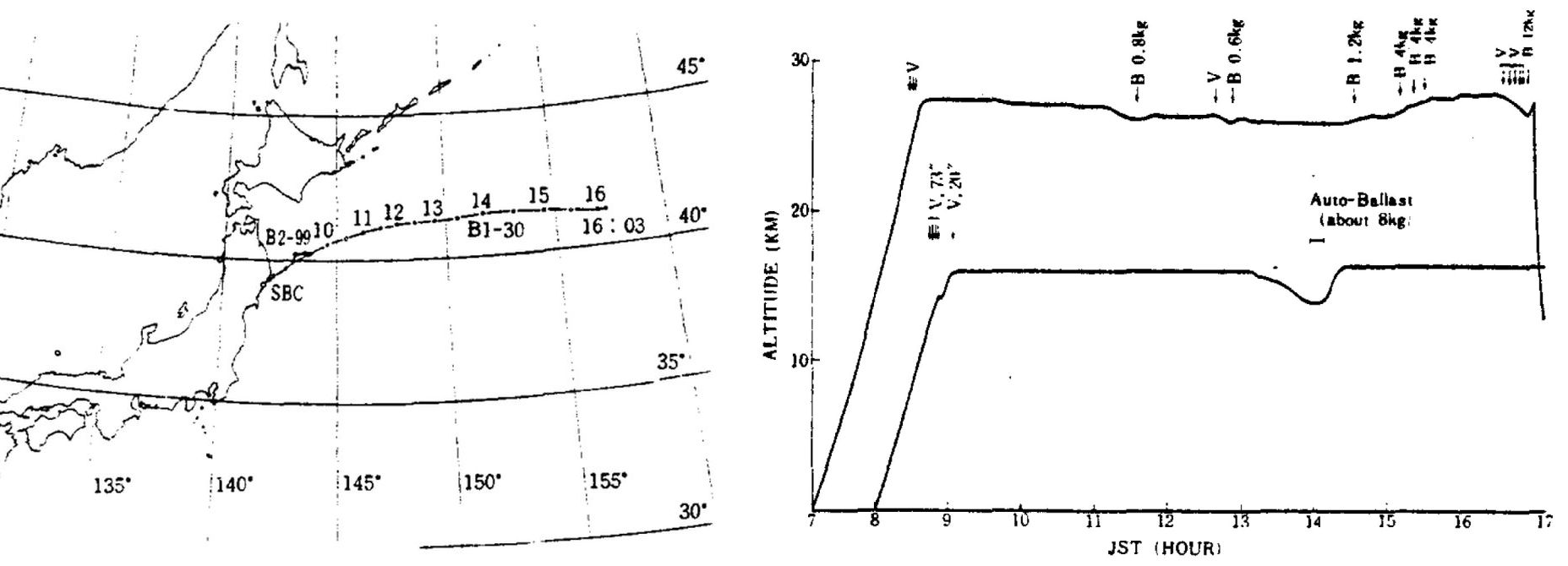
Balloon launched on: 10/4/1979 at 8:01 jst
Launch site: Sanriku Balloon Center, Iwate, Japan
Balloon launched by: Institute of Space and Astronautical Science (ISAS)
Balloon manufacturer/size/composition: Zero Pressure Balloon model B1 1.000 m3
Flight identification number: B1-30
End of flight (L for landing time, W for last contact, otherwise termination time): 10/4/1979 at ~ 17:00 jst
Balloon flight duration (F: time at float only, otherwise total flight time in d:days / h:hours or m:minutes - ): ~ 10 h
Landing site: In the Pacific Ocean, about 1300 km from the Japanese shore
Payload weight: 74 kg
External references
- Relay Balloon Advances in Space Research 3(6):67-70 (1983)
If you consider this website interesting or useful, you can help me to keep it up and running with a small donation to cover the operational costs. Just the equivalent of the price of a cup of coffee helps a lot.