
Purpose of the flight and payload description
Objective of the flight was to measure stratospheric water vapor concentration in situ over the Pacific Ocean from a balloon platform. The instrument was developed at the Institute of Space and Aeronautical Science, University of Tokyo.
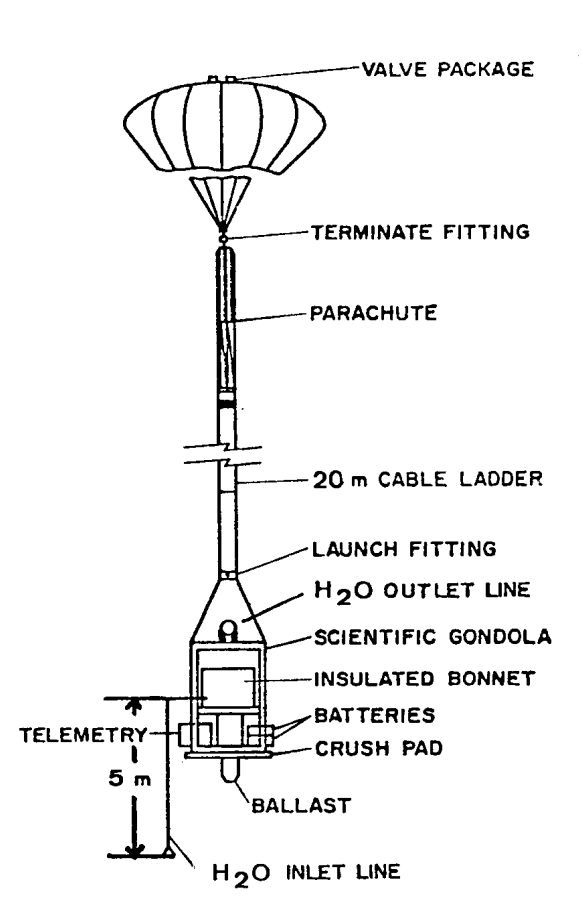
In the image at left we can see an scheme of the distribution of the flight train (click to enlarge). The core of the instrument was a multiple-traversal absorption cell with a total optical path length of 9.8 meters, achieved by bouncing the light beam 27 times through internal reflections. The cell and all associated optical benches were constructed from stainless steel, chosen for two reasons: the need to maintain vacuum integrity under the low-pressure stratospheric conditions, and the requirement for materials with small thermal expansion coefficients given the extremely low temperatures of the stratosphere. The cell was sealed and pre-evacuated on the ground for approximately four to five days using a cryo-sorption pump, and during evacuation it was baked repeatedly at temperatures between 80 and 90°C to drive off adsorbed water from the cell walls. After baking, the vacuum system was filled with dry nitrogen and the inlet and outlet ports were sealed with glass caps that were removed by remote command once the balloon reached the upper atmosphere, allowing stratospheric air to flow through the cell via a fan motor.
The light source was a gallium-arsenide Light Emitting Diode (LED), whose emission peak lies near the spectral region containing strong water vapor absorption lines in the so-called sigma-band. The LED was chopped by a chopper motor equipped with two butterfly-type sector mirrors coated with gold, which also served as beam-directing elements within the optical system.
The spectral filtering was accomplished by an extremely narrow band-pass interference filter with a bandwidth of 0.22 nm centered at 942.750 nm corresponding to the region of maximum absorption in the sigma-band of water vapor.
The radiation detector was a photomultiplier tube, cooled with liquid nitrogen to reduce dark current. This tube has a photocathode radiant sensitivity suited for the near-infrared. A beam splitter within the optical system separated the incident reference beam from the beam that had passed through the absorbing stratospheric air, so that both the incident light intensity and the transmitted intensity could be measured alternately within each measurement cycle.
The electronic detection and data processing system was based on a digital lock-in method. The photomultiplier output was fed through a pre-amplifier and then through a voltage-to-frequency converter, which digitized the signal while preserving its linearity. The counting of the digitized pulses for the reference beam and the absorbed beam was controlled by a precision gate circuit. The counted data were stored in 4-bit binary-coded decimal latches and updated every 6.25 seconds. An attenuator was also included in the optical path to allow adjustment of the incident or reference light intensity.
The telemetry system transmitted the digital data via two FM subcarrier channels at a carrier frequency of 1680 MHz. The conversion from digital to analog for transmission was handled by a DAC-08 EQ digital-to-analog converter. The interface circuits employed 8-bit multiplexers and a 2-line data selector. A housekeeping system monitored temperature at four points within the gondola, including outside the optical system, at the voltage regulator, at the universal measuring circuit board, and at the filter. It also monitored the pressure inside the absorption cell, the high voltage supply for the photomultiplier, fan motor rotation, and command acknowledgment signals from four cutter commands, along with five calibration voltage channels.
The entire scientific payload was mounted in an insulated bonnet, with batteries and a crush pad for landing, and was suspended approximately 20 meters below the balloon envelope by a cable ladder, with the telemetry package at 5 meters below the gondola.
Details of the balloon flight
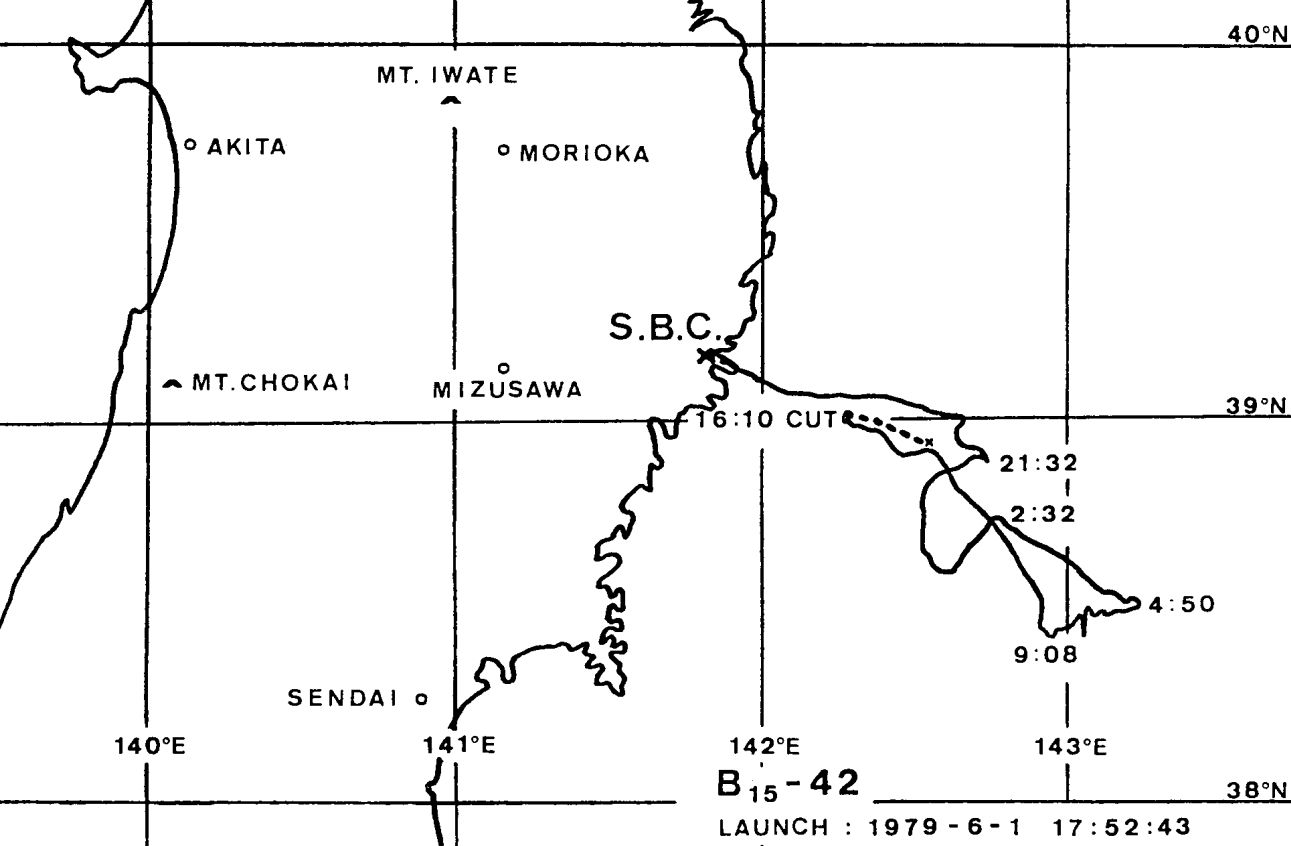
Balloon launched on: 6/1/1979 at 17:52 jst
Launch site: Sanriku Balloon Center, Iwate, Japan
Balloon launched by: Institute of Space and Astronautical Science (ISAS)
Balloon manufacturer/size/composition: Zero Pressure Balloon model B15 15000 m3
Flight identification number: B15-42
End of flight (L for landing time, W for last contact, otherwise termination time): 6/2/1979 at 16:10 jst
Balloon flight duration (F: time at float only, otherwise total flight time in d:days / h:hours or m:minutes - ): 23 h
Landing site: In the Pacific Ocean
The balloon was launched from the Sanriku Balloon Center in Iwate, Japan at 17:52 JST on June 1st. 1979. After a nominal ascent the balloon recahed an altitude of 28 kilometers and remained in flight for 23 hours before being recovered from the Pacific Ocean the next day.
External references
- Observation of Water Vapor in the Stratosphere [in Japanese] Bulletin of the Institute of Space and Aeronautical Science, University of Tokyo 16(2_B), 1087-1107, 1980-07
- Water Vapor Content in the Stratosphere Obtained by a Balloon Observation ISAS report 45(12), 231-289, 1980-12
Images of the mission
If you consider this website interesting or useful, you can help me to keep it up and running with a small donation to cover the operational costs. Just the equivalent of the price of a cup of coffee helps a lot.