
Purpose of the flight and payload description
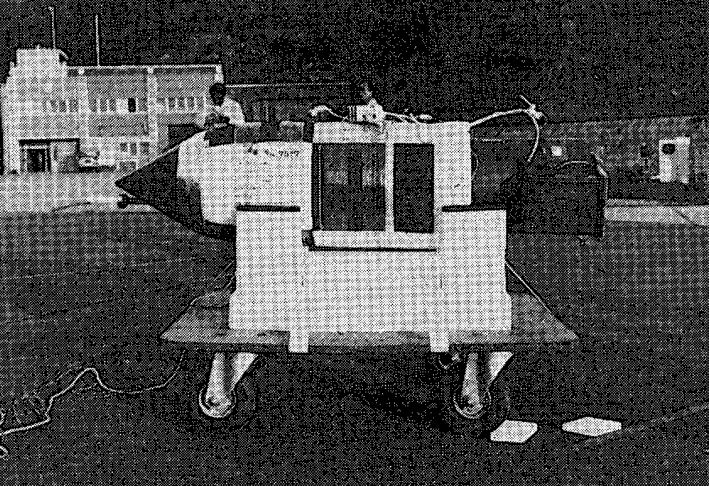
The objective of the flight was to drop a prototype parachute deployment device from a balloon at approximately 26 km altitude to evaluate the performance of both a pilot chute and a main parachute under near-operational conditions, as part of the development phase of a parachute-based deceleration descent system for recovering payloads from sounding rockets, specifically the S-310 single-stage rocket and the S-520 rocket then under development. Final goal was to slow payloads descending at high speed from upper atmospheric altitudes to a safe splashdown speed suitable for ocean recovery. The initiative was carried out in the late 1970s decade by the Institute of Space and Astronautical Science (ISAS) from Japan.
In the image at left we can see the Parachute Deployment Test Device (PDTD from now on) whose dimensions and shape were modeled roughly after the S-310 rocket payload section.
The deceleration system consisted of two parachute components stored in sealed containers pressurized at 1 atmosphere. The first was a pilot chute of 0.9 m diameter in a balloon type configuration, stored in a pilot chute container of approximately 1.5 liters capacity, whose purpose was to orient the payload in the prescribed direction and provide initial deceleration. The second was a main chute of 5.5 m umbrella diameter in an elliptical type configuration, stored in a main chute container of approximately 12 liters capacity, responsible for full-scale gentle descent. The main chute canopy was packed inside a deployment bag that would be released only once the pilot chute had pulled the canopy out to the point where its suspension lines were fully extended. An 8 mm camera box was mounted on the external wall of the PDTD to photograph the parachute deployment status. This camera activated 20 seconds after drop and could film for 200 seconds thereafter.
The device had a total weight of 65 kg at the time of drop, which decreased to approximately 60 kg by the time of main chute deployment. It carried a 1.6 GHz telemetry transmitter whose antenna pattern had a large notch in the axial direction, allowing attitude estimation through AGC level variation. Onboard instrumentation included three-axis accelerometers oriented mutually perpendicular, with one axis aligned in the suspension direction at the moment of drop, two strain gauges for measuring parachute deployment tension, pressure sensors measuring both tip pressure and internal cylinder pressure, and temperature sensors monitoring both internal and cylindrical case wall temperatures. A beacon transmitter was also included for location and recovery after PDTD splashdown, though it carried only 10 hours of power capacity.
Details of the balloon flight
Balloon launched on: 10/4/1978 at 7:!0 JST
Launch site: Sanriku Balloon Center, Iwate, Japan
Balloon launched by: Institute of Space and Astronautical Science (ISAS)
Balloon manufacturer/size/composition: Zero Pressure Balloon model B5 5.000 m3
Flight identification number: B5-92
End of flight (L for landing time, W for last contact, otherwise termination time): 10/4/1978 at 9:20 JST
Balloon flight duration (F: time at float only, otherwise total flight time in d:days / h:hours or m:minutes - ): 2 h 10 m
Landing site: Impact in the Pacific Ocean at coordinates 143° 04 E, 39° 29 N
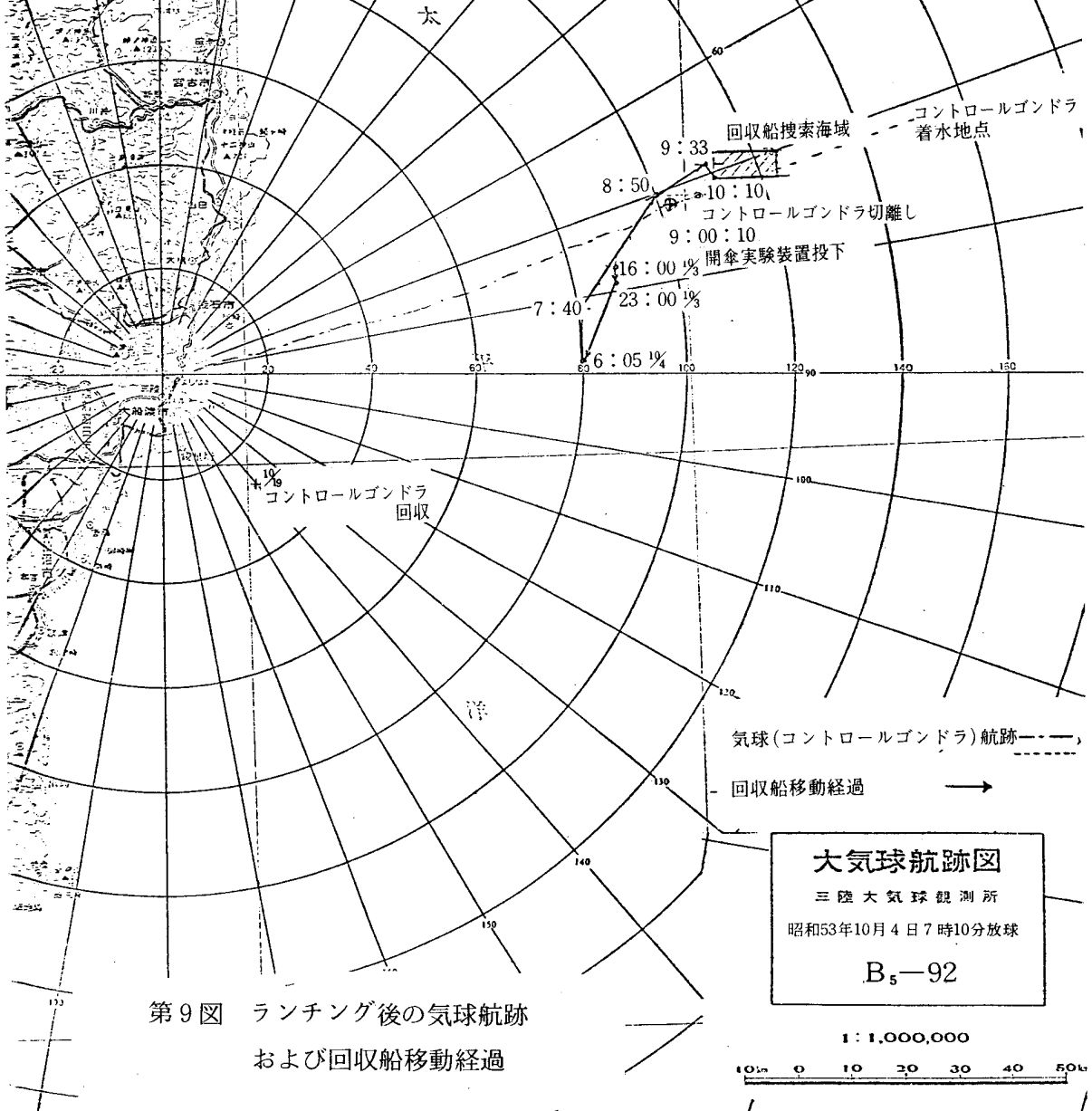
The balloon was launched from the Sanriku Balloon Center (SBC) on October 4, 1978, at 7:10 Japan Standard Time (JST). After release, it ascended at 270 m/min, entering level float at 25.5 km altitude at 8:23 JST, approximately 90 km ENE of the base. The balloon then continued northeast, and at 9:00 JST a command was transmitted from the ground to the gondola, activating the timer of the parachute deployment test device. Ten seconds later, the device was dropped. The balloon subsequently ascended to 30 km altitude, entered level float, and 21 minutes later the command control gondola was cut away and descended by parachute into the sea approximately 160 km ENE of the base. Following the drop of the parachute deployment test device, telemetry radio signals were received normally at the SBC down to approximately 1 km altitude, and then by a receiving vehicle dispatched to Hashizaki until splashdown, which occurred just after 9:20 JST. Simultaneously, elevation angle, azimuth, and slant range data were recorded from the receiving station. The splashdown point was estimated at approximately 143° 04' E, 39° 29' N.
A fishing boat was chartered for recovery of the parachute deployment test device and was requested to stand by in the anticipated splashdown area from the evening of September 3, the day before the experiment. The vessel was loaned a direction-finding receiver for the 1.6 GHz radio signal from the SBC and was asked to conduct a search using it. From 16:00 on September 3 onward, successively updated splashdown point estimates were communicated to the recovery vessel as new data became available. At 8:50 on September 4, the boat came within direct visual range of the balloon; however, as the balloon was drifting east-northeast at 30 km/h by the time of the drop, the distance between the vessel and the balloon increased rapidly. Consequently, the slowly descending device could not be visually tracked after release, and the 1.6 GHz signal could not be received due to the crew's unfamiliarity with the receiver. Instructions were issued to search the sea area indicated, taking into account local ocean currents near the splashdown point. The search continued until sunset, but neither beacon signal reception nor device recovery was achieved. As the beacon transmitter had only 10 hours of power capacity, the subsequent search was abandoned. The control gondola was recovered by another fishing boat on October 19, 1978.
External references
- Payload recovery experiments by sounding rockets and balloon in Japan 11th Aerodynamic Decelerator Systems Technology Conference (1991)
If you consider this website interesting or useful, you can help me to keep it up and running with a small donation to cover the operational costs. Just the equivalent of the price of a cup of coffee helps a lot.