
Purpose of the flight and payload description
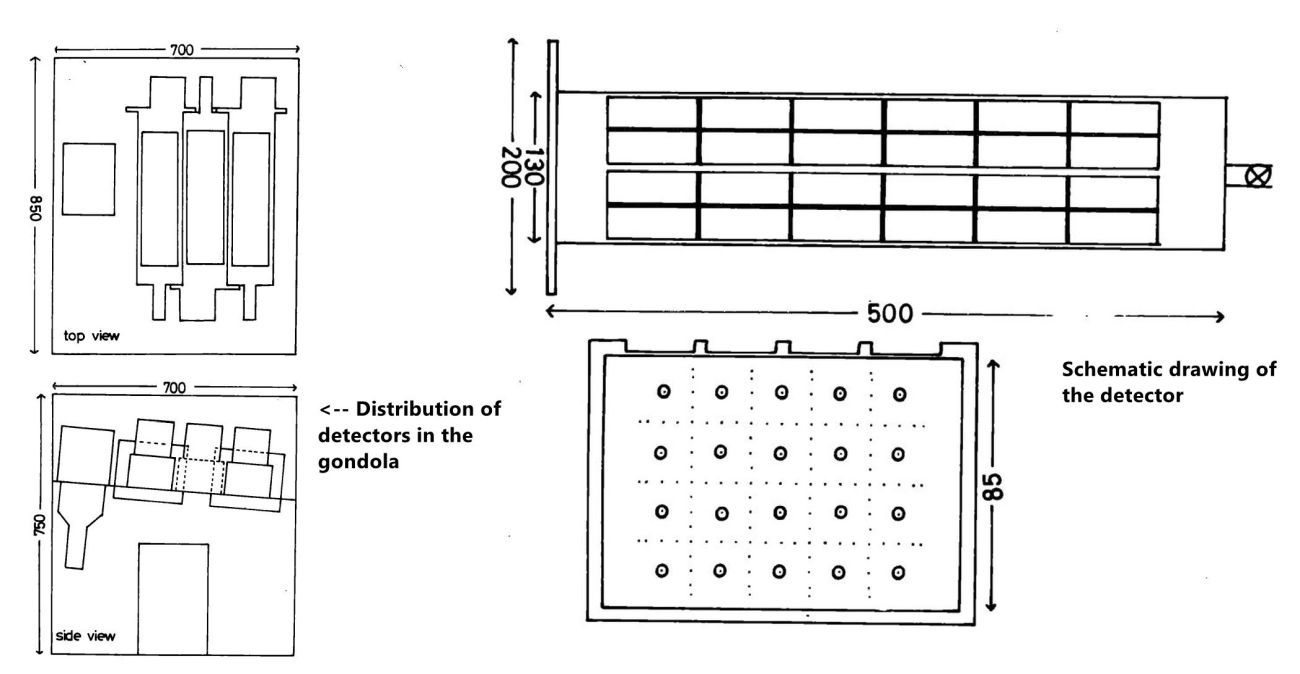
The objective of the flight was to perform observation of hard X-rays from celestial sources in the energy range of 20 to 100 keV. For that purpose a large-area, box-type pressurized proportional counter was developed at the Department of Physics, Osaka City University for deployment in a balloon-borne platform.
In the image at left we can see a scheme of the distribution of the detector in the gondola (click for more details). It consisted of 4 layers, with each layer aligned with five counters, producing a total of twenty counters arranged in a box configuration. In operation, two signals were fed out from the detector: one from an inner part comprising six counters, and another from an outer part comprising fourteen counters.
The entrance window of the detector was made from 1 mm thick aluminum and was filled with a gas mixture of Xenon and Methane at a pressure of 2.0 atmospheres. This gas combination and pressure gave the counter its detection sensitivity in the hard X-ray band. The counter efficiency as a whole was calculated and reached a maximum of nearly 80% at approximately 35 keV. The flight model used for observations had an effective area of 300 cm², though the design allowed for easy enlargement to 500 cm² per detector.
For the balloon flight, three pressurized proportional detectors were combined with a 3-inch diameter NaI(Tl) scintillation crystal detector, all positioned on the balloon gondola. The detector axes were pointed in the same direction, tilted 4° from the vertical, which allowed cross-checking of stability between detectors. The gondola measured 0.7 meters long, 0.86 mts wide and had a height of 0.75 mts. Total weight was approximately 100 kg, excluding ballast.
Signals from each detector were shaped and amplified as linear pulses, then routed to a central digital processor. To reject charged particles, the signals were fed into an anti-coincidence circuit. To determine the energy of incoming photons, the signals were summed and sent to an analog-to-digital converter (ADC) circuit. The full electronics system included mixers, low-level discriminators, amplifiers, rate meters, delay lines, a parity checker, a FIFO buffer, and a telemetry output to send counting rates to ground station.
Details of the balloon flight
Balloon launched on: 9/24/1978 at 7:59 JST
Launch site: Sanriku Balloon Center, Iwate, Japan
Balloon launched by: Institute of Space and Astronautical Science (ISAS)
Balloon manufacturer/size/composition: Zero Pressure Balloon model B30 30.000 m3
Flight identification number: B30-28
End of flight (L for landing time, W for last contact, otherwise termination time): 9/24/1978
Balloon flight duration (F: time at float only, otherwise total flight time in d:days / h:hours or m:minutes - ): F 12 h
The balloon was launched from the Sanriku Balloon Center in Japan at 7:59 Japan Standard Time on September 24, 1978, and remained at float altitude, between 4.7 mb and 5.6 mb of atmospheric pressure, for 12 hours. At float altitude, the background counting rates recorded were 42.8 ± 0.2 counts per second for the pressurized proportional counter and 10.8 ± 0.1 counts per second for the NaI(Tl) detector. The effective area of the proportional counter was 10 times that of the NaI detector, while its efficiency was approximately half that of the NaI detector.
External references
- Pressurized Proportional Counter 16th International Cosmic Ray Conference, Vol. 11, Pag 14 (1979)
If you consider this website interesting or useful, you can help me to keep it up and running with a small donation to cover the operational costs. Just the equivalent of the price of a cup of coffee helps a lot.