
Purpose of the flight and payload description
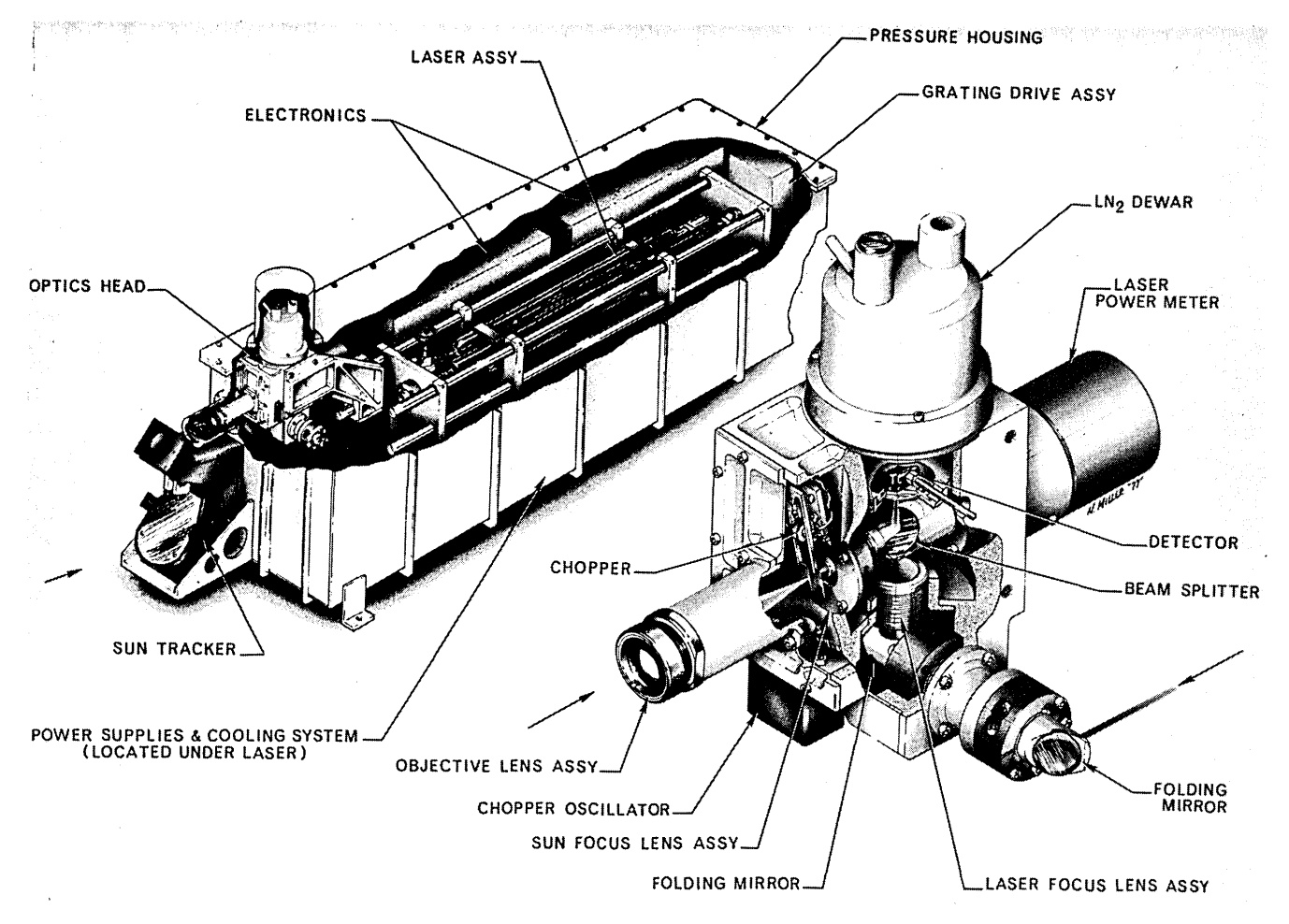
The LHR or LASER HETERODYNE RADIOMETER was a balloon-borne instrument for remote measurements of stratospheric trace species, primarily chlorine monoxide. It used the technique of solar occultation in the infrared by viewing the setting sun at large zenith angles from float altitudes near 40-45 km, which increased optical path lengths through the stratosphere. It was developed at the Jet Propulsion Laboratory
Inthe figure at left can be seen a cutaway scheme of the instrument (click to enlarge). Radiation entered through a 5-cm germanium window and was focused by zinc selenide optics. The local oscillator was a 14C16O2 laser. Frequency selection was achieved with a Littrow-mounted grating driven by a stepping motor, with fine adjustment from a piezoelectric transducer. The laser consumed ~70 W and used an Invar frame to minimize cavity drift. Solar and laser beams were combined on a dielectric-coated zinc selenide flat and focused onto a cryogenically cooled HgCdTe photomixer in a liquid nitrogen Dewar. A tuning fork chopper modulated the solar beam for synchronous detection. Stray reflections were minimized to reduce spurious modulation.
The photomixer, built at MIT Lincoln Laboratory, was a planar mercury cadmium telluride diode optimized for 10.6 µm heterodyne operation. Receiver electronics used two mixing stages. The photomixer down-converted the IR signal to the RF range, then a second stage mixed it to an intermediate frequency of 50250 MHz. A GaAs FET preamplifier with ~200 K noise temperature amplified the signal. Notch and bandpass filters rejected telemetry interference and unwanted sidebands. A six-channel filter bank with 2535 MHz bandwidth per channel provided the instrument's effective resolution.
The command and data system operated via PCM telemetry. Commands adjusted the laser grating angle, piezo tuning voltage, and receiver oscillator frequency. Sun and laser blockers allowed baseline and noise checks. Ground handling was performed with NCAR's telemetry equipment. Cooling was maintained by circulating fluid through the laser and electronics to an external radiator with resistive heaters.
The instrument was enclosed in a pressure vessel that maintained 1030 °C and 0.50.7 atm. Cooling loops, heaters, and internal fans controlled thermal conditions, and the housing was purged with nitrogen vapor. A gondola system with a reaction wheel and photodetectors maintained solar pointing within a few degrees, while a two-axis tracker at the instrument front provided ±15° acquisition and ~2 mrad pointing accuracy.
Details of the balloon flight
Balloon launched on: 9/20/1978
Launch site: National Scientific Balloon Facility (NSBF), Palestine, Texas, US
Balloon launched by: National Scientific Balloon Facility (NSBF)
Balloon manufacturer/size/composition: Zero Pressure Balloon Winzen 727.460 m3 (12.70 microns - Stratofilm)
Flight identification number: 1086P
End of flight (L for landing time, W for last contact, otherwise termination time): 9/20/1978
Balloon flight duration (F: time at float only, otherwise total flight time in d:days / h:hours or m:minutes - ): F 9 h 45 m
Payload weight: 1265 kgs.
External references
- A re-evaluation of laser heterodyne radiometer ClO measurements Geophysical Research Letters, vol. 10, Aug. 1983, p. 729-732
- Balloon-borne laser heterodyne radiometer for measurements of stratospheric trace species Applied Optics Vol. 20, Issue 4, pp. 536-544 (1981)
- Long-path laser measurements of stratospheric chlorine monoxide Quantum Electronics, IEEE Journal of (Volume:15 , Issue: 9 )
- National Scientific Balloon Facility Annual Report FY 1978 National Center for Atmospheric Research, January 1979
- Remote measurement of ClO in the stratosphere Geophysical Research Letters, Volume 6, Issue 3, p. 151-154
- Stratospheric trace constituent profile retrievals using laser heterodyne radiometer IR limb sensing spectra Applied Optics, vol. 20, Feb. 1, 1981, p. 505-513
If you consider this website interesting or useful, you can help me to keep it up and running with a small donation to cover the operational costs. Just the equivalent of the price of a cup of coffee helps a lot.