
Purpose of the flight and payload description
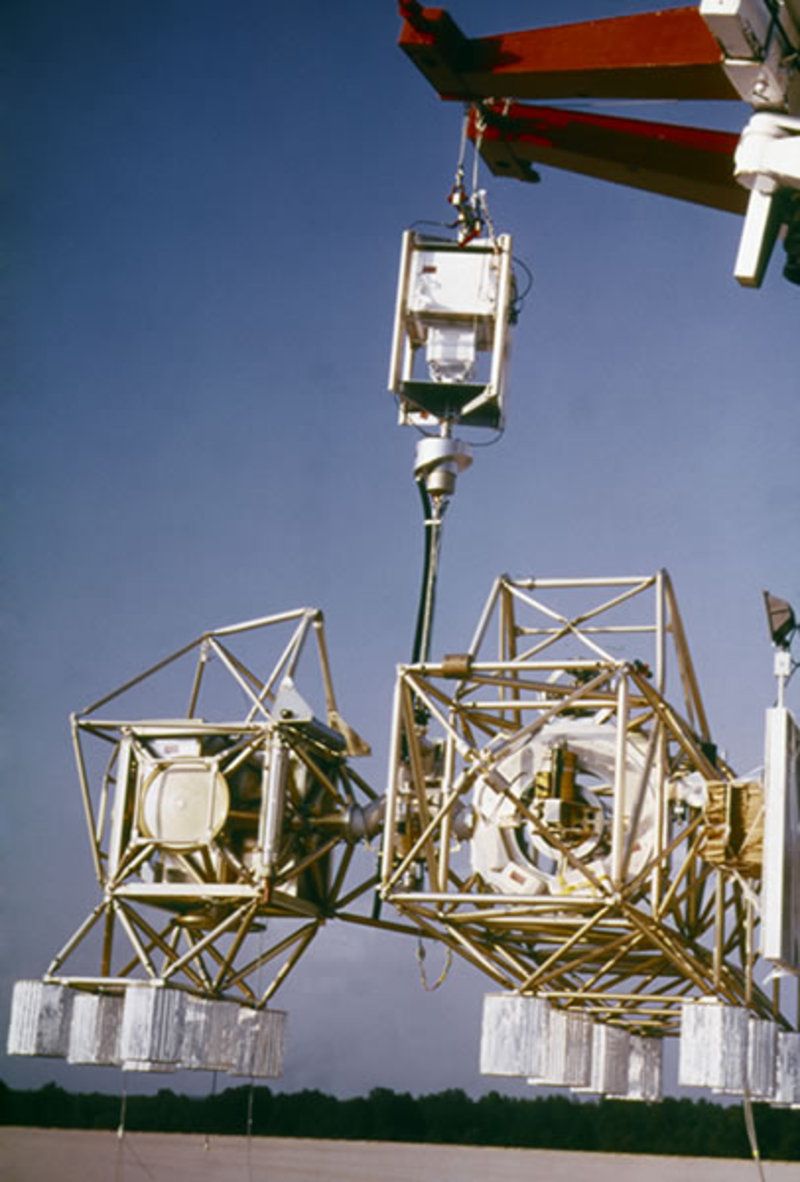
The GOLDENER DRACHE (German for Golden Dragon) was a three-axis stabilized balloon-borne platform developed at the Max-Planck-Institut für extraterrestrische Physik in Garching, West Germany, intended for high-resolution spectroscopy of celestial objects radiating in the far infrared between 20 and 200 micrometers. Its primary design objective was to locate and track non-visible infrared sources with a pointing accuracy better than 30 arcseconds for more than one hour per object, with an angular coverage spanning the entire hemisphere.
In the image at left we can see a picture of an early version of the instrument (click to enlarge). The gondola structure consisted of a framework of aluminum tubes supporting all mechanical, optical, and electronic components. The telescope and the instrumentation unit were connected by a yoke, forming the inertial system of the payload. This rested at its center of gravity in a hydrostatic ball bearing mounted on a support ring, selected for its extremely low friction and minimal moving parts. The bearing allowed rotation about any arbitrary axis while decoupling the payload from linear accelerations and pendulum motions of the balloon system. The bearing and ring together permitted motion from 0 to 63 degrees in elevation and plus or minus 15 degrees in cross-elevation. The support ring was suspended from the balloon via a motor-driven azimuth bearing that isolated the payload from balloon rotation. During takeoff and landing, motor-driven levers held the inertial system horizontal and locked to the support ring. Both the telescope and instrumentation unit were separately enclosed in aluminum tube frameworks with honeycomb crash pads on their lower sides to absorb landing shock.
The pointing system employed full three-axis space stabilization rather than a two-axis azimuth-elevation approach, which would have introduced image rotation unacceptable for extended infrared sources and lacked a free axis to compensate balloon cycling. Three reaction wheels, each assigned to one principal axis, kept the total momentum vector near zero without transferring momentum to the suspension. A continuously operating trimming system of movable masses along the elevation axes and an azimuth motor prevented progressive momentum accumulation in the wheels, which would otherwise have caused saturation and gyroscopic disturbances.
The attitude sensor chain progressed through three levels of refinement. Coarse stabilization to better than 0.5 degrees relied on a magnetometer, two inclinometers, and rate gyros. A three-axis gyro platform with an accuracy of plus or minus 2 arcminutes then served as an intermediate reference, sufficient to bring guide stars into the acquisition fields of the star sensors. Three gimballed star sensors with a plus or minus 15 degree off-axis range provided fine guiding: two at 40 arcseconds resolution oriented parallel and perpendicular to the telescope axis, and a third achieving 6 arcseconds. Stepper motors positioned the sensors with 3 arcseconds accuracy, and an additional sensor rotatable into the telescope beam allowed in-flight calibration of the positioning system. All star sensors were mounted directly on the telescope frame to eliminate bias from elastic deformation between structures.
In this first flight, the gondola carried a 40-centimeter telescope and a photometry experiment. Lasting approximately 7 hours at a float altitude of around 35 kilometers, this flight was conceived as a full-scale validation of the balloon system in all essential details relevant to the future 1-meter configuration, including mass distribution and power. The pointing stability achieved was plus or minus 15 arcseconds, demonstrating the readiness of the platform for more demanding science. Alongside the engineering validation, photometric observations in the far infrared were carried out on the central region of the Milky Way around Sagittarius B2 and on the external galaxy M101 with high spatial resolution.
Building on the success of this test flight, subsequents missions were carried out in early 1980s with the full scientific payload consisting of a 1-meter Dall-Kirkham telescope with a light-weighted CERVIT primary mirror, paired with a lamellar grating spectrometer featuring a 5-millimeter grating constant and a gallium-doped germanium bolometer cooled to 2 Kelvin in a liquid helium cryostat.
Details of the balloon flight
Balloon launched on: 7/18/1978
Launch site: National Scientific Balloon Facility (NSBF), Palestine, Texas, US
Balloon launched by: National Scientific Balloon Facility (NSBF)
Balloon manufacturer/size/composition: Zero Pressure Balloon Winzen 594.613 m3 (15.24 microns - Stratofilm)
Flight identification number: 1079P
End of flight (L for landing time, W for last contact, otherwise termination time): 7/18/1978
Balloon flight duration (F: time at float only, otherwise total flight time in d:days / h:hours or m:minutes - ): F 5 h 30 m
Payload weight: 1876 kgs.
External references
- National Scientific Balloon Facility Annual Report FY 1978 National Center for Atmospheric Research, January 1979
If you consider this website interesting or useful, you can help me to keep it up and running with a small donation to cover the operational costs. Just the equivalent of the price of a cup of coffee helps a lot.