
Purpose of the flight and payload description
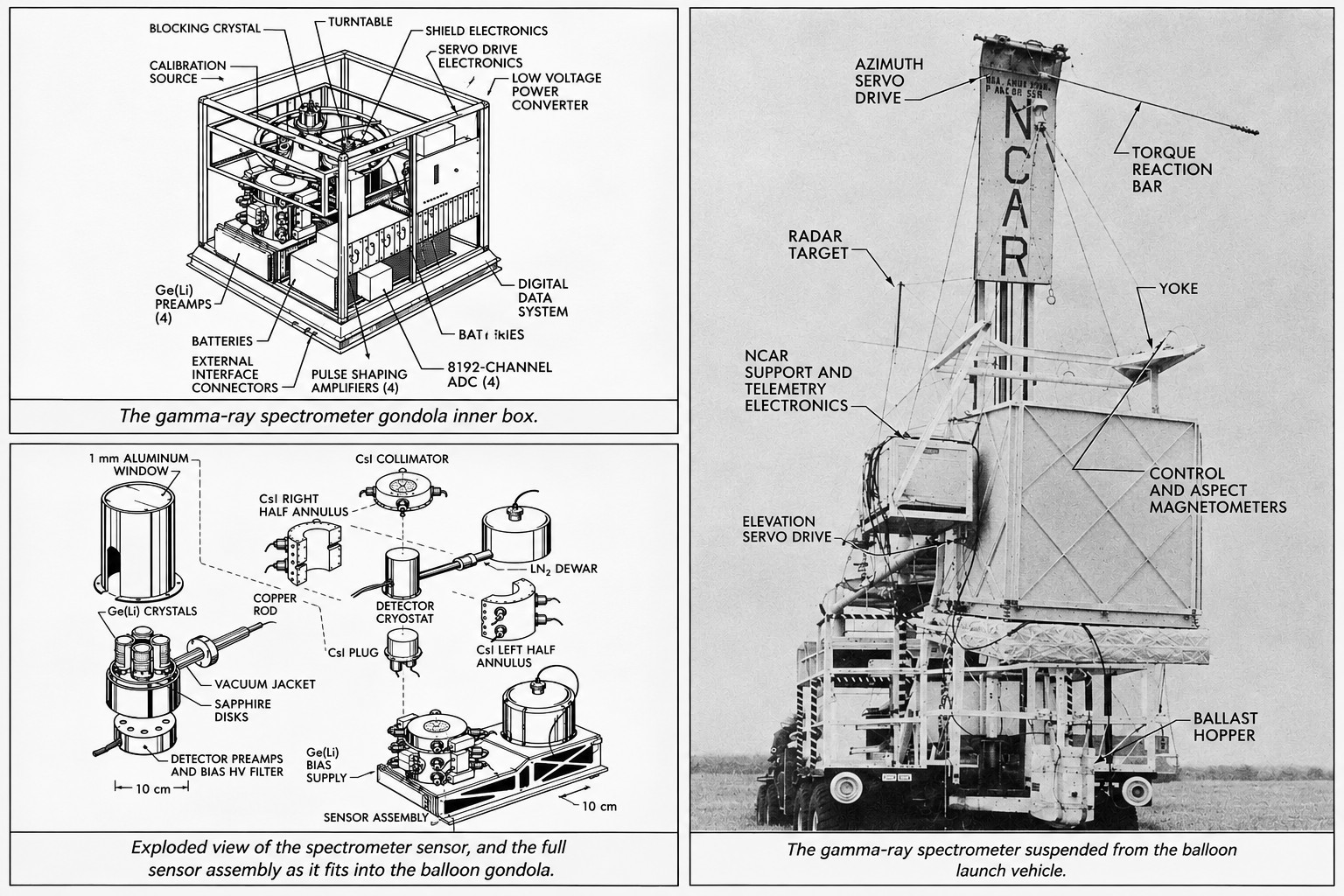
The objective of the flight was to detect and measure discrete gamma-ray line emissions from cosmic sources using a high-resolution GE(LI) SPECTROMETER developed at the Jet Propulsion Laboratory (JPL), California Institute of Technology. It consisted of four lithium-drifted germanium detectors housed in a common cryostat and surrounded by an active scintillation shield. Designed to operate over an energy range of 0.05 to 10 MeV, the system provided high energy resolution for investigating nuclear gamma-ray emissions associated with processes such as nucleosynthesis, cosmic-ray interactions with interstellar matter, and nuclear excitation in solar flares. The experiment served as a proof of concept for the High Spectral Resolution Gamma Ray Spectrometer (HSRGS), which incorporated four cryogenic germanium gamma-ray detectors and was launched aboard the HEAO-3 satellite in September 1979. The HSRGS operated in Earth orbit for 154 days.
The drawing at left shows a schematic of the flight gondola (click for more details).
The primary detectors consisted of four cylindrical Ge(Li) crystals arranged in a four-leaf-clover configuration. Each crystal had a closed-end coaxial geometry, with the closed surface facing forward. The detector dimensions were selected to maximize the active volume while limiting interactions between adjacent crystals. The individual crystals had geometrical areas of 13.2, 12.9, 13.2 and 14.5 cm², respectively, and lengths of 3.75, 3.66, 3.75 and 4.75 cm. The four detectors were mounted in aluminum trays connected to a copper cold plate through sapphire disks, providing thermal conduction while maintaining electrical isolation. The detector assembly was enclosed in a vacuum cryostat fitted with a 1 mm thick aluminum entrance window. Detector signals were coupled to individual preamplifiers, with associated bias-filtering and decoupling circuitry housed at the rear of the cryostat.
Cooling was provided by an 8-liter liquid-nitrogen dewar connected to the detector assembly by a 1.25 cm diameter copper rod. The dewar provided an estimated cooling lifetime of approximately 40 hours. Its pressure-relief valve regulated the internal pressure to about 500 millibars, allowing the operating temperature to be reduced while preventing the nitrogen from freezing. A molecular sieve was installed inside the cryostat to maintain vacuum cleanliness. The Ge(Li) detectors operated at a bias voltage of approximately 2.3 kV, supplied by carbon-zinc batteries housed in a pressurized aluminum enclosure.
Background rejection and Collimation were provided by a cylindrical shield made of sodium-activated cesium iodide, CsI(Na). The shield consisted of two halves forming an annulus around the detector cluster, a rear plug and a separate Collimator mounted above the annulus. The collimator was 7.62 cm thick, with four apertures aligned with the individual Ge(Li) crystals. The complete shield measured approximately 25.4 cm in diameter and 30.5 cm in length. Its scintillation elements were viewed by fourteen RCA 2067 photomultiplier tubes, four on each principal shield section and two on the rear plug. The shield provided anticoincidence rejection of events associated with energy deposition in the surrounding scintillator.
A separate thallium-activated sodium iodide, NaI(Tl), crystal was mounted above the detector assembly on a commandable turntable. Measuring 20.3 cm in diameter and 10.2 cm thick, it was viewed by three RCA 8054 photomultiplier tubes. The crystal could be rotated into the sensor aperture to block incoming radiation, allowing measurements of gamma rays penetrating the shield or originating in the instrument materials to be distinguished from radiation entering through the aperture.
Each Ge(Li) detector had an independent signal-processing channel comprising a pulse-shaping amplifier and an 8192-channel pulse-height analyzer. Four analog-to-digital converter channels were multiplexed into a common digital data system. Events were processed individually, with transmitted data including detector identification, pulse-height channel, event timing and flags identifying coincident interactions between detectors or between a detector and the active shield. This configuration allowed operation in total-absorption, sum-coincidence and pair-spectrometer modes. Housekeeping measurements included instrument voltages, temperatures, magnetometer outputs, servo data and thirty-two integral count rates.
The data system transmitted measurements to the ground through a PCM/FM/FM telemetry link operating at 8192 bits per second. No onboard data storage was provided. The instrument's average power consumption was approximately 125 W, supplied by fifteen 12 V, 20 Ah gelled-electrolyte lead-acid batteries. The electronics and detector assembly were installed within an aluminum gondola structure measuring 108 cm on each side, surrounded by multilayer thermal insulation. The gondola was suspended in a yoke incorporating azimuth and elevation orientation systems.
Details of the balloon flight
Balloon launched on: 6/15/1978
Launch site: National Scientific Balloon Facility (NSBF), Palestine, Texas, US
Balloon launched by: National Scientific Balloon Facility (NSBF)
Balloon manufacturer/size/composition: Zero Pressure Balloon Winzen 436.128 m3 (18.70 Microns - Stratofilm)
Flight identification number: 1076P
End of flight (L for landing time, W for last contact, otherwise termination time): 6/16/1978
Balloon flight duration (F: time at float only, otherwise total flight time in d:days / h:hours or m:minutes - ): F 11 h
Payload weight: 808 kgs.
The balloon was launched from the National Scientific Balloon Facility in Palestine, Texas, on June 15, 1978. Objective of the mission was to survey the gamma-ray sky in the 0.05-10 MeV energy range, focusing on the regions around the X-ray sources Her X-1 and Cyg X-1. Spectral measurements in this energy band were intended to provide information relevant to the study of supernova structure, nucleosynthesis, neutron star properties, and the distribution and composition of interstellar gas and dust. The flight also included an investigation of the effect of a thermal neutron shield on instrument activation.
The instrument remained at float altitude for approximately 10 hours, allowing a drift scan that covered Her X-1, Cyg X-1, and part of the galactic plane in the Cygnus region.
External references
- National Scientific Balloon Facility Annual Report FY 1978 National Center for Atmospheric Research, January 1979
StratoCat is an independent, non-commercial project maintained to preserve and share the history of scientific and stratospheric ballooning. If you find the site useful, you can help keep it running with a small donation toward its operating costs. Every contribution, even the equivalent of a cup of coffee, is greatly appreciated.